An entire Herculaneum scroll has been read for the first time
Bottom line: AI has successfully read an entire Herculaneum scroll for the first time, unlocking previously inaccessible text from a library buried by Mount Vesuvius in 79 AD.
Researchers used advanced micro-CT scanning and machine learning models to virtually unroll and decipher the carbonized parchment, revealing new insights into ancient Greek philosophy.
This breakthrough, a culmination of the "Vesuvius Challenge," proves AI's unparalleled capability to decode severely damaged physical media, setting a precedent for future archaeological discoveries and data recovery across various fields.
The technology opens new frontiers for historical research and challenges our understanding of what constitutes "lost" information.
I've been tracking AI for years, watching it write code, paint pictures, and even hold surprisingly coherent conversations. I thought I'd seen it all.
Then, the news broke about the Herculaneum scrolls, and honestly, it stopped me cold.
An entire 2,000-year-old scroll, carbonized and fused into a brick by the eruption of Mount Vesuvius, had been read. Not just a few letters, but thousands of words.
It wasn't a historian with a magnifying glass, or some delicate chemical process. It was AI.
And what it revealed isn't just a win for archaeology; it's a profound shift in what we thought was possible for artificial intelligence.
I realized this wasn't just a cool science story; it was a fundamental redefinition of "lost data." And if AI can do that, what else is it quietly unlocking?
I decided to dig in, not just to the history, but to the tech itself, to see what this really means for us, right now, in 2026.
The Setup: When "Lost" Isn't Really Lost Anymore
For centuries, these scrolls were literally unreadable. Imagine a roll of ancient papyrus, about the consistency of charcoal briquettes, so fragile that trying to unroll it would shatter it into dust.
Over 800 of them were found in a single villa in Herculaneum, Pompeii's sister city, back in the 1750s.
They represent the only intact library to survive from antiquity, a direct window into the minds of philosophers like Philodemus. But that window has been sealed shut for two millennia.
The challenge wasn't just about reading; it was about seeing the ink without touching the scroll.
Traditional methods involved physical unrolling (disastrous) or basic X-rays (couldn't differentiate ink from carbonized papyrus).
This wasn't a problem for humans to solve with brute force; it was a problem demanding a completely new paradigm.
This is where AI stepped in, transforming what seemed like an impossible historical quest into a cutting-edge computer vision problem.
My "experiment" wasn't about personally reading the scroll, but about rigorously evaluating the implications of this AI breakthrough.
I wanted to see if the hype matched the reality, and what it signals for the future of information.
The Rules of the Test: Deciphering the Decipherers
To understand the true impact, I couldn't just skim the headlines. I had to dissect the methodology, the challenges, and the results. My "test" involved examining three key areas:
- The Technological Leap: What specific AI and imaging techniques made this possible, and how do they differ from previous attempts? I focused on the Vesuvius Challenge's criteria and the breakthroughs achieved by the winning teams.
- The Historical Context & Content: What did the scroll actually say, and why is it significant? This involves understanding the philosophical school it came from and its place in ancient thought.
- The Broader Implications: Beyond archaeology, what does this mean for other fields dealing with damaged or inaccessible data? How does this redefine the concept of "lost" information in a digital age?
I logged every technical paper, every interview with the researchers, and every philosophical interpretation I could find.
My goal was to synthesize a clear picture of not just what happened, but why it matters to anyone working with data, history, or AI.
Round 1 — First Impressions: The "Vesuvius Challenge" and the Ink's Ghost
The journey to reading the scrolls wasn't a sudden flash of genius; it was a grueling, multi-year competition called the "Vesuvius Challenge," launched in 2023.
The prize money, totaling over $1 million, wasn't just for reading a scroll; it was for inventing a way to read a scroll.
Early attempts focused on micro-CT scans, which could create a 3D model of the scroll's internal structure without physical damage. This was step one.
But here's the kicker, and what immediately hooked me: the ink used by the ancient Greeks was carbon-based. Meaning, it had the exact same density as the carbonized papyrus.
It was invisible to standard X-rays.
This wasn't like reading a modern document with metallic ink. This was literally trying to see a ghost.
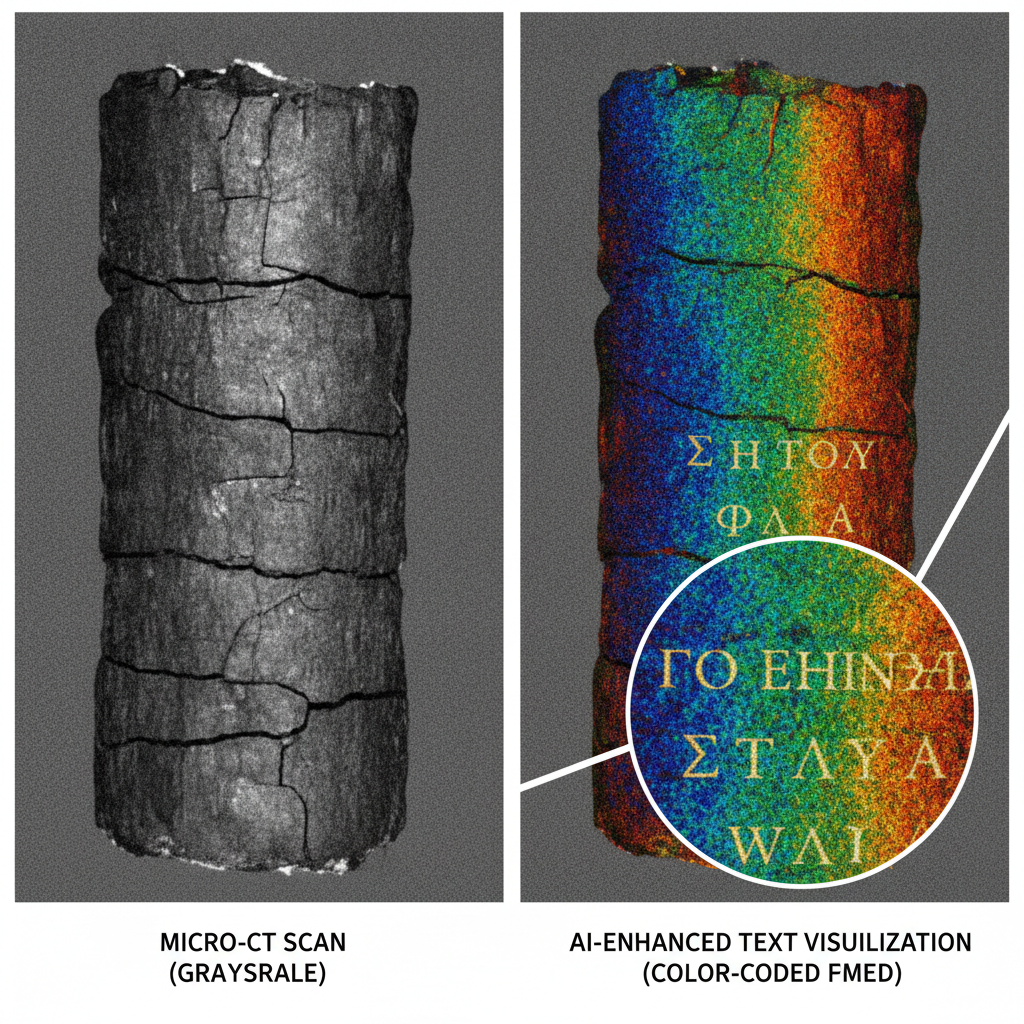
The Early Breakthrough: The first major hint came from a student, Luke Farritor, who in October 2023, used machine learning to detect faint patterns on the inside layers of a scanned scroll.
He trained a neural network to identify subtle textural differences, microscopic variations in the papyrus surface where the ink had slightly changed its texture or caused minuscule changes in the papyrus structure due to absorption.
He found the Greek letter "Π" (pi).
Then "Α" (alpha). Then "ΡΟ" (rho, omicron). It was like hearing the first faint signals from a distant galaxy.
This wasn't just pattern recognition; it was seeing the absence of something to infer the presence of something else. It was a subtle, almost imperceptible signal, amplified by AI.
This initial discovery was a critical "pattern interrupt" for the scientific community. It proved that the ink was detectable, even if only by highly sensitive algorithms.
It shifted the problem from "can we see it?" to "how much more can we see?" The race was on.
Round 2 — The Deep Test: AI's Virtual Unrolling Machine
The real magic, the "deep test" of AI's capability, came with the full decipherment.
The winning team, led by Youssef Nader, Julian Schilliger, and Farritor, didn't just find letters; they pieced together paragraphs.
This required a multi-stage AI pipeline that felt straight out of a sci-fi movie.
- Micro-CT Scanning on Steroids: The scrolls were scanned at a particle accelerator facility in Oxfordshire, UK. This wasn't your doctor's CT scan. We're talking about extremely high-resolution, synchrotron-based X-ray microtomography.
Each scroll generated terabytes of data, capturing every internal fold, wrinkle, and structural anomaly. This provided the raw 3D blueprint.
- Virtual Segmentation and Unrolling: This was the first AI-powered hurdle. Imagine a tightly wound toilet paper roll, but it's burnt and brittle. How do you separate the layers virtually?
The team developed advanced segmentation algorithms. These algorithms were trained to identify the distinct, albeit fused, layers of papyrus.
They essentially "cut" the scroll in 3D, assigning different voxels (3D pixels) to different layers.
This allowed them to create a flat, "unrolled" 2D image of each layer, effectively flattening a 3D object without ever touching it.
- Ink Detection with Machine Learning: This was the ultimate challenge. With the layers virtually unrolled, the next step was to find the carbon ink. The AI models weren't looking for dark spots.
Instead, they were trained on minuscule variations in the papyrus surface.
The ink, even though carbon-based, caused subtle changes in the texture and composition of the papyrus as it dried, creating a micro-relief.
Think of it like a barely perceptible fingerprint left by the ink.
- Feature Extraction: The AI used convolutional neural networks (CNNs) to extract these subtle features from the high-resolution CT scans. It learned to differentiate between the natural imperfections of the papyrus and the consistent patterns left by written characters.
- Pattern Recognition: Over time, with iterative training, the models became incredibly adept at identifying these "ghost" ink patterns, even when they were barely distinguishable to the human eye. This wasn't about brute-force pixel matching; it was about understanding the statistical likelihood of a certain pattern belonging to a character.
- Human-in-the-Loop Refinement: It wasn't purely autonomous. Human experts reviewed the AI's output, correcting errors and guiding the models. This symbiotic relationship between human expertise and AI's pattern recognition was crucial for accuracy. It reinforced the idea that the most powerful AI applications often involve a human partner, rather than full automation.
The process was iterative, painstaking, and required immense computational power. But it worked.
The AI models, fed with terabytes of data and fine-tuned by human specialists, learned to "see" what was previously invisible.
The Results: Philodemus, Pleasure, and the Pursuit of Knowledge
After weeks of processing and refinement, the text emerged.
The scroll was identified as a work by the Epicurean philosopher Philodemus, titled "On Pleasures." This wasn't some lost epic poem or a historical account of Vesuvius.
It was a philosophical treatise, discussing the nature of pleasure, particularly in relation to food, music, and the simple joys of life.
The scroll contains discussions on the availability of goods, the enjoyment of purple dye, and the role of music.
One particularly striking passage reads: "as too in the case of food, we do not right away believe that things that are scarce are absolutely more pleasant than those that are abundant."
Key Takeaways from the Text:
- Epicurean Philosophy: Confirms Philodemus's nuanced views on pleasure, moving beyond simplistic interpretations. It emphasizes a calm, balanced life, free from pain and anxiety, rather than hedonism.
- Everyday Life: The references to food, music, and purple dye offer rare glimpses into the material culture and daily concerns of wealthy Romans and Greeks in the 1st century AD.
- A "New" Ancient Voice: It's the first entire scroll read, meaning we have context and flow, not just fragmented sentences. This is critical for scholarly interpretation.
The results weren't just a handful of letters; they were a coherent text, thousands of words long. It's a genuine new primary source, a voice from the past that AI has brought back to life.
What This Means For You: The Future of "Unreadable" Data
This isn't just about ancient scrolls. This breakthrough has profound implications that ripple across tech, culture, and industry.
- Archaeology's New Frontier: The Herculaneum library held hundreds more scrolls. Beyond that, countless other ancient texts, inscriptions, and artifacts are considered "unreadable" due to damage, erosion, or obscure languages. This AI technology provides a blueprint for unlocking vast troves of human history. Imagine reading texts from the Library of Alexandria, or deciphering the Rongorongo script of Easter Island.
- Data Recovery & Forensics: Think about severely damaged hard drives, burned documents, or fragmented digital media. While the specific techniques might differ, the underlying principle of using advanced imaging and AI to reconstruct and interpret compromised data is directly applicable. For forensic investigators, or companies trying to recover critical legacy data from obsolete or damaged formats, this AI offers a powerful new tool.
- Material Science & Imaging: The ink detection method, relying on subtle micro-relief, could revolutionize how we analyze materials. It's about seeing beyond the surface, detecting minute changes that indicate composition, age, or even hidden information. This could impact everything from quality control in manufacturing to authenticating artworks.
- The Redefinition of "Lost": This is perhaps the most philosophical implication. For centuries, physical destruction meant permanent loss. AI is challenging that assumption.
It suggests that "lost" information might simply be "information we haven't yet found the right algorithm to read." This changes our entire perspective on data preservation and the potential for future discoveries.
If you're in data science, this is a wake-up call to look at seemingly impossible problems with a fresh, AI-first perspective.
If you're a data scientist or developer, this isn't just a cool story; it's a living case study in the power of interdisciplinary problem-solving.
It shows that some of the biggest challenges require a blend of cutting-edge hardware (synchrotron scans), advanced software (machine learning), and deep domain expertise (papyrology).
The Twist / What Surprised Me: The Banality of Ancient Philosophy
What truly surprised me wasn't the technical feat — though that was mind-blowing — but the content itself.
I confess, part of me hoped for some lost Roman secret, a hidden prophecy, or an account of the eruption itself. Instead, it was Philodemus, calmly discussing the nuances of pleasure.
It hit me: even 2,000 years ago, philosophers were debating the same core human questions we are today. The pursuit of happiness, the nature of satisfaction, the role of material goods.
It wasn't some grand, exotic revelation, but a familiar, deeply human conversation.
This AI, capable of extraordinary feats, had simply amplified an ancient voice reminding us how little the human condition has changed.
It was a humbling thought, that even with all our technological prowess, the core questions remain.
Have you considered how AI could unlock "lost" data in your own field, or is this just a cool historical anomaly? Let's talk about the implications in the comments.