AI Companies Are Quietly Hiring Electricians by the Thousands. Here's Why
In this article
Bottom line: Hyperscalers and AI infrastructure builders — Microsoft, Amazon, Google, Meta, OpenAI's data center partners — are absorbing electricians and carpenters faster than trade schools can graduate them, driven by a data center construction boom tied directly to AI compute demand.
For small electrical contractors, this means journeyman wages up 15-25% in hot markets since 2025, apprentices poached mid-program, and bid timelines stretching from weeks to months.
If you run a trade business anywhere near a hyperscale build site, your labor problem isn't hiring anymore — it's retention, and you need a plan for it this quarter.
I got a call in June from a guy named Pete who runs a six-person electrical contracting shop outside Columbus.
Two of his best journeymen gave notice in the same week — both headed to a data center build 40 minutes north, both taking a $12-an-hour raise and a signing bonus he couldn't match.
Pete wasn't losing them to a competitor. He was losing them to a hyperscaler's general contractor.
That's not a one-off story. That's the labor market right now for anyone who bends conduit or pulls cable for a living.
The Real Problem: Small Shops Can't Compete for Their Own Workforce
Electrical contracting has run a persistent labor shortage for years — the National Electrical Contractors Association has flagged it since well before AI was the reason.
But the AI-driven data center buildout has turned a slow squeeze into a full-on talent war, and small operators are the ones losing.
Here's the math a small shop owner is up against.
A single hyperscale data center campus can require 1,500 to 3,000 electricians and other skilled trades workers at peak construction — for months at a time, on one site.
Multiply that across the dozens of gigawatt-scale campuses under construction right now in Texas, Ohio, Virginia, Arizona, and Georgia, and you get a labor draw that dwarfs anything a regional contractor can offer.
A four-person residential and light-commercial shop in a growing metro isn't just competing with the guy down the road anymore.
It's competing with a general contractor who's building for a company that just raised $40 billion and needs the site live in 14 months, not 14 years.
That GC can pay $58 an hour plus per diem plus a bonus for finishing early. Pete can't match that and still keep his residential rates competitive for homeowners who balk at a $200 service call.
The result: apprentices leave mid-program, chasing the hourly rate instead of the credential.
Journeymen take the data center contract for a year, burn out on 60-hour weeks, and don't come back to residential work — they follow the next build.
Small shops are left bidding jobs they can't staff, or turning down work they'd normally take.
What Changed: The AI Buildout Made Trades Work the Bottleneck

The thing nobody predicted about the AI boom is that its hardest constraint turned out to be copper and concrete, not chips. You can buy more GPUs.
You can't conjure a licensed electrician out of nowhere in six months — training one takes four to five years through a proper apprenticeship.
So the hyperscalers and their construction partners — companies like Turner Construction, DPR, and Holder, who build most of the marquee AI campuses — have started running recruitment operations that look more like enlistment drives than hiring.
Turner and its peers now run direct-to-apprentice pipeline programs, partnering with community colleges and even offering to pay off existing apprenticeship debt to pull workers off other jobsites.
Some data center GCs are advertising completion bonuses worth $8,000-$15,000 for electricians who stay through a project's full build cycle — a structure explicitly designed to stop the churn they're causing everywhere else.
None of this is AI doing the hiring in any generative sense — no chatbot is interviewing electricians.
This is old-fashioned capital-intensive construction, at a scale and urgency that's new because the compute demand behind it is new.
Where AI tooling does show up is on the estimating and workforce planning side: platforms like Procore and Autodesk Construction Cloud now bake in AI-assisted labor forecasting so GCs can project trade demand six months out and start recruiting before they break ground, which is part of why the poaching starts earlier in a project's life than it used to.
For a small contractor, none of this is useful directly. There's no tool you can buy this month that replaces a electrician who left for a data center job.
What's actually useful is upstream: labor-matching platforms like Skillit and Trade Hounds, which small shops are increasingly using to shorten the time-to-hire when they do lose someone, and AI-assisted scheduling tools (BuilderTrend, Housecall Pro's dispatch AI) that let a four-person crew squeeze more billable jobs out of fewer hands.
That's a real, narrow win — it doesn't solve the shortage, but it buys you slack while it lasts.
The Decision Framework: The Stay-or-Compete Test
If you run a trade business anywhere near hyperscale construction, ask these four questions before you decide how to respond:
1. Is a hyperscale build within 60 miles of your labor pool? If yes, assume every employee with two or more years of experience is getting a call. Don't wait to find out.
2. Can you compete on total comp, or only on stability? You likely can't match data center hourly rates.
You can compete on year-round hours, no layoff risk between projects, and not living out of a extended-stay hotel.
Sell that explicitly — in writing, at review time, not as an assumption your people already know it.
3.
Should you subcontract INTO the data center boom instead of fighting it? Some small shops are doing better by picking up tier-two and tier-three subcontract work on these campuses — panel work, low-voltage, punch-list electrical — rather than trying to retain staff against it.
It's less glamorous than being the prime, but it turns the labor draw into revenue instead of a threat.
4. Is this a 2026-2027 spike or a structural shift? Data center capex from the major hyperscalers is contracted years out — this isn't a six-month blip.
Plan your apprenticeship pipeline and wage structure for a multi-year labor market, not a temporary squeeze you just need to ride out.
If you answer "compete on stability" and "subcontract in" to questions two and three, you have a workable plan.
If your honest answer to all four is "I don't know," that's the actual problem to fix first — not the labor market.
Honest Tradeoffs
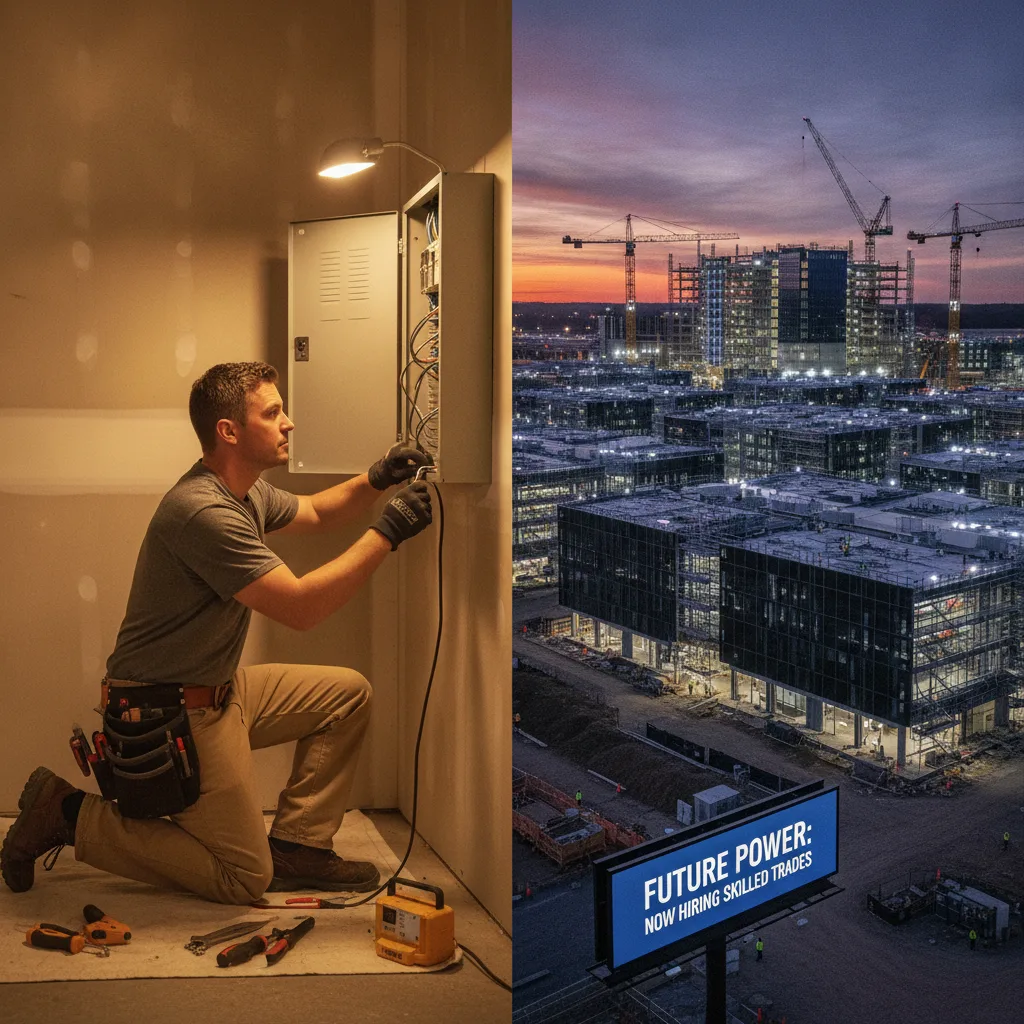
Subcontracting into a data center project sounds like the obvious move, and for some shops it is. But it comes with real costs the sales pitch skips.
Payment terms on hyperscale GC contracts often run net-60 or net-90, which can strangle a small shop's cash flow if you're used to net-15 residential invoicing.
Insurance and bonding requirements to work on a tier-one data center site are steeper than most four-person shops carry, and getting bonded up can eat a chunk of a slow season's margin.
There's also a cultural cost that doesn't show up in a bid.
Workers who spend a year on a data center megaproject — repetitive, high-volume, single-scope work — sometimes struggle to go back to the varied, judgment-heavy work of residential and light commercial.
A few contractors I talked to described re-onboarding a returning employee as nearly a re-training exercise. The skill didn't disappear, but the habits did.
And retention bonuses cut both ways. If you match a data center's signing bonus to keep someone, you've just reset your own wage floor for every other employee who'll expect the same next year.
That's not a one-time cost — it's a new baseline.
The Bottom Line
If a hyperscale build is going up near you, this is not a wait-and-see labor market — it's already reshaping who works for you and what you'll pay them.
Don't try to out-bid a $40 billion capital project on hourly rate; you'll lose and drain your margin doing it.
Compete on stability, explore tier-two subcontract work if the math pencils out, and rebuild your wage structure assuming this lasts through 2028, not through the next quarter.
Your one action this week: call your three best employees individually — not a group meeting — and ask them directly if they've been approached by a data center recruiter.
If the answer is yes for even one of them, you're already behind on retention, and the fix starts today, not after they hand in notice.
Has a hyperscale build near you started pulling workers off your jobs — or is your shop finding a way to benefit from it instead? I'd genuinely like to know what you're seeing.
Let's talk in the comments.
— Andrew
Founder of Signal Reads. Builder, reader, occasional contrarian.