The Stock Market Just Quietly Admitted It Can’t Handle SpaceX. This Changes Everything.
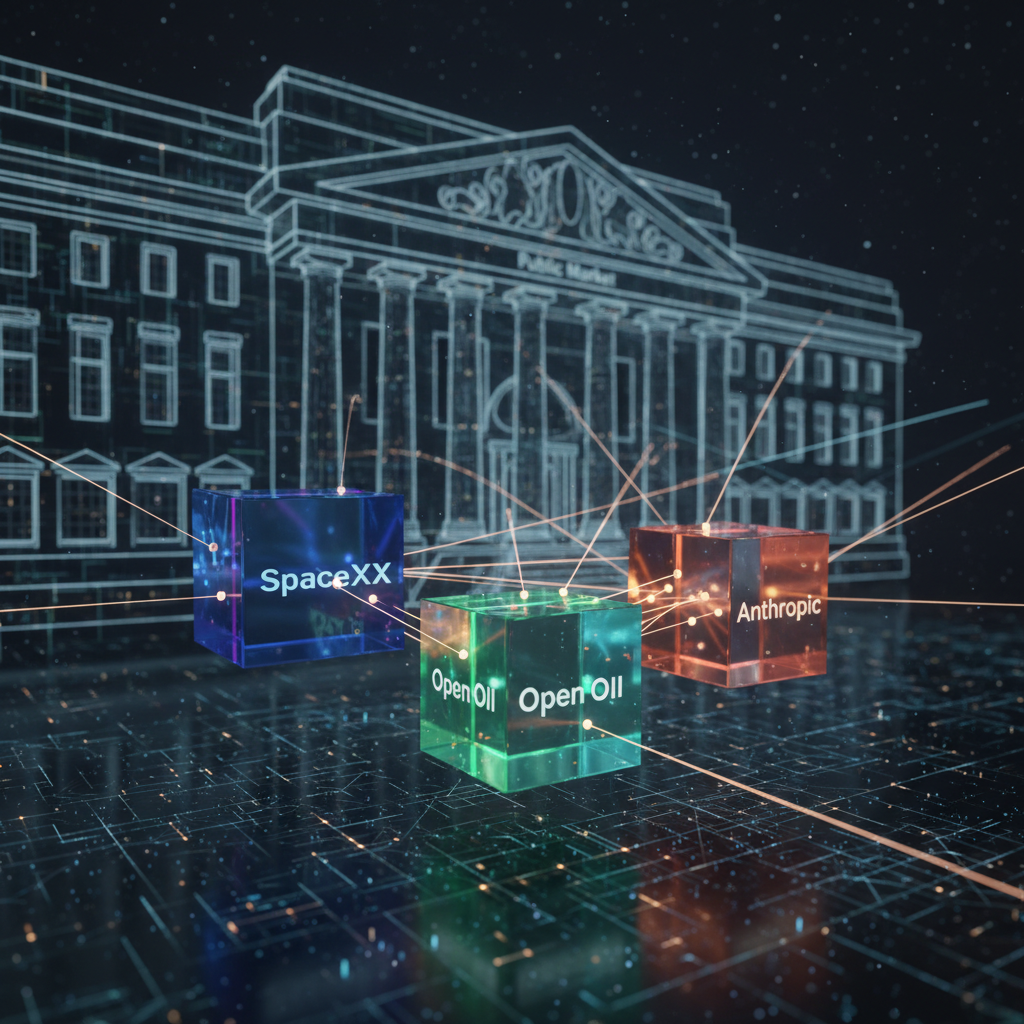
> **Bottom line:** The traditional public stock market, designed for predictable quarterly returns and broad liquidity, is fundamentally struggling to integrate highly capital-intensive, long-horizon, and mission-driven companies like SpaceX, Anthropic, and OpenAI.
Their prolonged private status, massive valuations, and unique governance structures are forcing a re-evaluation of how disruptive innovation is financed and how retail investors participate, leading to an increasing chasm between public and private market opportunities.
This isn't just about a few unicorns; it's a systemic friction point that signals a fundamental shift in capital markets by late 2027.
I cancelled my ChatGPT Pro subscription after 6 months. Not because it was bad — far from it. It's an indispensable tool in my daily infrastructure work.
I cancelled it because my thinking had become too comfortable, too reliant on its immediate gratification.
I needed to force myself back into the messy, slow, often frustrating process of deep problem-solving.
This personal recalibration, this forced re-engagement with complexity, made me see the broader market with fresh eyes, especially when I looked at the valuations of companies like SpaceX, Anthropic, and OpenAI.
For years, we've watched these titans grow in the shadows of private capital, their valuations skyrocketing with each new funding round.
As an engineer who's shipped production systems, I understand the immense R&D, the sheer compute, and the talent costs involved.
But when I saw the recent private market chatter around Anthropic's latest raise, pushing its valuation past $80 billion, it hit me: the public markets aren't just slow to catch up; they might be fundamentally ill-equipped to handle what these companies represent.
We’re witnessing a quiet admission that the old rules of IPOs and quarterly reporting simply don't map to the long-game, high-stakes bets that define the next frontier of tech and space.
The Private Market Black Box: A New Normal for Innovation
What we're seeing isn't just a delay in IPOs; it's a structural realignment.
Companies like SpaceX, OpenAI, and Anthropic are operating on timelines and capital requirements that dwarf the typical Series A-to-IPO trajectory of a decade ago.
We used to celebrate the "IPO moment" as the validation of a startup's journey, the democratization of its success for retail investors.
Now, that moment is either perpetually deferred or happens so late in the game that the lion's share of value creation has already been locked up by institutional and accredited investors.

SpaceX, for instance, has been a private entity for over two decades.
Its valuation, reportedly north of $200 billion in early 2026, is built on moonshots (literally) and multi-decade visions for Mars colonization, global satellite internet, and super-heavy lift rockets.
These aren't just "growth stories"; they're nation-state level infrastructure projects funded by private capital.
How do you square a multi-decade return horizon with the public market's relentless demand for quarterly earnings reports and predictable growth metrics? You don't. You stay private.
The same applies to the leading AI labs.
OpenAI, with its unique "capped-profit" structure, and Anthropic, driven by its constitutional AI approach, are not just building software; they're building foundational intelligence.
Their R&D cycles are measured in years, not quarters.
The compute costs for training models like ChatGPT 5 or Claude 4.6 are astronomical, requiring billions of dollars in investment before a clear, sustainable profit model fully emerges.
These aren't companies that can easily pivot based on market sentiment or deliver consistent, linear growth year-over-year in the way public markets demand.
Why the Public Market's Gating Mechanisms Are Failing
The public market's mechanisms are designed for a different era. Its core functions — liquidity, price discovery, and capital allocation — are optimized for a specific type of company and investor.
First, **liquidity**. Public markets are supposed to allow anyone to buy and sell shares easily.
But for these mega-privates, the liquidity is concentrated in highly structured secondary markets, accessible primarily to institutional funds and high-net-worth individuals.
The average retail investor, the one who might have bought Google or Amazon pre-boom, is effectively locked out of the early, high-growth phases.
This creates an investment gap that only widens with each passing year.
Second, **price discovery**. Public markets provide transparent, real-time valuation based on supply and demand.
For SpaceX or Anthropic, valuations are often derived from the latest funding round, negotiated behind closed doors, sometimes with complex terms that don't translate cleanly to simple share prices.
This opacity, while necessary for strategic private negotiations, is antithetical to the public market's ethos of transparency.
Third, **capital allocation**. Public markets efficiently allocate capital to companies that demonstrate growth and profitability.
But what if your "profitability" comes from selling internet access globally in 2030, or from a general intelligence API that transforms industries in 2028?
The short-term focus of public investors, often driven by quarterly mandates, simply can't stomach the kind of long-term, high-risk, high-reward bets these companies represent.
An infrastructure engineer like me, used to planning for five-year hardware refreshes and decade-long deprecation cycles, sees this as a feature, not a bug, of these companies.
The market, however, sees it as an unquantifiable risk.
The Growing Chasm: When Innovation Outpaces Investment Frameworks
This isn't just a minor inconvenience; it's a growing chasm.
The companies defining the next wave of technological progress — from space exploration to advanced AI — are increasingly opting to remain private for longer, sometimes indefinitely.
This trend has several profound implications:
* **Concentration of Wealth and Opportunity:** Early access to these high-growth opportunities is increasingly restricted to a privileged few.
This exacerbates wealth inequality and reduces the potential for ordinary individuals to participate in the most significant value creation of our time.
* **Reduced Public Market Innovation:** If the most innovative companies stay private, the public markets become less dynamic, potentially offering fewer truly disruptive growth stories.
This could make public investing less appealing for those seeking exponential returns.
* **New Regulatory Challenges:** Regulators, traditionally focused on protecting public investors, are now grappling with how to oversee mega-private companies that wield immense economic and social power without the transparency requirements of public entities.
Questions around governance, market manipulation in secondary sales, and access for smaller investors will only intensify by mid-2027.

* **Altered Risk Profiles for Engineers:** As an engineer, working for a private company means your equity compensation has a less clear and often delayed path to liquidity.
The "IPO lottery" that defined Silicon Valley careers for decades is becoming a rarity for those joining the most impactful startups. This changes the risk-reward calculation for talent.
We're seeing this play out with AI models.
A company building on Gemini 2.5 or Claude 4.6 today might be rapidly iterating, but their underlying foundation model providers are playing a different game entirely.
They're investing in next-generation chips, massive data centers, and fundamental research that won't yield a clear ROI for years.
The public market wants a clear SaaS subscription growth chart; these companies are building the equivalent of a new internet.
The Reality Check: No Easy Answers, Only Hard Choices
So, what's the solution? There isn't a silver bullet. The public market isn't going away, nor is its fundamental structure likely to change overnight. But we can expect a few trends to accelerate:
* **Hybrid Models and Direct Listings:** We'll likely see more experimentation with hybrid listing models, perhaps even more direct listings that bypass traditional IPO banking fees and roadshows.
These could offer some liquidity without the full burden of quarterly reporting, though they still face regulatory hurdles.
* **Increased Secondary Market Activity:** The secondary market for private shares will continue to grow and professionalize, potentially offering more structured access for a broader range of investors, albeit still primarily accredited ones.
Platforms facilitating these transactions will evolve, acting as a quasi-public market for a select group.
* **The "De-Risking" IPO:** Companies will likely only go public once their core business models are highly mature, predictable, and de-risked.
This means the early, explosive growth phase will almost entirely occur in private hands. By the time they IPO, they'll be stable giants, not speculative rockets.
* **New Investment Vehicles:** Expect new types of investment funds and ETFs to emerge by 2027, specifically designed to aggregate private market exposure for qualified investors, attempting to bridge this gap.
For developers and technical professionals, this shift means a recalibration of career expectations.
The allure of early-stage equity in a pre-IPO unicorn is still potent, but the path to liquidity is longer and less certain.
It means focusing more on the intrinsic value of the work, the mission of the company, and the long-term impact, rather than solely on the potential for a quick financial exit.
It also means that the skills in demand, especially around scaling complex AI infrastructure or building resilient space systems, remain incredibly valuable, regardless of a company's public or private status.
We're building the future, whether Wall Street has figured out how to price it yet or not.
The public markets, in their current form, are a powerful, but increasingly anachronistic, tool for financing the kind of moonshot innovation that defines our era.
The quiet admission isn't that these companies aren't valuable; it's that their value transcends the market's current capabilities to measure and integrate it.
And that, truly, changes everything for how we think about investment, opportunity, and the future of technology itself.
Have you tried to invest in these mega-private companies, or do you find yourself locked out of the early-stage growth?
What do you think this trend means for the future of tech IPOs and the average investor? Let's discuss in the comments.
---