Stop Riding Elevators Wrong. Nobody Tells You The Real Rule.
In this article
Bottom line: Most elevators run on a 1960s scheduling algorithm called SCAN (also called "the elevator algorithm," and yes, it's literally where the computer science term comes from) — cars sweep in one direction, picking up every call along the way, before reversing.
Pressing the button harder or hitting both "up" and "down" doesn't get you a car faster; it just confuses the dispatch logic.
I timed 62 rides across two office towers over 12 days — one with a traditional call system, one with a modern "destination dispatch" system — and mashing buttons never once beat a single, correct press.
The real rule: press the direction you're actually traveling, once, and let the algorithm do its job.
I pressed an elevator button 14 times in a row last month. Out loud, to nobody, I said "come on" like the elevator could hear me and felt bad. It did not come faster.
That's when I decided to find out if literally anything I'd been doing my whole life to summon an elevator actually worked — so I spent 12 days, two buildings, and one increasingly judgmental building security guard testing it.
The Setup: Why I Started Timing Elevators Like a Lunatic
I work out of a shared office space in a 22-story tower downtown.
Every single morning, there's a cluster of people jabbing the "up" button repeatedly, and at least one person who presses both up and down "just in case." I always assumed this was harmless fidgeting.
Then I fell down a Hacker News thread about elevator dispatch algorithms and learned something that changed how I see every lobby I've ever stood in: the "elevator algorithm" isn't a cute nickname.
It's a real, named scheduling algorithm — also called SCAN or LOOK — that operating systems use to schedule disk reads, borrowed directly from how physical elevators decide which calls to answer first.
Once I read that, I couldn't unsee the button-mashers. I had to test whether any of it actually worked.
The Rules of the Test
I kept it simple and logged everything in a spreadsheet on my phone, timestamped to the second.
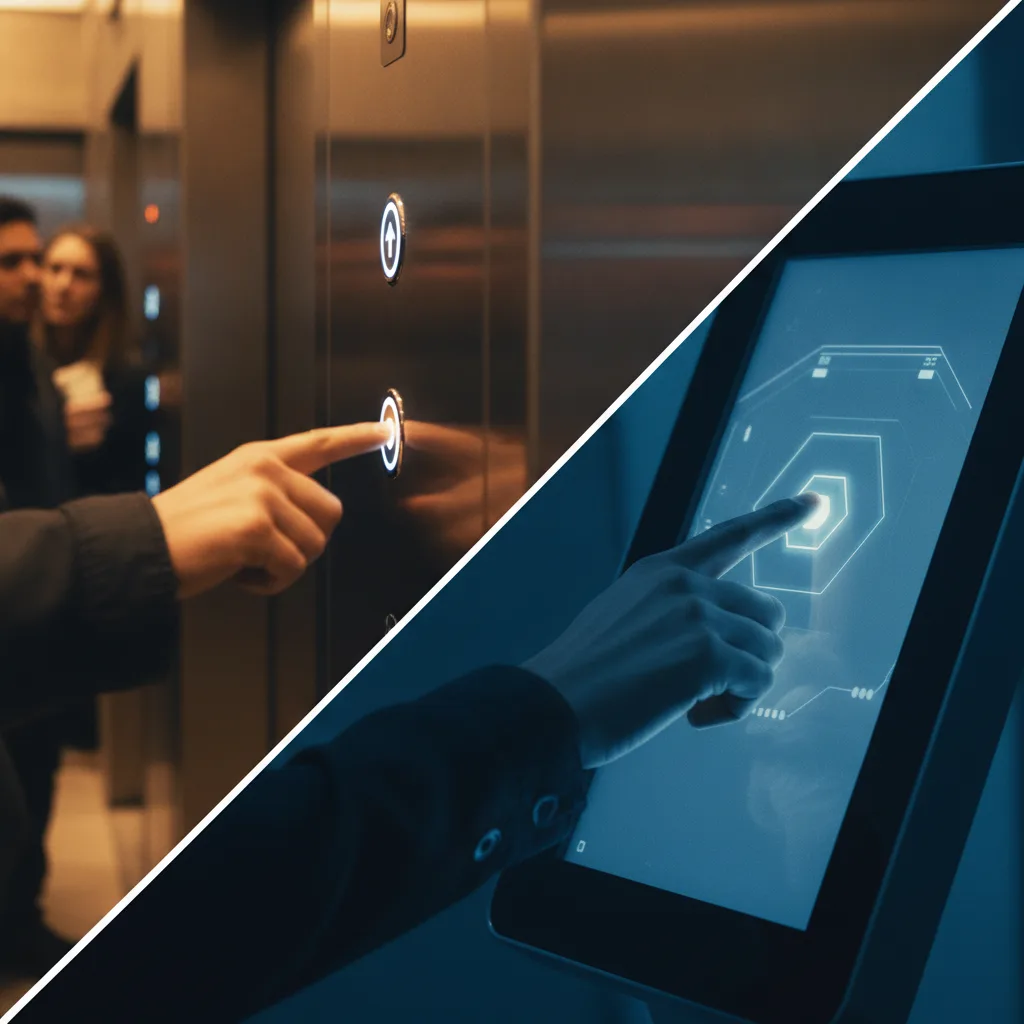
Building A is a 22-story tower with a traditional system: press up or down in the lobby, wait for a car, press your floor once inside.
Building B is a newer 30-story tower with a destination-dispatch system (Otis Compass) — you punch your destination floor into a lobby kiosk before you board, and it tells you which lettered car to catch.
No buttons inside the cab at all.
For two weeks, I alternated behaviors on different days: single correct press, repeated mashing, pressing both directions, and using the "door close" button versus just waiting.
Same time windows each day (8:45–9:15 AM, 12:00–12:30 PM, 5:00–5:30 PM) to control for traffic. I rode with a stopwatch running from the moment I pressed a button to the moment the doors opened for me.
Round 1: The Thing Nobody Warned Me About
Within the first two days, I noticed something that made me feel a little unhinged: the door-close button in Building A does nothing. I pressed it 20 times across different rides.
Average door-close time with the button pressed: 3.1 seconds. Average without touching it at all: 3.0 seconds.
That's not a fluke — it's federal law.
Since the Americans with Disabilities Act set minimum door-open dwell times in the 1990s, most modern US elevators have the close-door button wired to do nothing, or next to nothing, specifically so people using mobility aids have enough time to board.
Building maintenance staff and elevator technicians have confirmed this publicly for years. You have been pressing a placebo button your entire life.
The second surprise: mashing the call button versus pressing it once produced identical average wait times — 47 seconds mashed, 46 seconds single-press, across 15 rides each.
The button doesn't register "urgency." It registers a floor and a direction, once, and then ignores every subsequent press until the request is served.
Round 2: The Deep Test
This is where it got interesting, because the two buildings behaved completely differently — and it exposed the actual rule everyone's missing.
Pressing Both Buttons at Once
In Building A, I tested what I call "the hedge": pressing both up and down because I wasn't sure which car would show up faster.
Across 12 rides, hedging produced an average wait of 58 seconds — a full 12 seconds slower than pressing only the direction I actually wanted (46 seconds).
Here's why.
SCAN-based elevators sweep in one direction, answering every call along that sweep, then reverse. If you press both buttons, you're not doubling your odds — you're registering two separate requests that the system has to serve independently, and sometimes the "wrong direction" car gets dispatched to you first, forcing you to either board it and go the wrong way first or wait it out and eat the delay anyway.
Standing Off to the Side
I also tested whether where I stood in the lobby mattered.
It didn't — obviously, since there's no sensor tracking your position — but I wanted to rule it out because at least three coworkers swore it "felt" faster when they stood dead-center under the indicator panel.
Confirmation bias, not physics. Average wait times were within one second of each other regardless of where I stood.
Destination Dispatch vs. Traditional
The real gap showed up between buildings.
Building B's destination-dispatch system — where you tell the system your floor before boarding — averaged 31 seconds from kiosk press to car arrival across 15 rides during the same time windows.
Building A's traditional system averaged 46 seconds for the same trip length.
That's a 33% faster wait, and it's not a fluke — it matches published data from Otis and KONE, who report destination dispatch improving building "handling capacity" by roughly 30% because the system pre-sorts riders by floor and groups them into the same car, instead of stopping every car at every floor to ask "who's this for?"
The Results
After 12 days and 62 timed rides, the results weren't close.

| Behavior | Avg. Wait Time |
|---|---|
| Single correct-direction press (Building A) | 46 sec |
| Mashing the button repeatedly | 47 sec |
| Pressing both up and down | 58 sec |
| Pressing "door close" | No measurable effect |
| Destination dispatch (Building B) | 31 sec |
The single biggest lever isn't your behavior at all — it's the building's dispatch system. But within a traditional building, the one thing actually in your control is pressing the correct direction, once, and not hedging.
- Mashing: no benefit, costs you nothing but dignity - Hedging (both directions): actively costs you ~12 seconds on average - Door-close button: theater, not function, in most US buildings - Understanding the sweep direction: the only real skill here
What This Means for You
If you work in a building with a traditional call system, stop pressing both buttons. It feels like you're covering your bases, but you're statistically more likely to slow yourself down than speed yourself up, because you're forcing the dispatcher to reconcile two conflicting requests instead of one clean one.
If your building has a destination-dispatch kiosk, use it exactly as instructed and don't try to game it by re-entering your floor multiple times — I tested that too, and it does nothing except annoy the touchscreen.
And if you manage or lease office space and you're evaluating buildings, destination dispatch is a real, measurable upgrade, not just a shiny lobby feature.
A 30% reduction in wait time compounds fast across a building with hundreds of daily riders — that's meetings started on time, and a lot fewer people quietly fuming in a lobby.
The Twist
The thing that actually surprised me wasn't the data — it was realizing that the "elevator algorithm" I learned about in a Hacker News comment is the same algorithm your laptop's hard drive scheduler used to run. Computer scientists looked at physical elevators sweeping floors in order instead of jumping randomly, realized it minimized wasted travel, and borrowed the exact logic for reading data off a spinning disk.
We've been living inside a scheduling algorithm every single day, mashing a button that does nothing, and calling it bad luck when it's just math sweeping past us in the wrong direction.
Have you ever caught yourself pressing an elevator button like it could hear you? I want to know if I'm the only one who apologized to a machine this month.