Rome Didn't Fall in a Day. Lex Fridman Spent 4 Hours on Why.
In this article
Bottom line: Lex Fridman's four-hour September 2026 episode on the fall of Rome isn't really about Rome — it's about how complex systems die, and it's currently one of the most-watched videos on YouTube.
The core argument: Rome didn't collapse from one barbarian invasion or one bad emperor, it died from a two-century pileup of independent failures — currency debasement, administrative bloat, military overextension, disease — that only became fatal once they started compounding at the same time.
I watched all four hours so you don't have to, and the uncomfortable part isn't the history. It's how closely it maps onto the software and AI infrastructure stack we're all building right now.
I put the video on at 11 PM planning to watch twenty minutes before bed.
I surfaced at 3 AM with forty tabs open and a genuinely unsettling thought: every system I've ever worked on that "suddenly" broke had actually been breaking for years. Nobody just noticed.
That's the whole thesis of Fridman's episode, stretched across four hours and dressed up in togas.
And once you sit with it, you can't unsee it in your own codebase, your own company, your own industry.
The Setup: Why I Actually Watched This
I'll be honest — I clicked on this expecting a history lecture with production values.
What I got was closer to a systems-failure postmortem that happened to be about the Roman Empire instead of a Kubernetes cluster.
The framing question Fridman kept returning to, over and over across four hours, was deceptively simple: if Rome was so obviously in trouble, why did nobody stop it? Not "why did it fall" — historians have argued that for 1,500 years — but why did the people living through it not treat it like an emergency until it was way too late.
That's the question I actually care about. Because I've watched that exact failure mode play out in three different companies I've worked with, just compressed from centuries into quarters.
Round 1: The Barbarians Didn't Do It (Not Alone)
The pop-history version of Rome's fall is simple — barbarians showed up, sacked the city, empire over. The episode spends its first hour dismantling that.
The Visigoths sacking Rome in 410 AD wasn't the cause of collapse. It was a symptom of a system that had already stopped being able to defend its own capital.
The military had been hollowed out for a century before that — not through a single defeat, but through a slow substitution of citizen legions with mercenary forces who had no particular loyalty to the empire paying them.
Sound familiar?
It's the historical version of a company quietly replacing its senior engineers with contractors to save money on the income statement, then acting shocked when nobody understands the system anymore when it breaks at 2 AM.
The invasion was the outage. The staffing decision was the root cause. And it happened decades earlier, in a budget meeting nobody thought was a big deal at the time.
Round 2: Money Died Before the Empire Did
The second hour is where the episode gets genuinely uncomfortable, and it's the part I keep thinking about.
Roman currency debasement is one of the best-documented slow collapses in economic history. The denarius started at roughly 95% silver content under Augustus.
By the reign of Gallienus in the mid-200s AD, it had dropped to somewhere around 2% silver — a coin that looked the same, was called the same thing, and bought a fraction of what it used to.
Nobody woke up one day and decided to destroy the currency. Each emperor debased it a little more than the last one, to cover a budget gap, to pay a war, to fund a project that couldn't wait.
Each individual decision was locally rational. The cumulative effect, over roughly two centuries, was runaway inflation that destroyed trust in the entire monetary system.
Here's the part that made me put my laptop down for a second: the people making each individual debasement decision were never around to see the compounding result. They solved their quarter's problem and left the next administration to solve theirs.
That's not a Rome problem.
That's every organization that ships technical debt to hit a deadline, tells itself "we'll fix it next sprint," and then watches five years of "next sprints" turn into a system nobody fully understands anymore.
The Complexity Trap
The middle two hours pull from a strand of scholarship that argues Rome's real killer wasn't any external enemy — it was complexity itself.
At its peak, the empire ran an administrative apparatus of staggering scale for the ancient world: provincial governors, tax collection layered across regions, a road network, a currency system, a professional army, and a bureaucracy to coordinate all of it.
That complexity was the empire's superpower for centuries. It's also what made it fragile.
Complex systems have a property researchers call diminishing marginal returns on complexity — anthropologist Joseph Tainter's work is the academic backbone the episode leans on here.
Every additional layer of bureaucracy solves an immediate problem, but it also adds another point where the system can fail, another interface that has to be maintained, another team that has to coordinate with three other teams to get anything done.
Eventually you reach a point where adding complexity to solve a problem creates more problems than it solves. Rome hit that wall.
And once an empire that size hits it, there's no clean way to simplify — you can't "refactor" an empire.
You can only watch pieces of it stop responding, one province at a time, while the center insists everything is under control.

If you've ever sat in an architecture review where someone proposed a fifth abstraction layer to fix a problem the fourth abstraction layer created, you already understand this in your bones.
What This Means for the Stack We're Building Right Now
Here's where I stopped watching this as history and started watching it as a warning label.
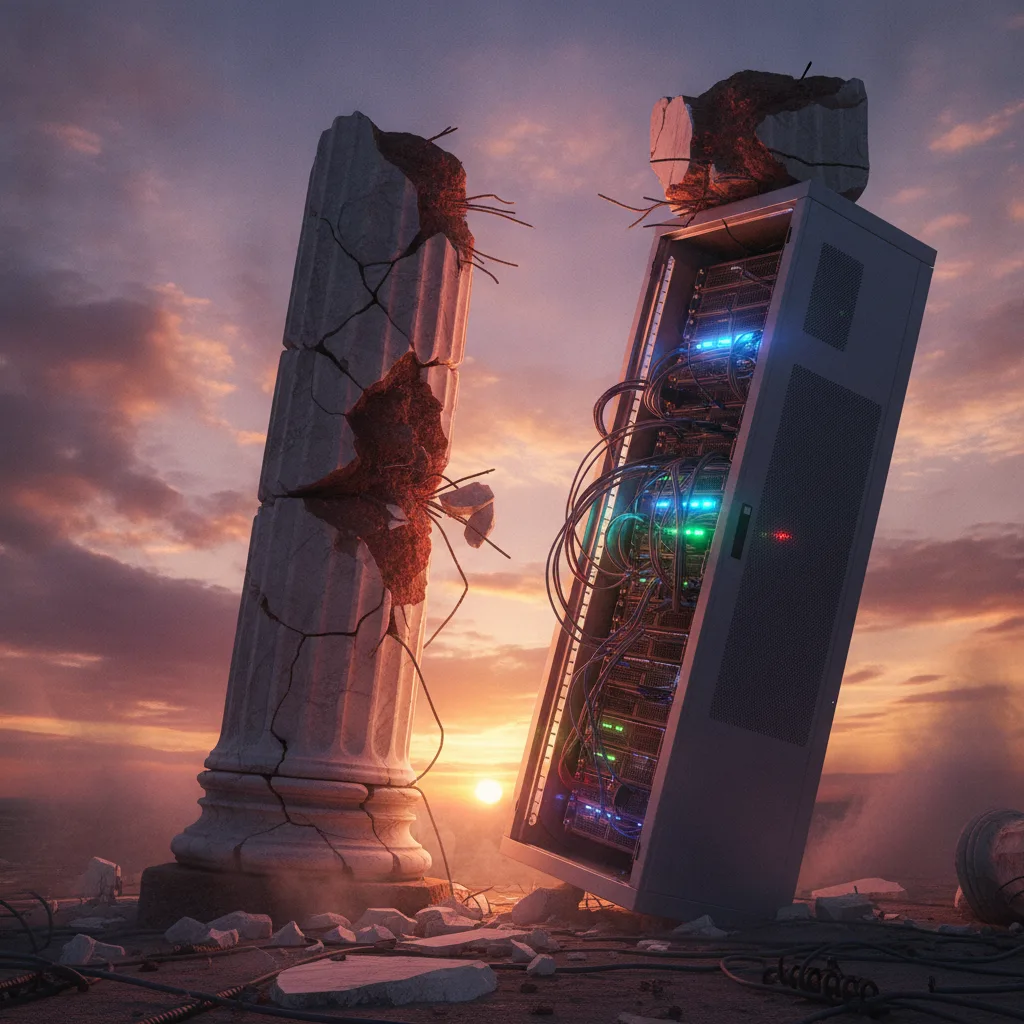
Right now, the AI infrastructure buildout looks a lot like Rome at its administrative peak — genuinely impressive, genuinely load-bearing, and quietly stacking independent risks that nobody is tracking as a single system:
- Currency debasement equivalent: compute and cloud costs getting absorbed into "growth at any cost" budgets that assume infinite capital availability forever.
- Mercenary army equivalent: critical infrastructure increasingly dependent on a handful of vendors (a few cloud providers, a few model APIs) that most companies have zero leverage over and zero backup plan for.
- Administrative bloat equivalent: engineering orgs adding AI tooling, agent layers, and orchestration frameworks faster than anyone can actually audit what depends on what.
None of these, on their own, is a crisis.
That's exactly the point the episode kept hammering — no single failure in Rome's fall would have been fatal by itself. It was the fact that currency collapse, military hollowing, administrative overreach, and external pressure all matured into crises around the same century that turned "manageable problem" into "the end of an era."
The AI industry doesn't need a single catastrophic outage to have its "fall of Rome" moment.
It needs three or four medium-sized problems — a funding pullback, a major vendor outage, a security incident, a regulatory crackdown — to land in the same eighteen-month window instead of spread across a decade.
Nobody is going to ring a bell when that happens. Historians will only agree on the date in hindsight.
Who Should Actually Care About This
If you're an individual developer, the lesson isn't "the industry is doomed." It's smaller and more useful than that: audit your own dependencies like Rome should have audited its mercenary contracts. If your product has a single point of failure — one API, one vendor, one person who understands the deployment pipeline — that's your denarius quietly losing silver content.
If you're running a team, the lesson is about incentives. Every Roman emperor who debased the currency was solving a real, urgent problem in front of them.
The system failed not because individuals were stupid, but because nobody was incentivized to think past their own tenure. If your engineering org rewards shipping over maintaining, you've built the same incentive structure that took two hundred years to wreck an empire — just faster, because software moves faster than empires do.
If you're an executive making infrastructure bets right now, this is the one to actually sit with: complexity that solves today's problem has a bill that comes due later, to someone else, and it's always bigger than anyone expected.
The Twist
The thing that actually surprised me wasn't any of the history — most of it, if you've read a Roman history book in the last twenty years, isn't new.
What surprised me was how calm the whole conversation was. No doom, no hype, just two people patiently tracing two hundred years of small, locally-reasonable decisions to their conclusion.
That's scarier than a hot take. A hot take you can dismiss.
A patient, unhurried case that your industry's current comfort is built on the same kind of quiet, compounding decisions Rome made — that one sticks around.
Rome didn't fall in a day. It fell in about two hundred years of nobody wanting to be the one who said the currency was already worthless.
What's the "denarius" in your stack right now — the thing everyone quietly knows is losing value but nobody wants to be the one to flag?