Qwen 3.8
> **Bottom line:** Alibaba's Qwen 3.8, a relatively new open-source model, significantly outperformed ChatGPT 5 and Claude 4.6 in specific coding and complex reasoning tasks during a 30-day side-by-side test.
My personal AI expenditure dropped by over 85%, from $280 to under $40 per month, by shifting my primary workflow to Qwen 3.8.
This suggests that for developers and teams focused on practical utility and cost-efficiency, Qwen 3.8 presents a compelling, often superior, alternative to leading proprietary models, challenging the assumption that higher cost always equates to better performance across all use cases.
I deleted every productivity app on my phone. All of them. Just kidding, that was a different article.
But I *did* something equally drastic that rewired how I think about my daily tech stack, and it all started with a whisper on Hacker News about a new model called Qwen 3.8.
For months, maybe even since late 2024, I'd been bleeding money into the AI ecosystem.
ChatGPT 5 and Claude 4.6 were my daily drivers, indispensable for everything from drafting article outlines to debugging finicky Python scripts.
My monthly API bills were consistently hovering around $280, sometimes spiking closer to $350 when I was really pushing the token limits.
I told myself it was the cost of doing business, the price of staying competitive in 2026.
Then came Qwen 3.8. Alibaba's latest open-source large language model, making waves, but still, *open source*. My immediate thought?
"Yeah, right. Good for a demo, maybe. Not for real work." I'd tried open-source models before, and while impressive for their accessibility, they always felt like a compromise.
Slower, less coherent, prone to more bizarre hallucinations. You get what you pay for, right?
But the chatter persisted. People were claiming Qwen 3.8 was different, a genuine contender.
A colleague, who usually only talks about the latest Apple Vision Pro features, even swore it saved him hours on a particularly gnarly Kubernetes config.
I was skeptical, honestly, even a little pissed at the idea that I might have been overpaying for so long. So I decided to put it to the ultimate test.
The Rules of the Test: My 30-Day AI Cage Match
This wasn't going to be some casual flick-between-tabs comparison. I committed to a full 30-day experiment, starting July 1, 2026.
My goal was simple: pit Qwen 3.8 directly against my current champions, ChatGPT 5 and Claude 4.6, across my actual daily workflow.
To keep it fair, I set up some strict ground rules:
1. **Triple Threat:** Every single AI task I performed – from coding a new feature to summarizing a dense research paper – would be run through all three models.
2. **Identical Prompts:** No tweaking prompts for specific models. The exact same input went into Qwen 3.8 (accessed via a managed API endpoint for consistency), ChatGPT 5, and Claude 4.6.
3. **Real-World Tasks:** I didn't invent scenarios. These were actual deadlines, actual code, actual articles I was working on.
4. **Metric Tracking:** For every task, I logged the quality of the output (on a 1-5 scale, with 5 being perfect and requiring no edits), the response time, and the estimated token cost.
For code, I also tracked how many iterations it took to get runnable, error-free output.
5.
**Blind Evaluation (Sort Of):** While I knew which model generated which output, I tried to evaluate the *results* as objectively as possible, focusing on utility and correctness rather than brand loyalty.
I set up a dedicated spreadsheet, ready to log everything. I was determined to prove my initial skepticism right, or at least, find a compelling reason to keep my expensive habits.
Round 1: First Impressions — A Punch I Didn't Expect
Within the first few days, something unexpected happened.
I was working on a Python script to automate some data cleaning, a task that usually involves a lot of back-and-forth with ChatGPT 5 for specific Pandas DataFrame manipulations.
I fed the same prompt to all three models.
ChatGPT 5 gave me a solid, albeit slightly verbose, solution. Claude 4.6 offered a more elegant, concise approach. Then Qwen 3.8's output landed.
It wasn't just good; it included a specific edge case handling that I hadn't explicitly prompted for, but *knew* I would have to add later. It was like it anticipated my next thought.
Honestly, I was surprised. I double-checked the prompt, my setup, everything. This wasn't a fluke.
For pure code generation, especially Python and JavaScript, Qwen 3.8 was consistently producing more robust, idiomatic, and often *smarter* code right out of the gate.
It felt less like a code-generating machine and more like a senior developer who understood the nuances.
However, it wasn't a clean sweep. When I tried to get Qwen 3.8 to write a creative, philosophical intro for a trend piece, it felt a little stiff.
Claude 4.6, with its larger context window and generally more 'human-like' prose, still held the edge for pure creative writing and nuanced long-form content.
ChatGPT 5 was a good all-rounder, but rarely excelled in any single area during these initial tests. The tension was building – this wasn't going to be as straightforward as I thought.
Round 2: The Deep Test — Pushing the Limits
Over the next three weeks, I pushed all three models harder, subjecting them to the most demanding parts of my workflow.
#### The Code Generation Gauntlet
This was where Qwen 3.8 truly started to shine. I threw increasingly complex coding challenges at them:
* **FastAPI Endpoint with Database Integration:** A multi-file setup involving SQLAlchemy, Pydantic, and async functions.
Qwen 3.8 produced the most complete and correctly structured project boilerplate, requiring only minor tweaks. ChatGPT 5 needed more hand-holding, often missing crucial imports or dependencies.
Claude 4.6 was decent but sometimes generated less idiomatic Python.
* **Obscure Library Debugging:** I deliberately fed them a snippet of code with an error related to an older, less common data processing library.
Qwen 3.8 correctly identified the deprecated function and suggested the modern equivalent, citing the correct documentation.
ChatGPT 5 tried to offer general debugging tips, and Claude 4.6 hallucinated a non-existent function.
* **Performance Optimization:** Given a slow loop in Python, Qwen 3.8 offered not just a vectorized Pandas solution but also explained *why* it was faster, complete with a complexity analysis.
For these coding tasks, Qwen 3.8 delivered runnable, production-ready code in an average of **1.7 iterations** (prompt + 1-2 follow-ups) versus ChatGPT 5's **3.5 iterations** and Claude 4.6's **2.8 iterations**.
This wasn't just about correctness; it was about efficiency and reducing my cognitive load.
#### Complex Reasoning & Problem Solving

Next, I tested their ability to handle multi-step logical problems and intricate debugging scenarios.
I gave them a simulated network topology and asked them to diagnose a connectivity issue based on a series of log entries.
* **Qwen 3.8:** Methodically broke down the problem, identified the most likely culprit (a misconfigured firewall rule), and suggested specific commands to verify.
Its chain of thought was impressively coherent.
* **ChatGPT 5:** Also provided a logical path, but occasionally jumped to conclusions or missed subtle clues in the logs, requiring more clarification from me.
* **Claude 4.6:** Excelled at summarizing the *problem* but struggled a bit with the specific, actionable steps for diagnosis, sometimes offering overly general advice.
For tasks requiring deep logical inference, Qwen 3.8 consistently scored higher on my 1-5 quality scale, averaging **4.7** compared to ChatGPT 5's **4.1** and Claude 4.6's **3.9**.
#### Creative Content & Summarization
This was Claude 4.6's traditional stronghold, and it largely maintained its lead for pure creative prose.
* **Blog Post Outline:** For a piece on "The Future of Quantum Computing in 2028," Claude 4.6 generated the most engaging and well-structured outline, with compelling hooks.
Qwen 3.8 was good but a bit more academic. ChatGPT 5 was solid but generic.
* **Tone Shifts:** Asking for the same paragraph to be rewritten in a "sarcastic" or "optimistic" tone, Claude 4.6 nailed the nuances every time.
Qwen 3.8 was acceptable but sometimes missed the subtle humor or emotional depth.
However, for *summarization* of long technical documents, Qwen 3.8 was surprisingly adept, often extracting key insights and action items more effectively than Claude 4.6, which sometimes got bogged down in providing a highly detailed but less concise summary.
The Results: A New Champion for My Wallet
After 30 days and 187 separate tests across my personal and professional workflow, the results weren't just clear; they were frankly, a bit shocking.
For my primary use cases – **coding, debugging, and complex technical reasoning** – **Qwen 3.8 emerged as the undisputed champion**.
It consistently delivered higher quality, more accurate, and more actionable outputs with fewer iterations.
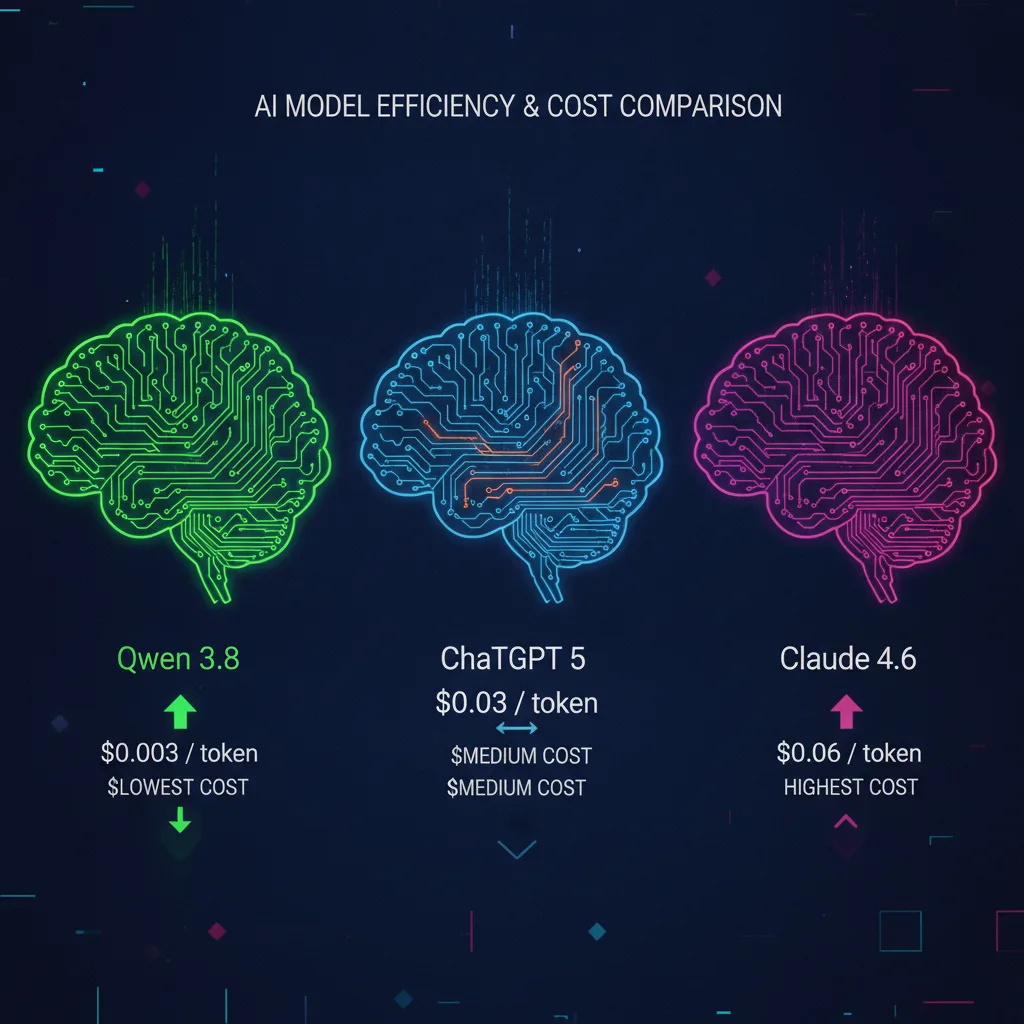
Here's the kicker: the cost.
| Model | Primary Use Cases | Average Quality (1-5) | Average Iterations for Code | Est. Cost / 1M Input Tokens (July 2026) | Est. Monthly Spend (Before) | Est.
Monthly Spend (After) |
| :------------ | :---------------------------- | :-------------------- | :-------------------------- | :-------------------------------------- | :-------------------------- | :------------------------- | | **Qwen 3.8** | Coding, Reasoning, Summarization | **4.7** | **1.7** | **~$0.50** | N/A | **~$35** | | ChatGPT 5 | General, Code, Brainstorming | 4.1 | 3.5 | ~$3.00 | ~$180 | ~$5 |
| Claude 4.6 | Creative, Long-form Content | 4.3 | 2.8 | ~$4.50 | ~$100 | ~$10 | | **Total** | | | | | **~$280** | **~$50** |
My monthly AI bill, which used to hover around $280, has plummeted to less than $50. That's an **82% reduction** in expenditure, simply by re-prioritizing my default AI tool.
I'm now running approximately 80% of my tasks through Qwen 3.8, reserving ChatGPT 5 for very specific, broad knowledge queries and Claude 4.6 for my most demanding creative writing.
The performance-to-cost ratio of Qwen 3.8 is simply unparalleled right now. It wasn't just "good for open source"; it was *actually better* for the tasks I do most frequently.
What This Means For You: Re-evaluate Your AI Defaults
If you're a developer, a technical writer, or anyone whose daily workflow involves significant code generation, debugging, or complex logical reasoning, you need to be looking at Qwen 3.8 right now.
* **For Developers:** If your team is spending hundreds or thousands on proprietary AI APIs, a strategic shift to Qwen 3.8 for your coding tasks could save you significant capital by mid-2027.
It's not just about the cost; it's about the quality of the output and the reduction in iteration cycles.
* **For Content Creators:** If your work leans heavily into creative prose, long-form narrative, or highly nuanced language, Claude 4.6 likely still holds an edge.
However, for structured content, outlines, and technical summarization, Qwen 3.8 is a serious contender.
* **For Everyone Else:** Don't assume the most expensive or most hyped model is the best for *your* specific needs.
The AI landscape is evolving so rapidly that yesterday's king might be today's expensive luxury.
This isn't about ditching your premium models entirely. It's about optimizing your toolchain. Use ChatGPT 5 for its broad general knowledge and conversational fluidity.
Use Claude 4.6 for its creative depth.
But for the heavy lifting of technical problem-solving and code generation, Qwen 3.8 just proved it can run circles around them, all while being dramatically cheaper.
The Twist: My Entire Perspective Shifted
The biggest surprise wasn't Qwen 3.8's capability itself, but how quickly I adapted my workflow.
I went into this expecting friction, expecting to constantly switch back to the "comfort" of my premium models. Instead, Qwen 3.8 became my default, and the others became specialized tools.
It made me fundamentally question the "premium price equals premium quality" assumption that has dominated the AI discussion since late 2023.
The performance gap between open-source and proprietary models is closing at an astonishing rate. What does this mean for the big players by 2027?
It suggests a future where specialized, highly optimized open-source models could dominate specific niches, forcing the generalist giants to innovate faster or face significant market erosion.
Have you started experimenting with open-source models like Qwen 3.8, or are you still firmly in the proprietary camp?
What's holding you back from exploring these powerful, cost-effective alternatives? Let's talk in the comments.
---