Nobody Told You: How One Bet Lost $35 Billion on AI
In this article
Bottom line: Leopold Aschenbrenner, the then-25-year-old ex-OpenAI researcher whose 2024 essay predicted AGI by 2027, built a hedge fund that hit $45 billion and returned 270% in five months of 2026 — then lost roughly $35 billion in July when Chinese open-weight models spooked AI infrastructure stocks and his leverage triggered forced liquidation.
Citadel scooped up $16 billion of his holdings overnight at a double-digit discount. His thesis on AI wasn't necessarily wrong.
His bet size, structured on borrowed money, couldn't survive being early by even a few weeks.
I've spent a decade watching infrastructure teams get punished not for being wrong, but for being right at the wrong speed.
You provision for 10x growth that arrives in month eighteen instead of month six, and you're bleeding cash the whole time you're "correct." Leopold Aschenbrenner just lived that lesson at a scale most of us will never touch — $35 billion, gone in about four weeks.
The Setup: A Researcher Who Called the Future, Then Bet Everything On the Timing
Aschenbrenner isn't some anonymous Reddit trader who got lucky on options.
He worked on OpenAI's superalignment team before getting fired in 2024 over what he says was a disagreement about safety disclosures.
That same year he published "Situational Awareness," a widely circulated essay arguing AGI was coming by 2027 and that almost nobody — governments, markets, most of the AI industry itself — was pricing that in correctly.
Then he did something most essayists never do: he put real money behind the argument.
He launched an investment vehicle, reportedly also called Situational Awareness, built around a simple long/short thesis.
Go long everything that supplies the AI buildout — chipmakers, memory manufacturers, data center operators, power infrastructure. Go short the software companies that AI was about to make obsolete.
By mid-2026 it looked like the trade of the decade. Reports pegged the fund's two-year return at 1,000%, including a 270% run in just the first five months of 2026 alone. Money poured in.
The fund's assets swelled toward $45 billion. And Aschenbrenner leaned in harder, using borrowed capital to size up positions that were already working.
The Core Insight: Being Right About AI Isn't the Same as Being Right About Timing
This is the part developers and infra people should sit with, because it maps almost exactly onto capacity planning decisions we make constantly — just with far higher stakes.

The Trade That Looked Unbeatable
The infrastructure-long thesis wasn't crazy. If AGI arrives by 2027, someone has to build the data centers, fab the chips, and generate the power for it.
Nvidia, SK Hynix, Micron, CoreWeave — these companies were the pick-and-shovel plays on a gold rush that, by every visible metric in early 2026, was accelerating.
Hyperscaler capex guidance kept climbing.
Larry Ellison's Oracle was pouring money into AI infrastructure so aggressively that analysts were openly warning the buildout looked bigger, relative to the economy, than the dot-com bubble ever was.
Aschenbrenner's short side made sense too: why own a SaaS company whose entire moat is a workflow that a capable model could automate away?
The Chinese Model That Broke the Thesis
Then, in July 2026, a wave of highly capable open-weight models out of China demonstrated they could handle a large share of real-world AI workloads at a fraction of the compute cost the market had assumed was necessary.
It was a rerun of the DeepSeek shock from January 2025, except this time the market had a lot more leveraged money sitting on top of the "compute scarcity forever" assumption.
If you don't need as much silicon, power, or data center square footage to get frontier-level performance, the entire long side of the trade takes a direct hit.
SK Hynix, SanDisk, Micron, and CoreWeave all fell more than 35% during the month.
The short side — software companies supposedly about to be disrupted — didn't necessarily rally in a way that offset it.
The spread that had made Aschenbrenner rich for two years inverted in a matter of weeks.
Leverage Doesn't Care If You're Right
Here's the mechanic that actually destroyed the fund, and it's the part every engineer who's ever over-committed to a cloud reserved-instance contract should recognize.
Borrowed money doesn't ask whether your long-term thesis is correct. It asks whether you can post collateral today, at today's price, regardless of where the price will be in six months.
As the infrastructure stocks cratered, margin calls arrived. The fund couldn't meet them by trimming gently — it had to dump inventory into a falling market.
By July 30, roughly $16 billion in stock got unloaded in an overnight block trade at more than a 10% discount to market, with Ken Griffin's Citadel on the buy side.
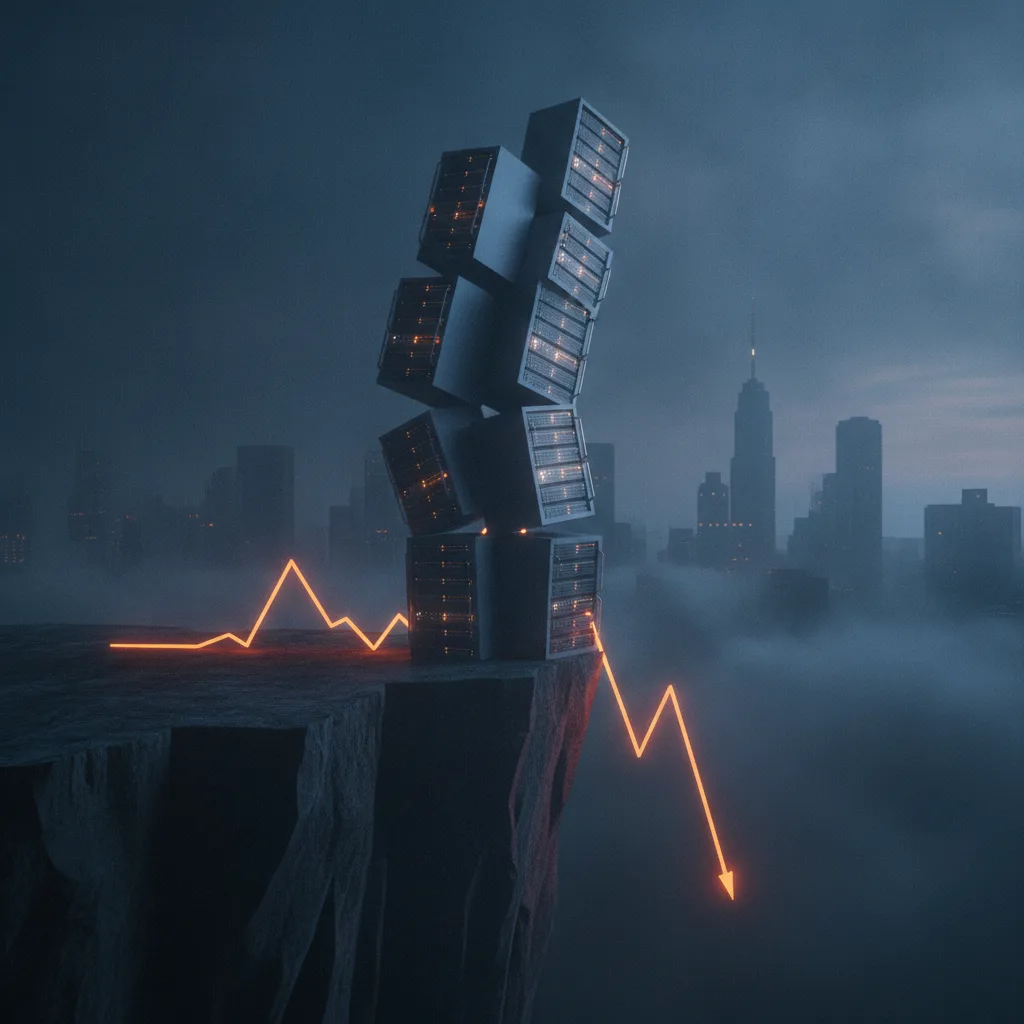
A fund that held $45 billion was left with something closer to $10 billion.
That's roughly a 78% drop in a single month, even though the fund was reportedly still up around 80% for the year once you account for the gains banked earlier.
Read that last sentence twice.
The strategy was still net profitable for 2026 and it nearly blew up anyway. That's what leverage does — it doesn't just amplify your returns, it amplifies your exposure to bad timing until timing is the only variable that matters.
The Reality Check: The Bubble Debate Misses the Actual Lesson
A lot of the YouTube commentary around this story frames it as "proof the AI bubble is bursting" or, in the opposite corner, "proof the AI trade still works, he just got unlucky." Both framings are lazy.
Neither tells you anything you can use.
What actually happened is narrower and more useful: a specific, highly leveraged position collided with a specific, unpredictable timing event. The Chinese open-weight models didn't prove AI infrastructure demand is fake — hyperscaler capex commitments for 2027 haven't meaningfully retreated.
What they proved is that the efficiency curve on inference is not smooth or predictable, and anyone betting on a linear, ever-increasing compute requirement is exposed to sudden step-function corrections whenever a cheaper method ships.
That's not a crypto-bro leverage story dressed up in AI language.
It's the same failure mode I've watched play out in infrastructure budgets for years, just with nine more zeroes: teams that size their commitment to the trend line instead of the confidence interval get hurt the moment reality moves off that line, even briefly.
The Practical Takeaway: What This Actually Means If You Work in Tech
You're not running a $45 billion hedge fund, but you're probably making smaller versions of the same bet right now — reserved GPU capacity, multi-year cloud commitments, headcount plans built around "AI will 10x our output by Q2." A few things worth carrying out of this story:
- Separate the thesis from the position size. Aschenbrenner's read on AGI timing might still turn out roughly correct. That has nothing to do with whether a specific, leveraged trade on that timing was sound risk management.
- Watch the efficiency curve, not just the demand curve. Every few months, a cheaper way to get similar model quality shows up — DeepSeek in January 2025, the Chinese open-weight wave in July 2026. If your infra plan assumes today's compute cost per unit of capability holds steady, build in the assumption that it won't.
- Leverage is a timing amplifier, not a conviction multiplier. If you wouldn't bet the position unlevered, adding debt doesn't make the underlying call more correct — it just makes the deadline for being correct much shorter.
- Treat "the AI bubble" framing with suspicion either direction. One fund's forced liquidation is a data point about leverage and correlation risk in a crowded trade, not a referendum on whether transformer-based systems keep improving.
I don't think Aschenbrenner's essay was wrong.
I think he built a position that required the future to arrive on a schedule the market couldn't guarantee, and then removed his own margin for error right when he needed it most.
Have you seen your own team make the smaller version of this mistake — over-committing infrastructure spend to an AI timeline that hasn't actually arrived yet?
What did it cost you when the schedule slipped?
Sources:
- Brief #36: The Smartest Money in AI Lost $35 Billion in a Month. Then It Doubled Down.
- How to Lose $35 Billion - The Free Press
- Oracle's Massive AI Bet Has Already Cost Larry Ellison $207 Billion
- A $35 Billion Bet That AGI Could Not Wait - StartupHub.ai
- The man who predicted the AI future just lost $35 billion on it
- Former OpenAI Researcher Bets on AI Stocks After $35 Billion Wipeout