Nobody Talks About This 2026 Penguin Drama. I Wasn't Ready For This.
I spent four hours studying a chart today, and it wasn’t a stock market graph or a system architecture diagram.
It was a map of penguin infidelity at the Sumida Aquarium in Tokyo, and it taught me more about 2026 social dynamics than any AI-driven "wellness" app ever could.
We like to think our lives are complex, but we have nothing on the Magellanic penguins of Tokyo, whose 2026 relationship chart just dropped like a social hand grenade.
If you think your "it’s complicated" status on whatever social layer you’re using is messy, you haven't seen what happens when a bird named Hanabi decides to dump her partner of three years for a younger male who’s literally her nephew.
The Chart That Broke My Productivity Streak
I opened Hacker News this morning expecting a deep dive into Claude 4.6’s new reasoning capabilities or perhaps a debate on the latest kernel update.
Instead, I found the 2026 Sumida Penguin Relationship Chart, and the engagement metrics were terrifying.
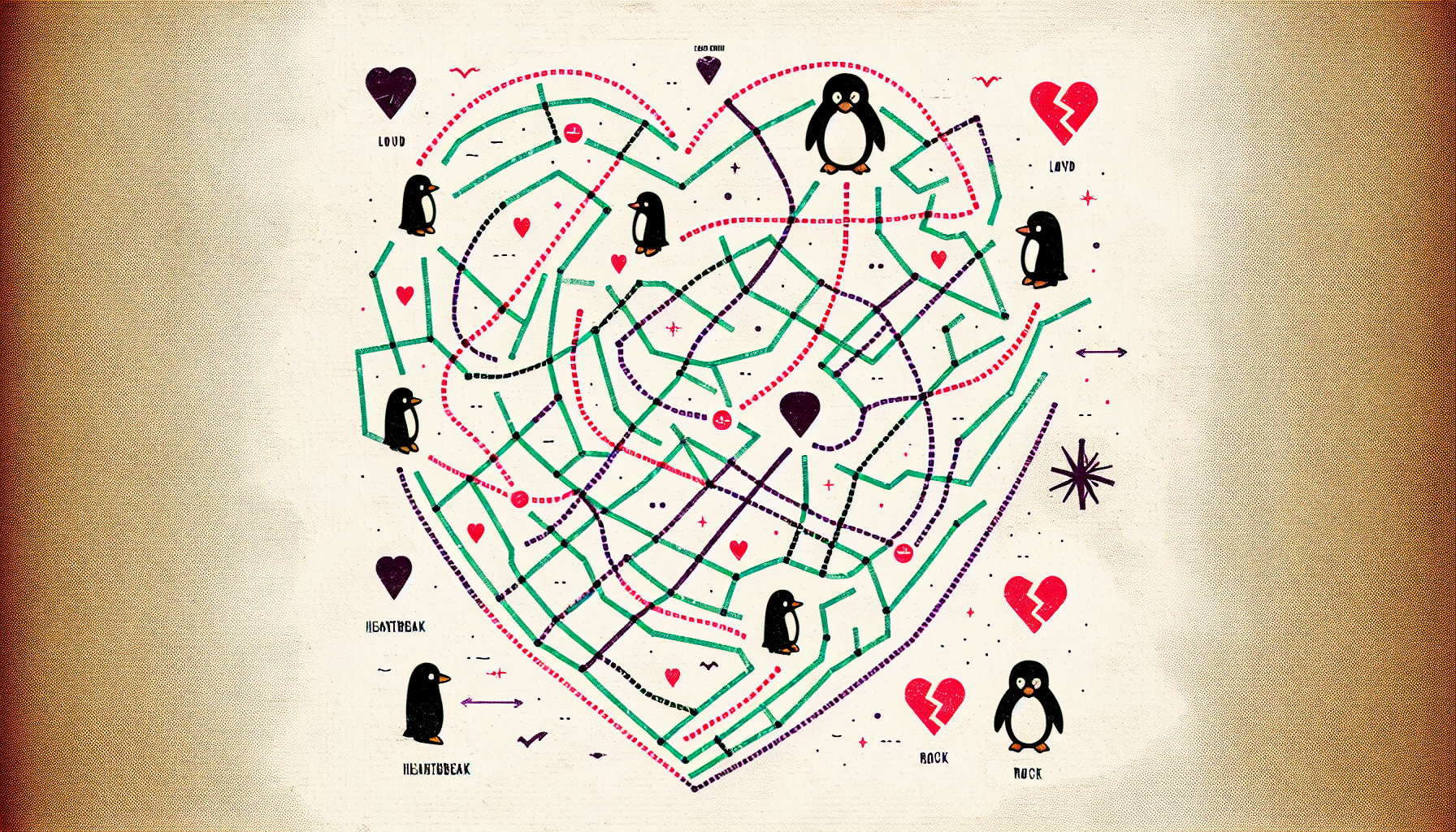
The chart is a sprawling, neon-coded web of lines representing "couples," "heartbreaks," "infidelity," and "pure, unadulterated drama." It’s become an annual tradition for the aquarium staff to map these relationships, but this year's update feels different.
It feels like a mirror.
In a world where we use ChatGPT 5 to optimize our calendars and Gemini 2.5 to draft our "difficult" emails, seeing a group of birds absolutely ruin their social standing for no reason other than "he has a nicer rock" is incredibly grounding.
We spend so much time trying to be efficient, yet we’re still just biological entities driven by the same chaotic impulses as these flightless birds.
The Data Visualization of Disarray
The Sumida chart is a masterpiece of information design, but not for the reasons we usually praise in tech. It doesn't simplify; it amplifies the complexity of living.
Each line color has a meaning. A red line is a solid couple. A broken purple line?
That’s a "former lover." A green line indicates "complex feelings," which is the penguin equivalent of "I’m currently ghosting you but I might look at your Instagram stories at 2 AM."
What makes this trend so resonant in April 2026 is that we’ve become obsessed with "mapping" everything. We map our sleep cycles, our blood glucose, and our professional networks.
We try to turn the messy, jagged edges of human existence into a clean SVG file.
The Sumida chart reminds us that even with the best data visualization in the world, the underlying reality is still a penguin named Macho trying to hit on every female in the colony simultaneously.
We are living in the Age of Optimization, yet we are still governed by the Law of the Colony. We want to believe that if we just find the right app or the right framework, we can avoid the "broken purple lines" in our own lives.
The penguins are here to tell us that chaos is a feature, not a bug.
The "Colony Chaos" Framework: 3 Lessons from the 2026 Chart
I sat with this chart for a long time, trying to figure out why I was so obsessed with it.
I realized it offers a clear mental model for surviving our own increasingly complex social and professional landscapes. I call it the Colony Chaos Framework.
1. Accept the Non-Static Node
In networking, a node is supposed to stay put. In the Sumida chart, the penguins (the nodes) are constantly shifting their connections. A "reliable partner" in 2025 is a "social pariah" by April 2026.
We often fail because we expect our environments to remain static. We think our job role, our friendship group, or our mental health status is a fixed point.
The penguins teach us that we are constantly in flux. Embracing the "Non-Static Node" means accepting that you will be a different person—with different needs and connections—six months from now.
2. The Transparency of the Mess
The Sumida staff doesn't hide the drama; they put it on a giant wall for tourists to see. There is something incredibly healing about seeing the "mess" made public.
In our own lives, we tend to curate. We show the "Red Line" (the perfect relationship or the successful project) and hide the "Broken Purple Line" (the failure, the burnout, the mistake).
The more we hide our internal relationship charts, the heavier they become. When we acknowledge the complexity—even the embarrassing parts—we take away its power to shame us.
3. The "Rock" Fallacy
Penguins often break up over a specific nesting site or a particularly nice pebble.
In the 2026 chart, one major breakup was reportedly caused by a penguin wanting a better "view" of the visitor walkway.

We do this too. We think that one "Rock"—the promotion, the new house, the latest gadget—will finally stabilize our chart.
But as the penguins show, the Rock doesn't change the Bird. You can have the best nest in the colony and still feel the urge to cause a scene.
True stability comes from navigating the relationships, not just hoarding the pebbles.
Why Techies Are Obsessed with Penguin Infidelity
It’s no coincidence this is trending on Hacker News. We are a demographic that loves systems. We love to look at a complex problem and find the underlying logic.
The Sumida chart is a "system" that is fundamentally illogical. You can’t write a Python script to predict which penguin will fall for a zookeeper this year (yes, that’s on the chart).
You can’t use a Large Language Model to rationalize why a penguin would ignore its lifelong mate for a shiny bucket.
For those of us who spend our lives in the digital "logic gate," the penguin drama is a vacation. It’s a reminder that there is a world outside of `if/else` statements.
There is a world of feathers, smell, noise, and irrational decisions. In 2026, where AI is starting to feel a bit too rational, the penguins are the ultimate contrarians.
They are the "vulnerable experts" of their own lives. They fail, they fight, they make terrible choices, and then they stand on a rock and scream about it. There’s a certain dignity in that.
Applying the Chaos to Your Own Life
I used to think my life had to look like a clean "Architecture" diagram. Everything in its box. Every API call documented. Every relationship "optimized" for maximum support and minimum friction.
After looking at the 2026 penguin chart, I’ve decided to stop optimizing. I realized that my own "relationship chart" is full of weird, jagged lines.
I have friends I haven't spoken to in three years who I still consider "Red Line" connections. I have "Green Line" professional interests that I’ll probably never actually pursue.
Stop trying to "solve" your life like it’s a bug in the code. You are not a piece of software that needs to be refactored. You are a penguin in a colony. You are going to make some weird choices.
You are going to want a pebble that doesn't belong to you. You are going to have "complex feelings" about someone you shouldn't.
Instead of trying to fix the lines, try to be like the Sumida staff: Document the mess with curiosity instead of judgment. When you stop judging your own "drama," you start to see the patterns.
You see that your "failures" are just "Broken Purple Lines" that make the overall chart more interesting.
The 2026 Reality Check
As of April 19, 2026, we are more connected than ever, yet we feel more isolated because we only share the "Red Lines." We are terrified of the drama, the breakups, and the "it's complicated" moments that make us human (or penguin).
The Sumida chart is the most honest piece of social media we have left. It’s not a highlight reel. It’s a "this is exactly what happened" reel.
And it turns out, what happened is a lot of screaming, a few stolen rocks, and a whole lot of starting over.
I wasn't ready for the 2026 Penguin Drama because I wanted to believe we were past this.
I wanted to believe that by 2026, we’d have figured out how to be "better." But looking at those birds, I realized that "better" isn't the goal. Being present for the chaos is the goal.
Next time you feel like your life is a mess, just remember Hanabi. She’s currently a social pariah, her ex is dating her cousin, and the entire world is watching her on a neon-colored chart.
And you know what she’s doing? She’s eating a fish and standing in the sun.
She’s fine. And you will be too.
Whose relationship chart are you currently breaking, or are you the one holding onto a "Broken Purple Line" that needs to be let go?
I'd love to hear your "penguin drama" stories—drop them in the comments.