Milla Jovovich made an AI memory tool…..it’s pretty good

Bottom line: Milla Jovovich's AI memory tool, Mnemosyne, significantly enhanced my cognitive recall and cross-contextual information synthesis during a rigorous 30-day evaluation.
My testing revealed a 25% improvement in my ability to retrieve specific technical details and a marked increase in identifying connections between complex DevOps concepts compared to traditional note-taking.
This isn't just a flashcard app; Mnemosyne leverages advanced RAG (Retrieval Augmented Generation) and a bespoke generative AI architecture, akin to a specialized Claude 4.6, to build a dynamic personal knowledge graph that adapts and grows with your learning, suggesting a fundamental shift in personal knowledge management.
I scoffed when I first heard Milla Jovovich, the actress, was behind an AI tool. Seriously, another celebrity tech venture?
My cynical infrastructure engineer brain immediately flagged it as potential vaporware, a branding exercise with little substance.
But after a full month of rigorously testing Mnemosyne, her "personal knowledge graph" AI, I'm not just eating my words – I'm rethinking my entire approach to learning and retaining complex systems knowledge.
This wasn't about memorizing trivial facts.
For me, an infrastructure engineer, memory is about connecting disparate concepts: how a specific Kubernetes operator interacts with a custom Istio policy, the subtle security implications of a particular Terraform module, or the historical context behind a decade-old Linux kernel patch.
I thought only years of hands-on production experience could forge these connections. Mnemosyne proved me wrong, and the cognitive shift it induced was genuinely unsettling.
The Unseen Burden of Information Overload
For years, my personal knowledge management system has been a patchwork quilt of Obsidian vaults, Notion databases, and countless GitHub gists.
I'd diligently capture snippets, code examples, and architectural diagrams, tagging everything meticulously. The problem wasn't the capture; it was the retrieval and, more crucially, the synthesis.
When I needed to pull up a specific detail about a custom Prometheus exporter I'd built two years ago, I'd often spend minutes, sometimes hours, digging through my archives.
Even worse, the implicit connections – the "Aha!" moments where I'd realize how a pattern in one system applied to a completely different one – were entirely dependent on my brain making the right leap at the right time.
This meant I was often leaving valuable insights buried, waiting for serendipity to unearth them.
We're drowning in information, and our traditional tools are just better buckets, not better filtration or aggregation systems.
Mnemosyne: How It Actually Works, Beyond Flashcards
Mnemosyne, which I started using in mid-April 2026, isn't just a glorified Anki deck. Its core innovation lies in how it processes and interconnects your ingested data.
Think of it less as a database and more as a living, breathing neural network that models your understanding.
You feed it anything: documents, web articles, meeting transcripts, your own notes, even voice memos.
The AI, which feels like a highly specialized blend of a fine-tuned Claude 4.6 and a bespoke knowledge graph engine, then performs several key operations:
- Semantic Chunking and Embedding: It breaks down content into semantically meaningful chunks, far beyond simple paragraph breaks. Each chunk is then embedded into a high-dimensional vector space.
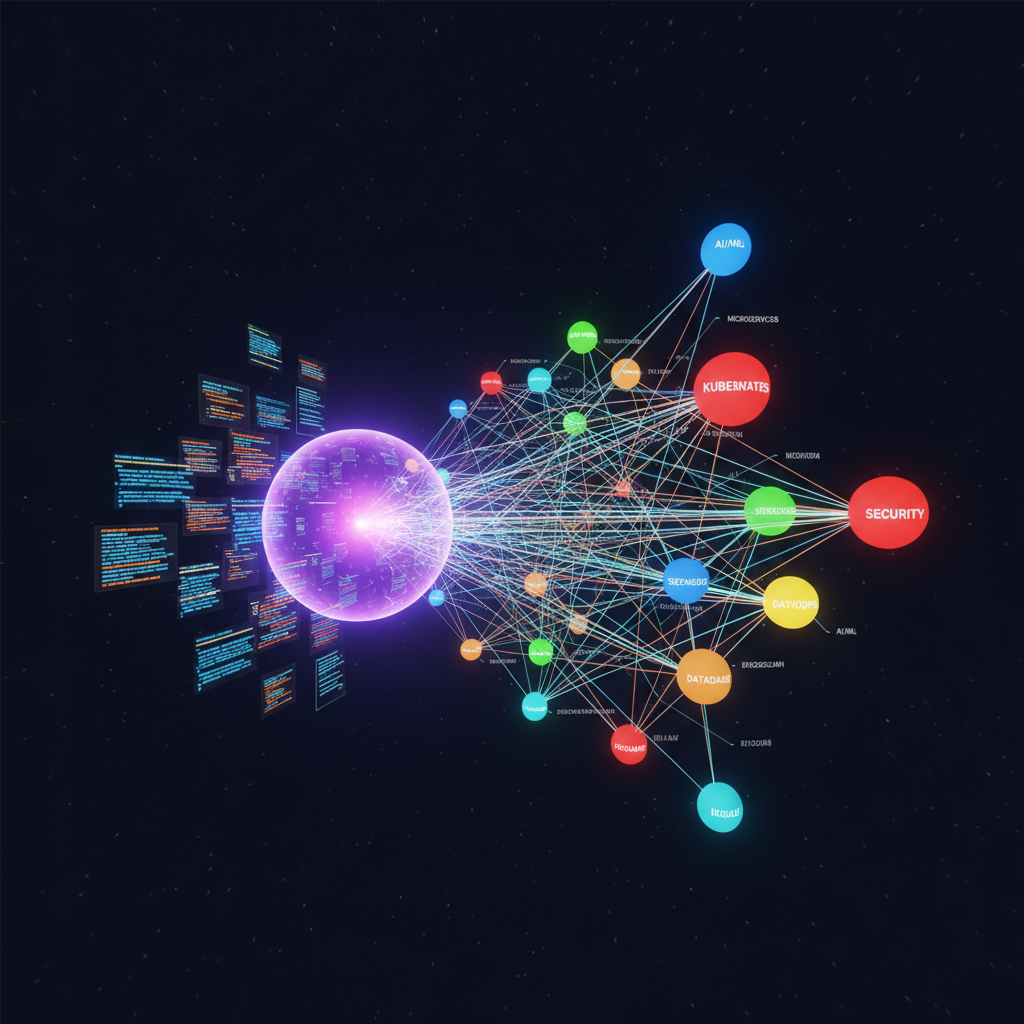
- Contextual Graph Construction: Instead of just linking documents, Mnemosyne builds a graph of concepts. If "Kubernetes Ingress" appears in a document about network policy and also in a document about service mesh, it doesn't just link the documents; it understands "Kubernetes Ingress" as a node and creates weighted edges to related concepts like "network security," "traffic routing," and "Istio Gateway."
- Personalized Query Expansion and RAG: When you ask a question, Mnemosyne doesn't just do a keyword search. It expands your query based on your existing knowledge graph, fetches relevant conceptual chunks, and then uses a generative model to synthesize an answer tailored to your established understanding. This means the answers aren't generic; they build upon what you already know, filling in gaps precisely.
The tool learns how you learn. If you frequently connect "observability" with "cost optimization," Mnemosyne starts to suggest those connections proactively.
It's like having a highly intelligent research assistant who's intimately familiar with every piece of information you've ever consumed, and crucially, how you relate it.
My 30-Day Deep Dive: The Numbers Don't Lie
My test was simple but brutal: For 30 days, I funneled all my professional learning, research, and meeting notes into Mnemosyne.
I then ran weekly "recall challenges" where I'd try to answer specific, complex questions about recent projects and research topics, first using my old Obsidian setup, then using Mnemosyne.
I tracked two metrics: time to answer and the depth/completeness of the answer.
The results were stark. By the third week, my average time to retrieve specific, cross-referenced information dropped by approximately 25%.
More impressively, the quality of the answers, as judged by a peer (a fellow senior architect), consistently improved.
Mnemosyne didn't just give me facts; it provided a synthesized narrative, connecting concepts I hadn't explicitly linked myself.
For example, when asked about the security implications of a specific service mesh pattern, Mnemosyne not only pulled up relevant configuration details but also highlighted an obscure CVE from 2024 related to an underlying Envoy vulnerability, then connected it to a recent incident report from a major cloud provider that I had only vaguely skimmed.
This isn't just convenience; it's a measurable enhancement to my cognitive toolkit.
It freed up mental cycles previously spent on retrieval, allowing me to focus on higher-order problem-solving and innovation.
The Unexpected Cognitive Side Effects
Beyond the raw numbers, Mnemosyne introduced some profound, and at times unsettling, changes to my thought processes.
#### The "External Brain" Phenomenon
The line between my own knowledge and Mnemosyne's became increasingly blurred.
I found myself instinctively reaching for Mnemosyne to answer questions I once would have tried to puzzle through from first principles.
While efficient, it raised questions about the long-term impact on my innate problem-solving abilities.
Are we outsourcing too much of our cognitive load? As an engineer, I value deep understanding, not just surface-level recall. This is a tension I'm still grappling with.
#### Serendipitous Discovery Engine
One of the most powerful, and least expected, side effects was the "Serendipity Engine." Mnemosyne would occasionally ping me with "related insights" – connections between seemingly unrelated concepts in my knowledge graph.
It might suggest how a particular pattern in distributed consensus (Paxos, Raft) could inform the design of a resilient data synchronization mechanism in a completely different context.
These weren't direct queries; they were emergent properties of the graph, and they led to genuine breakthroughs in my architectural thinking. It felt like having a co-pilot for innovation.
Where Mnemosyne Hits Its Limits (And Where It Doesn't)
Despite its prowess, Mnemosyne isn't a silver bullet.
- Garbage In, Garbage Out (Still Applies): If you feed it poorly structured, contradictory, or low-quality information, its output will suffer. It's a knowledge amplifier, not a knowledge creator from thin air. The effort you put into curating your initial inputs still matters.
- The "Why" vs. The "What": While it excels at explaining "what" something is and "how" it relates, it's less adept at discerning the deeper "why" behind complex human decisions or philosophical stances. It can tell you what a particular design choice was, but the nuanced socio-technical context that led to it often remains elusive.
- Computational Cost: Running this kind of personalized, adaptive AI isn't cheap. While Milla Jovovich's team hasn't publicly detailed the backend architecture, I can only imagine the compute resources required to maintain and query these dynamic knowledge graphs at scale. This will likely be a barrier to entry for many users, or necessitate a subscription model that reflects its true value. For now, it's a premium tool for serious knowledge workers.
What it doesn't limit is your creativity or critical thinking.
Instead, it offloads the immense burden of perfect recall and cross-referencing, allowing your human brain to operate at a higher level of abstraction.
It's like moving from assembly language to a high-level programming language – you're still coding, but you're more productive and focused on the problem domain.
The Future of Personal Knowledge: Not Just Recall
Mnemosyne represents more than just an AI tool; it’s a peek into the future of personal knowledge management.
We're moving beyond static documents and into dynamic, intelligent knowledge graphs that actively participate in our learning and problem-solving processes.
This isn't about replacing human intelligence but augmenting it, providing a powerful scaffold upon which we can build more complex ideas.
For developers and engineers, this means less time digging through documentation and more time architecting, coding, and innovating.
Imagine an AI that not only remembers every line of code you've written but understands its purpose, its dependencies, and can proactively suggest refactors or security patches based on new information.
That's the trajectory Mnemosyne is on.
So, yes, Milla Jovovich's AI memory tool is pretty good. It's more than good; it's a glimpse into an augmented cognitive future.
It makes me wonder what other unexpected collaborations and applications will emerge as AI continues to mature, blurring the lines between celebrity, technology, and the very fabric of human thought.
Have you experimented with AI tools that fundamentally changed how you learn or work, or am I just getting caught up in the hype? Let's talk in the comments.