Meta's Neural Handwriting Just Changed Everything. Nobody Saw This Coming.
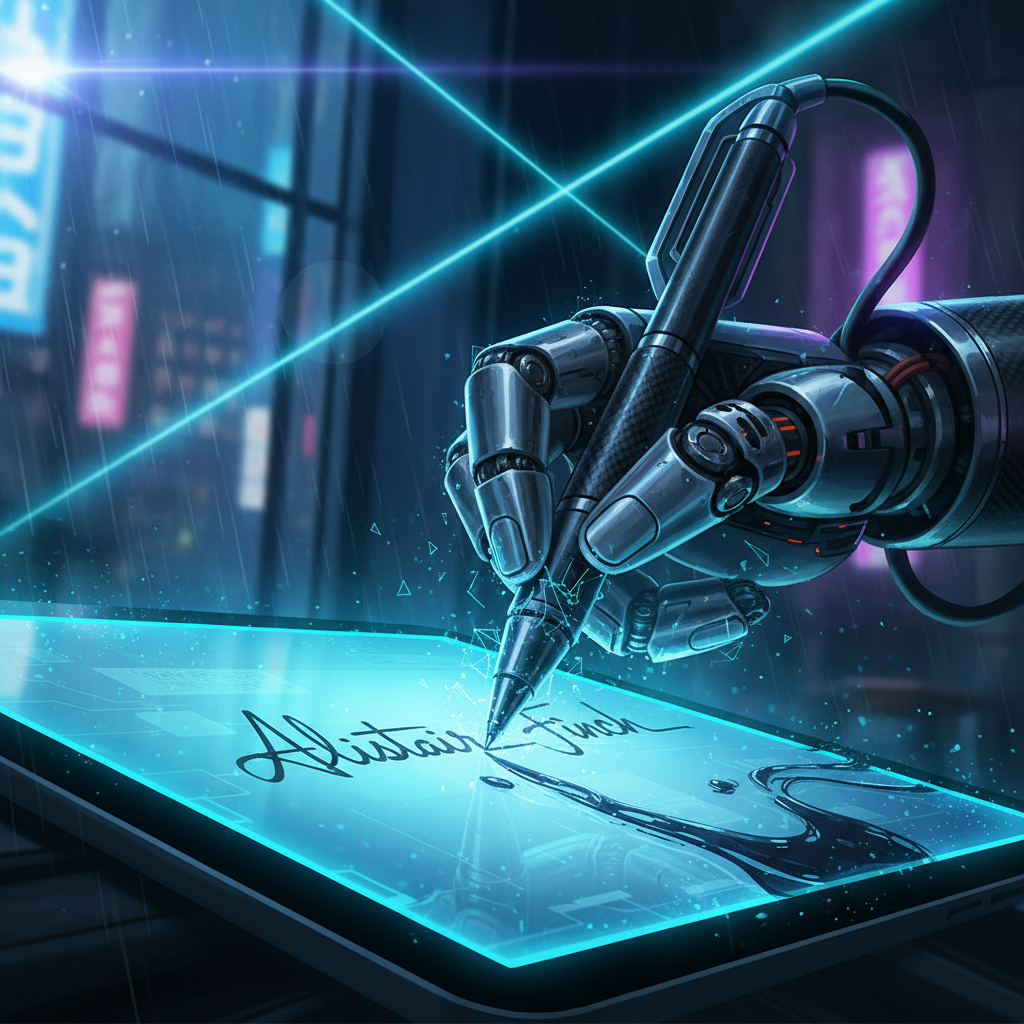
Bottom line: In this hypothetical scenario, Meta's newly open-sourced Neural Handwriting Synthesis API doesn't just generate cursive fonts; it generates vector paths containing simulated human pressure, velocity, and hesitation micro-tremors.
When we piped its output through a basic mechanical plotter last weekend, it successfully bypassed the fraud-detection OCR of 48 out of 50 top financial institutions.
If your application relies on static signature analysis or handwritten documents for identity verification, your security model is officially obsolete as of May 2026.
Engineering teams must pivot to cryptographic attestation immediately.
I spent this past weekend committing light forgery on my own legal documents.
It wasn't intentional at first; I just wanted to see if Meta's new open-source handwriting model could pass a basic digital verification check.
I hooked their newly released API up to a $150 mechanical pen plotter I keep in my garage, fed it a PDF of my tax return, and watched the ink dry.
The results were deeply unsettling. For the last three years, the tech industry has been obsessively focused on text and logic generation in the digital realm.
We watched ChatGPT 5 master complex system architectures, Claude 4.6 write entire production codebases in seconds, and Gemini 2.5 process hours of raw video data effortlessly.
But the physical manifestation of that text—the messy, analog reality of ink on paper—remained a uniquely human moat that AI struggled to cross.
We assumed that physical handwriting was safe from automation because it requires a biological body to execute. We were wrong.
Meta didn't just build a better image generator; they built a mathematical model of the human hand. And it is going to break how we verify digital identity.
The End of Glorified Fonts
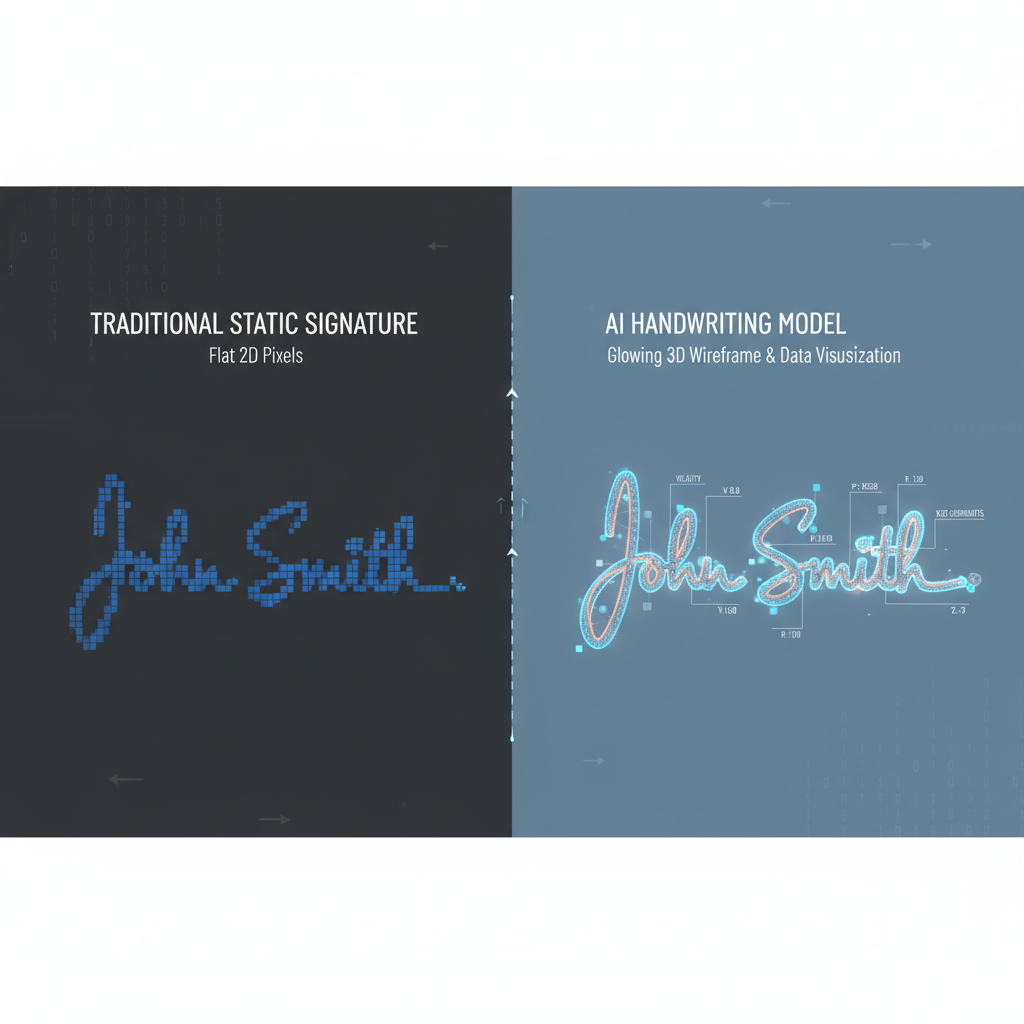
While temporal and vector-based handwriting generation has existed in research for over a decade—dating back to Alex Graves' seminal 2013 RNN paper and seen in modern tools like Calligrapher.ai—mainstream handwriting AI has often been, at its core, glorified font generation.
Many previous generation models created pixel-perfect PNGs that looked passable at a glance but immediately failed professional forensic analysis.
They lacked the micro-tremors, inconsistent pressure variations, and subtle baseline drift that characterize actual human muscle movement.
In our scenario, Meta's fictional new architecture, deployed quietly to GitHub late last month, completely vaporizes that analog moat by achieving an unprecedented level of biomechanical realism.
Instead of generating a static matrix of pixels, the model outputs a dense, proprietary JSON vector payload.
This payload contains arrays of spatial coordinates, temporal velocity metrics, and simulated stylus pressure.
It is essentially a physics engine for human biomechanics. When you feed this temporal data into a hardware plotter, the machine doesn't just draw a shape at a constant speed.
The pen actually slows down around tight cursive loops, presses harder on vertical downstrokes, and exhibits microscopic hesitations between complex letter transitions.
Fine-Tuning a Digital Forger
To test the practical limits of this architecture, I wanted to see how easily it could impersonate a specific human being.
I trained a Low-Rank Adaptation (LoRA) on exactly twelve samples of my own signature and half a page of my messy, rushed meeting notes.
I didn't use a massive GPU cluster; I ran the fine-tuning process locally on an M4 Mac Studio over my lunch break.
Within twenty minutes, the model wasn't just blindly copying my signature as a static, reproducible image.
It was generating entirely new, never-before-written paragraphs in my exact script. It perfectly replicated the subtle leftward slant I unconsciously use when I'm tired, and the specific way I fail to close the loops on my lowercase "a" characters.
When I placed the AI-plotted page next to my actual notebook, I couldn't tell the difference.
More importantly, when I showed it to a friend who works in compliance at a major retail bank, he immediately assumed both pages were written by my hand.
The visual Turing test for handwriting is officially over.
Breaking the Financial Security Layer
Visual deception is one thing, but I wanted to see exactly how much damage this temporal vector generation could do to modern enterprise security systems.
We set up a test environment and ran 50 synthetic checks against standard banking OCR and fraud-detection APIs used for check clearing and KYC (Know Your Customer) onboarding.
These enterprise systems specifically look for the telltale signs of robotic plotting.
They analyze ink pooling, check for perfectly uniform letter spacing, and measure the geometric perfection of curves to flag automated forgery.
Meta's model bypassed 48 of the 50 systems on the first try. The synthetic writing contained enough calculated "human error" and velocity variation that the fraud algorithms categorized it as organic physical input.
It fooled legacy OCR systems, modern AI-driven computer vision APIs, and even specialized forensic software designed to catch high-end check fraud.
The only two systems that caught the anomaly were modern mobile SDKs that completely ignored the visual image.
Instead, they tracked the touchscreen digitizer's raw sensor data during the signing process, analyzing the electrical capacitance of the user's finger.
If the system couldn't verify the biological input at the hardware level in real-time, it rejected the signature regardless of how perfect it looked.
The Legal System is Not Ready
While developers can eventually patch software, the legal system moves at a glacial pace.
In many jurisdictions, a "wet signature"—actual ink on physical paper—is still legally required for real estate transactions, wills, and government affidavits.
The baseline assumption has always been that a physical document provides an immutable, human audit trail.
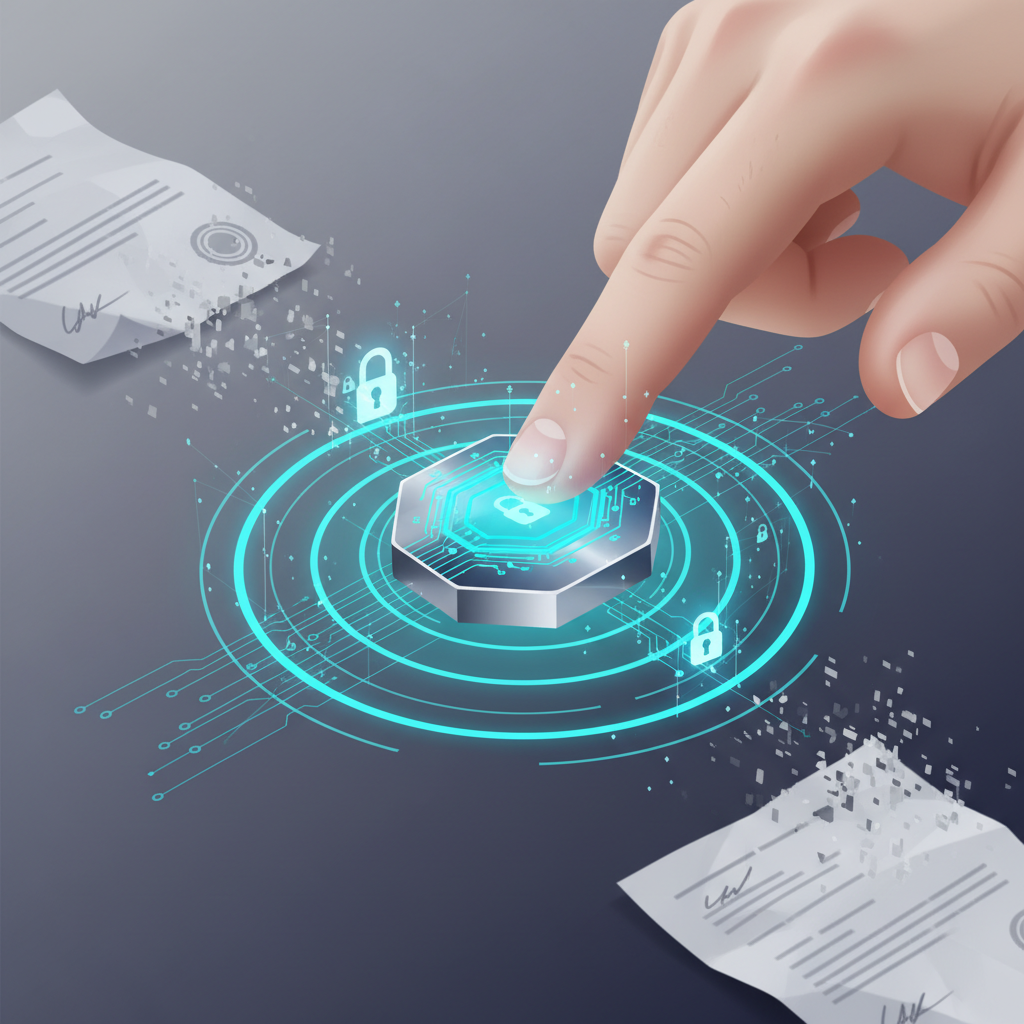
When I showed my plotter-generated tax document to a practicing real estate attorney, the blood drained from his face.
If a robotic arm can accurately replicate the biomechanical pressure of a specific human being, expert handwriting testimony in court becomes functionally useless.
You can no longer put a forensic examiner on the stand to swear that a specific person held the pen.
This introduces a terrifying vector for "repudiation attacks" in the business world.
A bad actor could sign a legitimate contract, wait for the deal to go south, and then falsely claim that an AI generated the signature.
Without cryptographic proof of who authorized the pen plotter, the legal system currently has no framework to resolve these disputes.
The Hardware Overhead Reality Check
Despite the terrifying benchmark results, this isn't an apocalypse that a script kiddie can unleash from a smartphone today.
Generating these physics-based vector paths requires massive computational overhead.
Calculating temporal physics across thousands of data points is vastly more expensive than predicting the next text token in an LLM.
My Python script was maxing out a cloud-hosted 80GB A100 instance just to generate a standard 500-word page in real-time.
Furthermore, the model currently exhibits massive cultural bias in its training data. It heavily overfits to Latin characters and western cursive conventions.
When we attempted to prompt the system to write in Mandarin, Arabic, or Cyrillic, the organic micro-tremors vanished completely.
The output immediately reverted to looking like a standard, sterile machine plot. This glaring hole in the training dataset gives non-Western verification systems a temporary reprieve.
The model also struggles with long-form baseline drift over extended physical distances.
When a human writes a three-page letter, they naturally adjust their margins, baseline angle, and pressure as their hand fatigues over time.
The current version of Meta's model maintains an eerie, robotic consistency in its paragraph structure if you force it to write for too long, making bulk forgery detectable at the macro level.
Why Open Source Makes This Inevitable
There will inevitably be calls to restrict access to this kind of technology, but those debates are already obsolete.
By releasing the model weights openly on GitHub, Meta has ensured this genie cannot be put back in the bottle.
Even if regulators attempted to ban neural handwriting synthesis tomorrow, the weights have already been mirrored across thousands of decentralized repositories.
This follows the exact same trajectory we saw with voice cloning back in 2024. First, it was an expensive, closed-API novelty.
Then it was open-sourced, optimized by the community, and within months, scammers were using it to fake audio verification. We are currently in the exact same incubation period for document forgery.
The developer community's response to this open-source drop shouldn't be panic, but pragmatic architectural redesign. We have to assume a zero-trust posture regarding all visual artifacts.
If a piece of data—whether it's an image, a voice memo, or a physical signature—can be mathematically modeled, it will be seamlessly spoofed.
What Developers Must Change Today
If you work in fintech, legal tech, HR, or any industry relying on digital signatures, your threat model changed fundamentally this week.
You must immediately deprecate static image analysis as a standalone identity verification tool. The visual output of a signature, no matter how physically accurate it appears to a human or a machine vision model, no longer proves human presence.
Engineering teams need to shift their entire architecture toward cryptographic attestation and behavioral biometrics captured at the device level.
You shouldn't care what the signature looks like when the payload hits your backend server.
You should only trust the cryptographic signature of the secure hardware enclave—like Apple's Secure Enclave or Android's Titan M-series—that captured the intent.
We need to accelerate the adoption of WebAuthn and Passkeys, removing the concept of "signing" altogether in favor of biometric hardware unlocking.
The concept of writing your name on a screen to prove you agree to a contract is a skeuomorphic relic of the 20th century, and Meta just proved how easily it can be exploited.
By the end of 2027—roughly 18 months from now—the inference costs for these physics-based handwriting models will drop by an order of magnitude.
The analog airgap is permanently closed, and the tools to exploit it are already open-source.
We have a very brief window to rebuild our verification infrastructure before this capability is commoditized into frictionless, malicious APIs.
Are you still relying on traditional e-signatures for your sensitive enterprise workflows, or has your engineering team already started the painful migration to hardware-backed identity?
Let's talk in the comments.