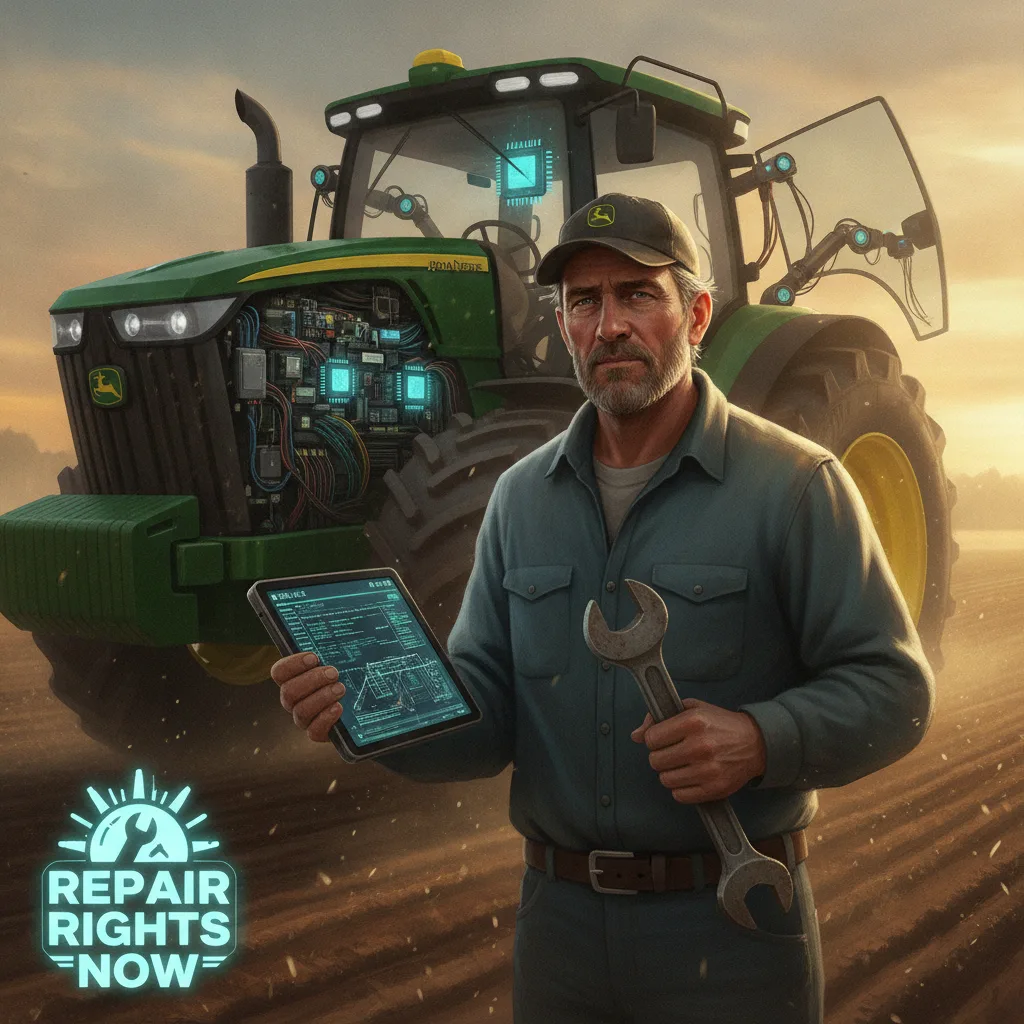
John Deere's
Bottom line: The FTC's recent settlement with John Deere, granting farmers the right to repair their equipment, isn't just about wrenches and tractors; it's a critical precedent for the future of AI.
This ruling exposes a fundamental vulnerability in our increasingly AI-driven infrastructure: the right to debug and maintain proprietary, embedded AI systems.
For any developer or organization deploying AI on specialized hardware, this outcome forces a re-evaluation of our supply chains, our security posture, and the true ownership of the "smart" systems we build.
I cancelled my ChatGPT Pro subscription after six months, not because the models weren't powerful, but because I realized I was outsourcing a critical part of my thinking.
That was just the tip of the iceberg. What truly shook my confidence in our AI-driven future wasn't a large language model's hallucination, but a legal battle over farm equipment.
For years, I've prided myself on building resilient systems. My infrastructure designs account for redundancy, failover, and observability.
I've shipped production code where every line of Python and Go was scrutinized for potential black boxes.
But a few weeks ago, as I read the details of the FTC's settlement with John Deere, it hit me: I'd completely overlooked the physical layer of the AI stack.
The John Deere debacle laid bare a fundamental flaw in how we think about ownership and repair in an age where AI isn't just in the cloud, but embedded in everything from our phones to our combines.
The Combine That Couldn’t Be Fixed: A Parable for Embedded AI
Imagine a tractor, not just any tractor, but a $500,000 behemoth equipped with GPS-guided plowing, AI-powered yield optimization, and sophisticated diagnostics.
It’s essentially a rolling data center with a diesel engine. Farmers, the actual owners, found themselves unable to perform even basic repairs.
A sensor fault, a software glitch, or a mechanical issue requiring a diagnostic code could only be fixed by an authorized John Deere technician.
Not because the repair was inherently complex, but because the necessary proprietary software tools, the digital "keys" to the machine's brain, were locked away.
This wasn't just an inconvenience; it was an operational nightmare. Downtime during harvest season could mean losing hundreds of thousands of dollars.
Farmers, who have historically been masters of self-reliance and field repairs, were suddenly at the mercy of a single vendor's schedule and pricing.
The issue wasn't a lack of mechanical skill; it was a lack of software access.
The embedded AI and control systems, designed to make the equipment smarter, had inadvertently made it less resilient and less owned by its operator.
The FTC settlement, finalized earlier this year on July 09, 2026, mandated that John Deere provide farmers and independent repair shops with the necessary diagnostic tools, software, and documentation.
This isn't a small victory; it's a tectonic shift.
It forces us to acknowledge that when AI is embedded in physical systems, the right to repair that hardware is inextricably linked to the right to access and understand its underlying software and AI.
And that, for us as infrastructure engineers and AI developers, carries profound implications.
The Invisible AI Supply Chain: Your Models Are Not Isolated
We often think of AI models as abstract entities living in GPU clusters or containerized services. We focus on data pipelines, training regimes, and deployment strategies.
We meticulously monitor inference endpoints and track drift.
But what happens when that AI model is running on a custom ASIC in a smart factory robot, or powering the predictive maintenance of a wind turbine?
#### Your AI Models Are Not Isolated
The truth is, every AI model has a physical footprint. It runs on hardware, relies on firmware, and interacts with sensors and actuators.
The robustness of your AI isn't just about your code; it's about the entire stack, right down to the silicon and the soldering.
If a critical piece of hardware fails, or if a firmware update introduces a bug that impacts your model's performance, who has the ability to diagnose and fix it?
The John Deere case highlights that for years, vendors have locked down these physical components with proprietary software.
This creates an "invisible AI supply chain" where the hardware, and thus the AI it hosts, becomes a black box even to its owner.
We've optimized for performance and convenience, inadvertently building single points of failure into our most critical infrastructure.
#### The Right to Repair is the Right to Debug
For developers, debugging is a fundamental right. We need access to logs, stack traces, and source code. Without these, we’re flying blind.
The John Deere settlement essentially extends this "right to debug" to the physical world.
If a tractor's AI-driven steering system malfunctions, the problem could be mechanical, electrical, or a software bug in the embedded AI.
Without access to diagnostic tools and code, isolating the root cause becomes impossible for anyone outside the OEM.
This is analogous to deploying a mission-critical AI service to a cloud provider but being denied access to your instance's hypervisor logs, kernel dumps, or even the ability to SSH into the box.
It’s unthinkable for enterprise infrastructure, yet it has been the norm for embedded AI systems.
The John Deere ruling cracks open this black box, setting a precedent that the ability to repair hardware must include the ability to inspect and interact with its controlling software and AI.
#### A Precedent for Open AI Systems
This isn't just about farmers. This settlement sends a clear signal across every industry where AI is embedded in specialized hardware.
Think about medical devices, industrial automation, defense systems, or even smart home technology.
If a vendor can lock you out of repairing your owned hardware, they effectively control your operational uptime, your data, and your ability to innovate or secure your own systems.
This precedent pushes towards a future where "open" doesn't just apply to source code, but to the entire hardware-software-AI stack.
It forces a conversation about interoperability, standardized diagnostics, and the ethical implications of proprietary AI living inside essential machinery.
The Reality Check: The Developer’s Dilemma
Of course, the issue isn't entirely black and white. OEMs often cite intellectual property, security concerns, and the complexity of their systems as reasons for restricting access.
Allowing unfettered access could theoretically lead to dangerous modifications, security vulnerabilities if third parties introduce malware, or simply bricked equipment due to untrained hands.
These are valid concerns, particularly when dealing with complex AI algorithms that could be sensitive or critical to performance.

However, the current model has created an unsustainable dependency. We are increasingly building AI into infrastructure that is designed to be opaque and unrepairable by its operators.
This "black box" problem of AI isn't just about understanding why a neural network made a particular decision; it's also about understanding why the physical system it controls just stopped working, and having the means to fix it quickly and efficiently.
The balance needs to shift from absolute vendor control to a shared responsibility model that empowers owners without compromising safety or IP.
The Practical Takeaway: Building Resilient AI Infrastructure
The John Deere settlement should be a wake-up call for anyone designing, deploying, or managing AI systems.
It's time to extend our systems thinking beyond the code and into the physical world where our AI lives.
#### Demand Transparency in Your AI Stack
When acquiring AI-driven hardware, ask hard questions. What are the diagnostic capabilities? Is there an API for system health monitoring?
What level of software access is provided for debugging or even minor repairs? Don't just look at the AI model's performance metrics; scrutinize the maintainability of the entire system.
Factor repairability into your total cost of ownership.
#### Design for Offline and Local Debugging
Not every AI system will operate with constant cloud connectivity or immediate vendor support.
Design your embedded AI solutions with robust local logging, diagnostic modes, and even manual override capabilities.
Assume your systems will fail in the field, far from a network connection, and plan for how local personnel can triage and potentially repair them without specialized proprietary tools.
This means thinking about edge AI with self-healing capabilities and robust local observability.
#### Think Beyond the Code: Hardware as a Service
As infrastructure engineers, we've mastered "Infrastructure as Code." Now, we need to think about "Hardware as a Service" with a focus on its entire lifecycle, including end-of-life maintenance and repair.
This means advocating for modular hardware designs, open-source firmware where feasible, and standardized interfaces for diagnostics.
The goal is to build systems that are not just performant, but also sustainable and repairable.
#### Advocate for Open Standards
The John Deere case wasn't resolved by a single company's goodwill; it was driven by regulatory pressure and advocacy.
As an industry, we need to push for open standards for diagnostics, data access, and repair protocols across all embedded AI systems.
This prevents vendor lock-in, fosters innovation, and ensures that the physical infrastructure underpinning our AI revolution remains resilient and truly owned by its operators.
The right to repair isn't a niche issue for farmers; it's a blueprint for how we'll build and maintain all AI-driven physical systems moving forward.
It’s a stark reminder that if we cannot fix the hardware, we cannot truly control the AI.
How much of your "owned" AI infrastructure is actually a black box you can't debug or repair when it truly matters? What's the one piece of AI-driven hardware in your stack that keeps you up at night?
Let's talk in the comments.