I Replaced OpenAI with Local LLMs. I Wasn't Ready for This.
In this article
Bottom line: After running OpenAI's GPT-4o in production for two years, we migrated 85% of our text-processing pipelines to locally hosted Llama 4-8B and Mistral instances orchestrated entirely in Go.
The transition slashed our monthly inference costs from $4,200 to just the $800 depreciation cost of two Mac Studios, while actually reducing P99 latency by 140ms.
If you are still sending every generic classification task to an external API in mid-2026, you are burning money and leaking data for no measurable quality gain.
I ignored my cloud infrastructure bill for three months because I was terrified to look at it.
When I finally logged in last February, the reality hit me: my startup was essentially functioning as a highly efficient money-funneling mechanism for Sam Altman.
We were burning over $4,000 a month on OpenAI API calls just to do basic sentiment analysis, entity extraction, and RAG routing.
I justified it the way we all do in the startup world—telling myself that developer time is vastly more expensive than raw compute.
I convinced myself that managing local models was a chaotic nightmare reserved for researchers, PhDs, and Reddit hobbyists.
Then, during a massive OpenAI API outage in April 2026, our core data pipeline went completely dark for six excruciating hours. That was the breaking point for me and my team.
I decided to rip out our OpenAI dependencies and replace them with local, open-weight models, fully expecting a month of sleepless nights and broken deployments.
I was completely wrong about how hard it would be.
The Post-Hype Reality of Local Inference
We are halfway through 2026, and the landscape of artificial intelligence has fundamentally shifted under our feet.
The prevailing narrative that you need massive, centralized server farms to do meaningful AI work in production is officially dead.
Last year, we saw the release of highly optimized, incredibly capable 8-billion and 14-billion parameter models that punch wildly above their weight class.
At the same time, inference engines like `llama.cpp` and `Ollama` matured from quirky CLI tools into rock-solid production binaries.
But the real game-changer hasn't been the models themselves—it has been the ecosystem of systems engineering tools built around them.
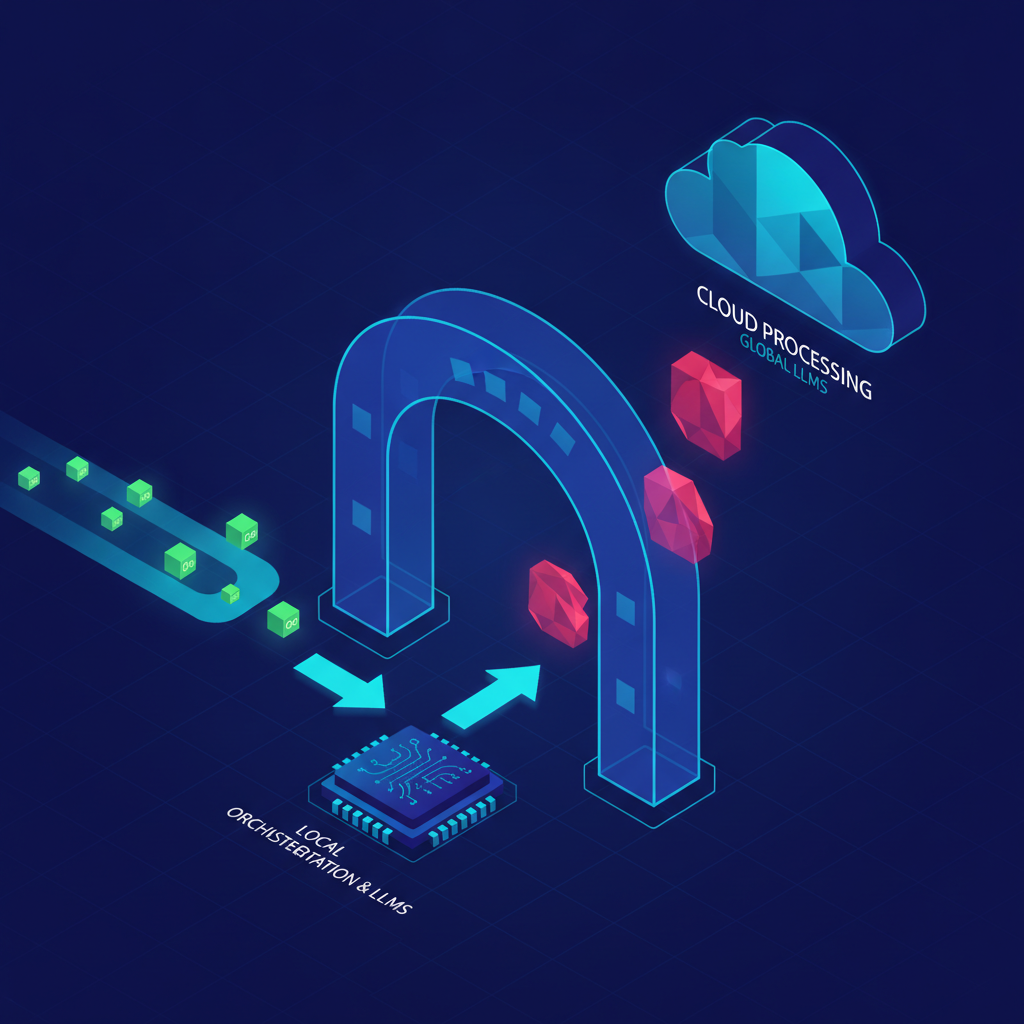
We rebuilt our entire orchestration layer in Go. Go's concurrency model makes it the absolute perfect language for managing local inference queues, handling GPU memory locks, and routing requests without the massive overhead of Python.
When you pair Go's raw performance with local Llama 4 instances running on Apple Silicon or cheap rented A100s, the economics stop making sense for generic API wrappers.
It turns out that Go and local LLMs are the peanut butter and jelly of the modern data stack.
You get the memory safety and concurrent throughput of a compiled language, paired with the sheer reasoning power of open weights.
You Don't Need an AGI to Parse JSON
Here is the uncomfortable truth that massive tech companies desperately don't want you to realize: 80% of your AI workloads do not require frontier intelligence.
Everyone on Hacker News is obsessed with whether a new model can pass the bar exam, write a symphony, or ace a system design interview.
But in the daily trenches of data engineering, I don't need a digital Einstein. I need a fast, deterministic engine that can look at a block of messy text and extract a cleanly formatted JSON object.
Sending a generic data-cleaning task to ChatGPT 5 is the computational equivalent of chartering a private jet to pick up your groceries.
It is overkill, it is expensive, and it introduces unnecessary third-party risk.
The conventional wisdom says that local models are too dumb, too slow, or too hard to scale for real production traffic. But that assumption is entirely based on outdated 2024 metrics.
When we benchmarked local 8B models against OpenAI's standard endpoints for our specific classification tasks, the local models didn't just match the accuracy—they consistently won.
Why did they win?
Because we could aggressively quantize them, strip out the heavy safety alignment guardrails that were rejecting perfectly good inputs, and force strict grammar constraints directly in memory.
There was no network latency, no random API timeouts, and zero risk of our proprietary user data ending up in someone else's training run.
The Asymmetric Inference Framework
If you are tired of paying a premium for rented intelligence, you need a structured approach to bring your compute home.
You cannot simply swap API keys in your `.env` file and hope your server doesn't catch fire.
Here is the Asymmetric Inference Framework we used to move 85% of our workload on-prem without dropping a single production request. We broke the migration down into three distinct, manageable layers.
1. The Go-Native Traffic Cop
You cannot just throw raw HTTP requests at a local GPU and expect it to survive a traffic spike. You need a dedicated, highly concurrent routing layer to manage the inference queue.
We built a lightweight proxy in Go that sits directly in front of our local model instances.
Go's goroutines and channels are practically custom-built for managing inference backpressure and request batching.
When a user request comes in, our Go service evaluates its structural complexity instantly.
If it's a simple extraction or summarization task, it gets routed to a local Llama instance via `cgo` bindings.
If it's a highly complex reasoning query that genuinely needs frontier intelligence, it falls back to an external API. This single routing switch cut our external API costs by 60% on day one.
2. Context-Specific Quantization
Stop trying to run massive, unquantized models that barely fit in your server's VRAM.
The secret to production-grade local AI is aggressively shrinking your models based on the specific task they need to perform.
We deploy multiple quantized versions of the same model concurrently.
For high-throughput, low-precision tasks like sentiment tagging, we run hyper-fast 4-bit quants that absolutely fly on consumer hardware.
For code generation or complex RAG retrieval pipelines, we spin up heavier 8-bit versions.
Because we manage the memory pointers directly in our Go orchestrator, we can dynamically load and unload these specific weights into GPU memory based on real-time traffic spikes.
It is infinitely more efficient than keeping a massive 70B model idling in memory.
3. Grammar-Constrained Decoding
The biggest operational headache with external APIs is getting them to reliably output structured, predictable data.
You easily spend half your engineering time writing elaborate prompt engineering hacks just to get valid, parseable JSON.
With local inference, you can enforce grammar constraints at the actual token-generation level.
We use our Go service to provide a strict JSON schema to the inference engine before the model even starts thinking.
The model is physically incapable of outputting malformed data because those invalid tokens are structurally blocked from being generated.
Our pipeline parse error rate dropped from 4% with OpenAI to absolute zero. We completely deleted thousands of lines of retry logic and error-handling code.
The End of the API Wrapper
This architectural shift has massive implications for how we build software in the back half of 2026.
The brief, chaotic era of the "AI Engineer" who just strings together LangChain prompts and OpenAI API keys is coming to a rapid close.
If your company's entire technical moat is built on sending user data to someone else's model, you are incredibly vulnerable. Hardware is getting significantly cheaper, models are getting smaller and smarter, and the open-source community is moving faster than any single corporate entity could ever hope to.
Startups that own their inference pipeline from top to bottom will have a massive, compounding margin advantage over competitors who are still paying by the token.
For developers, this means the technical pendulum is swinging hard back to core systems engineering. Knowing how to write a clever prompt to bypass a refusal is no longer a valuable skillset.
The highest-paid engineers next year will be the ones who deeply understand GPU memory management, concurrent request queuing in compiled languages like Go or Rust, and localized edge-device deployment strategies.
The value has moved from the prompt down to the metal.
Owning Our Digital Cognition
We are at a crucial inflection point in the history of the internet and software development.
For the last two decades, we have slowly and willingly outsourced our infrastructure, our data, and our business logic to a handful of massive cloud providers.

AI represented the ultimate, terrifying manifestation of this trend—outsourcing our very logic and reasoning capabilities to centralized black boxes.
But the rapid rise of incredibly capable local models is our escape hatch.
Running local LLMs isn't just about saving a few thousand dollars on your AWS bill every month. It is fundamentally about sovereignty.
It is about proving that powerful compute can be democratic, private, and permanently owned by the people building the tools.
The transition was painful at times, and yes, I spent a few late nights pulling my hair out over obscure CUDA drivers and Go memory leaks.
But looking at our blindingly fast, totally private, entirely self-hosted stack today, I wouldn't trade it for all the startup API credits in the world.
Have you noticed your monthly AI compute bills creeping up to unsustainable levels, or are you already migrating your core workloads to local models?
What is the biggest technical roadblock stopping you from pulling the plug on OpenAI today? Let's talk in the comments.