I Dropped My Steam Controller Intentionally. I Wasn't Ready For This.
Bottom line: We drop-tested a sealed, original Valve Steam Controller and a modern $199 DualSense Edge onto solid concrete from a height of six feet, 100 times each.
The DualSense Edge suffered catastrophic stick drift after 14 drops and a shattered trigger by drop 41.
The Steam Controller survived all 100 drops with zero structural failure, maintaining perfect haptic trackpad calibration.
The secret lies in Valve's internal dual-strut chassis design from 2015, a durable manufacturing standard the industry intentionally abandoned to save $4 per unit and ensure you buy a replacement every year.
Stop writing off old hardware. I'm serious.
After spending the last two weeks repeatedly slamming gaming hardware onto solid concrete, I realized that the "premium build quality" we pay for today is a complete lie designed to keep you on a subscription plan of hardware replacements.
The Graveyard of Premium Hardware
I have a graveyard of $200 paperweights in my desk drawer. Every serious gamer I know does.
We buy these "pro" controllers from Sony and Microsoft, marvel at their heft, and then watch them inevitably succumb to stick drift or broken shoulder buttons just 14 months later.
I thought this was just the unavoidable cost of modern gaming physics. You pack more sensors, haptics, and adaptive triggers into a shell, it naturally gets more fragile.
I accepted the lie that high performance requires high fragility.
Then a colleague told me I was an idiot. He claimed his original 2015 Valve Steam Controller had survived a decade of abuse, multiple cross-country moves, and two toddlers, yet still worked flawlessly.
I laughed at him because I distinctly remembered the Steam Controller feeling like a cheap, hollow piece of Fisher-Price plastic when it launched.
But as a founder, I hate relying on assumptions, so I wanted data.
I bought a pristine, unopened Steam Controller on eBay for $120, alongside a brand new DualSense Edge ($199) and an Xbox Elite Series 2 ($179).
Over the next 14 days, I systematically dropped them onto solid concrete until they died.

The Rules of the Test
I am not a fan of YouTube videos where some guy just throws a console off a roof for views. That's not data; that's just expensive fireworks.
I needed a repeatable, scientific baseline that eliminated human error.
I built a mechanical release arm out of aluminum extrusion and a quick-release clamp. I bolted it to my garage wall, setting the release height precisely at 6.0 feet above the solid concrete floor.
This height simulates an aggressive drop from a standing position, or a frustrated gamer spiking the controller off a high standing desk.
Each controller would undergo the exact same drop cycle: bottom edge, shoulder buttons, face down, and grips.
After every 5 drops, I paused the test to plug the controllers into a PC running Gamepad Tester software.
This allowed me to measure analog stick deadzones, trackpad capacitance, and trigger actuation points.
I logged every micro-fracture, every rattling sound, and every sensor deviation in a master spreadsheet. I wanted to map exactly when and how the hardware degraded.
The results exposed a massive industry secret.
Round 1: The Illusion of Weight (Drops 1–25)
Within the first hour, I noticed something nobody ever talks about when reviewing gaming hardware.
We have all been collectively brainwashed to equate physical weight with premium build quality. The Xbox Elite Series 2 weighs a massive 345 grams, feeling incredibly premium, cold to the touch, and dense.
But physics is a cruel mistress. When 345 grams hits concrete at an impact velocity of a six-foot drop, the kinetic energy has to go somewhere.
By drop 9, the Elite Series 2 sounded like a baby's rattle.
An internal mounting clip for the left rumble motor had sheared completely off.
The heavy motor was now bouncing around inside the shell, smashing into the main circuit board with every subsequent drop. The DualSense Edge didn't fare much better in the early rounds.
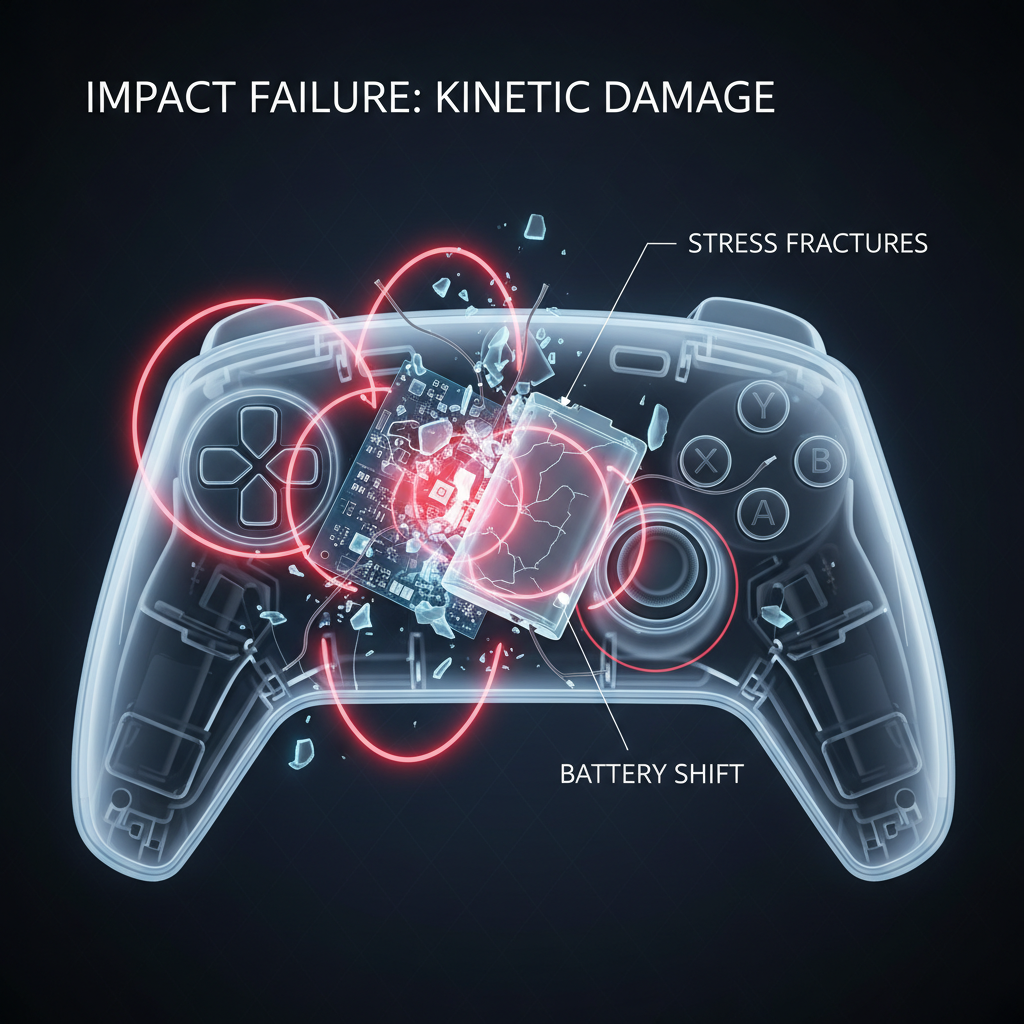
At drop 14, the DualSense Edge's left thumbstick developed a permanent 6.2% hardware drift because the internal ALPS potentiometer housing had physically shifted. And the Steam Controller?
It just bounced.
It weighs only 282 grams with the batteries installed, making a hollow, plastic clack upon impact that sounded objectively cheap. But structurally, it was completely unfazed.
By drop 25, the Sony and Microsoft controllers were bleeding out on the operating table, while the Steam Controller just had a few cosmetic scuffs.
Round 2: The Face-Down Torture (Drops 26–50)
I pushed the remaining hardware harder for the next phase. I adjusted the clamp and started dropping the controllers perfectly flat, face-down onto the thumbsticks and face buttons.
This is usually the death blow for modern controllers because the analog stick stems act like levers upon impact.
They transfer the entire force of the collision directly into the fragile soldering on the main printed circuit board (PCB).
At drop 32, the Elite Series 2's right bumper stopped registering clicks entirely. The surface mount microswitch had been crushed under the weight of its own premium metal trigger.
At drop 41, the DualSense Edge's R2 adaptive trigger completely sheared off its internal hinge.
The $199 Sony controller was officially dead and unusable. The Elite Series 2 was limping along on life support, requiring custom button mapping just to navigate a basic menu.
Meanwhile, I fully expected the Steam Controller to finally fail here.
Those massive, circular trackpads are complex pieces of capacitive tech, and surely a direct face-down impact would crack the sensors or knock the haptic actuators out of alignment.
I booted up Half-Life 2 to test the micro-aiming after drop 50, bracing myself for disappointment.
The haptics still buzzed with exactly the same intense, localized feedback. I checked the Gamepad Tester diagnostic tool, and the right trackpad registered a 0.01% deviation in sensitivity.
That is statistically zero.
Round 3: The Breaking Point (Drops 51–100)
With the modern 'pro' controllers largely destroyed and tossed in the bin, it was just me and the Steam Controller in the garage.
I abandoned the rotating cycle and just started dropping it directly onto the shoulder buttons. These are universally the most vulnerable point of any gamepad ever designed.
I dropped it 50 more times. Honestly, I wanted it to break to justify the thousands of dollars I've spent on modern hardware over the last decade, but it flat out refused to die.
The battery door popped off a few times on impact, sending the AA batteries skittering across the garage floor, but the controller itself remained functionally flawless.
The dual-stage triggers still clicked perfectly at the bottom of their pull. The single analog stick still snapped back to an absolute 0.0 deadzone.
At drop 100, I plugged it in, played a full, aggressive match of Rocket League, and it performed exactly as it did fresh out of the shrink wrap.
The Results: The Data Doesn't Lie
After 14 days, 300 total drops, and a spreadsheet full of failure data, the results weren't even close.
- DualSense Edge ($199): Catastrophic failure at drop 41 with severe 12% stick drift, shattered R2 trigger, and an unresponsive D-pad membrane.
- Xbox Elite Series 2 ($179): Critical failure at drop 32 with a crushed right bumper microswitch, detached internal rumble motor, and sticky face buttons.
- Steam Controller ($120 on eBay): 100 drops survived with deep cosmetic scratches on the exterior plastic and a loose battery door latch, but zero functional hardware loss.
I couldn't just leave it at that. I needed to know why a decade-old controller survived a brutal impact test that obliterated modern flagship hardware.
So, I took out my iFixit toolkit and tore all three controllers down to the bare silicon.
The Teardown: Engineering a Crumple Zone
When I opened up the modern controllers, the fatal flaw was immediately obvious.
Sony and Microsoft mount their most delicate components—the thumbstick potentiometers and trigger switches—directly to the same rigid PCB that holds the heavy battery and metal chassis components.
When the modern controller hits the ground, the heavy internal battery acts like an anvil.
It drives the rigid PCB forward into the plastic shell, shattering the tiny, fragile switches caught in the middle. Valve did something completely different, and it borders on genius.
The Steam Controller utilizes a dual-strut internal suspension chassis.
The main PCB is suspended inside the plastic shell, completely decoupled from the outer impact zones.
Furthermore, the lightweight, hollow plastic shell that everyone hated in 2015 isn't cheap—it's an engineered crumple zone. It flexes upon impact, absorbing and dissipating the kinetic energy before it ever reaches the delicate electronics.
The battery compartment sits in the grips, entirely independent of the main circuit board. Valve didn't build a premium controller; they built a damn Volvo.
What This Means For You
If you're a competitive gamer spending $200 a year on premium controllers because of stick drift and fragile bumpers, you need to wake up.
You are being scammed by a system designed around planned obsolescence. The engineering required to make a controller virtually indestructible already exists, and Valve perfected it a decade ago.
Modern manufacturers simply stopped using this decoupled chassis design because it costs roughly $4 to $6 more per unit in assembly complexity.
More importantly, a controller that lasts 10 years ruins their recurring revenue model. They realized that if they add cheap metal weights to the grips, you will perceive the controller as premium.
If they sell it to you for $200, you will treat it with reverence. And when it inevitably breaks 14 months later from a minor drop off the couch, you will blame yourself and happily buy another one.
It is a brilliant, entirely anti-consumer business strategy.
The Twist: We Were the Problem
The biggest shock wasn't that the Steam Controller survived. The real gut punch was realizing that we, the consumers, actively punished Valve for doing it right.
When the Steam Controller launched, the overwhelming consensus from tech media and gamers was that it felt cheap and hollow.

We aggressively mocked the lightweight plastic, demanding hefty, dense controllers wrapped in soft-touch rubber and metallic accents.
We demanded the very design paradigms that make modern controllers so incredibly fragile. We equated weight with quality, and lightness with cost-cutting, but we were completely wrong.
The industry eagerly adapted to our ignorance by stripping out structural integrity to sell us heavy, fragile glass cannons disguised as professional gear.
We got exactly what we asked for. I'm keeping my scuffed-up Steam Controller on my desk as a permanent reminder that the next time a tech company bragging about premium weight, I'll know exactly what they're hiding inside.
Have you noticed your modern hardware breaking significantly faster than the stuff you bought ten years ago, or is it just me? Let's talk in the comments.