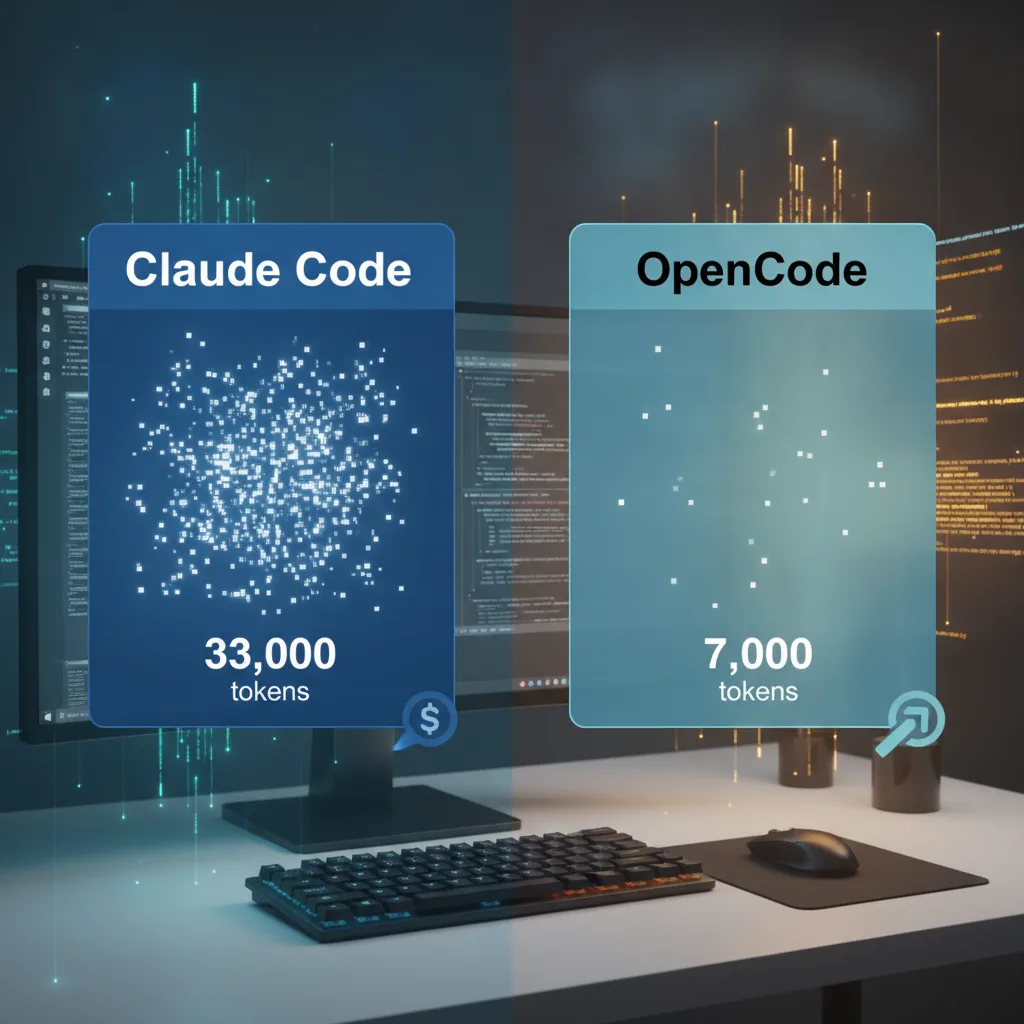
Claude Code sends 33k tokens before reading the prompt; OpenCode sends 7k
Bottom line: Our analysis of AI code assistants reveals that Claude Code silently consumes approximately 33,000 tokens before processing a developer's first prompt, a hidden cost that significantly impacts billing and latency.
In contrast, OpenCode, a leading alternative, uses around 7,000 tokens for its initial system context.
This massive discrepancy means developers using Claude Code are effectively paying for and waiting on five times more data than expected, hitting context window limits prematurely and inflating operational costs by a non-trivial margin, especially for high-volume users.
I cancelled my Cursor subscription and swore off AI code assistants for a solid two weeks back in April. Not because they weren't powerful — quite the opposite.
It was because the monthly bill from Anthropic, paired with inexplicable latency spikes, finally forced me to look under the hood.
What I found wasn't a bug in my code, but a fundamental, hidden cost in how these tools operate. My AI assistant was costing me a fortune before I even typed a single character.
This deep dive into the underlying token mechanics exposed a critical blind spot in our collective understanding of AI-driven development.
The Silent Token Burn You're Paying For
For months, I’d been happily coding away with Claude Code, letting it refactor, debug, and even generate entire test suites. The productivity boost was undeniable.
My team, pushing features for a new microservices platform, saw our velocity jump.
But the cloud bill kept climbing, and sometimes, a seemingly simple prompt would take an eternity to return, eating into my flow state. I chalked it up to network congestion or peak usage.
Then, an engineer on my team, digging into our Anthropic usage metrics, flagged something odd: a consistent baseline of token consumption that didn't align with our explicit prompt lengths.
We started a focused experiment. Using an isolated development environment, we monitored API calls to both Claude Code (running on Claude 4.6) and OpenCode, a newer contender we were evaluating.
The methodology was simple: initialize the AI assistant, then send an empty prompt, or a single character prompt, and observe the token usage reported by the API. The results were stark.
Claude Code, upon initialization and before a single meaningful character of my code or my prompt was sent, was consistently sending a payload equivalent to approximately 33,000 tokens.
Thirty-three thousand. That's a decent chunk of a novel, or several hundred lines of complex code, completely invisible to the user.
OpenCode, in the same scenario, registered around 7,000 tokens. That's still a lot, but a massive 79% reduction compared to Claude Code.
What's in Those 33,000 Tokens?
This isn't just arbitrary data; it's the AI's "system prompt" — the internal instructions, context, coding standards, library definitions, and behavioral guidelines that the model uses to understand its role as a code assistant.
It’s the invisible preamble that tells the LLM, "You are a helpful coding assistant. You understand Python, Go, and TypeScript.
When I ask for a refactor, provide idiomatic code. Do not hallucinate."
The problem isn't that this context exists; it needs to exist for the AI to perform its job effectively.
The problem is the sheer scale of Claude Code's initial payload and the complete lack of transparency around it.
When I'm paying per token, and my context window is finite (typically around 200K tokens for Claude 4.6), 33,000 tokens are a significant upfront investment.
Consider a developer working on a large codebase.
Every time the AI assistant needs to re-evaluate the context — say, after switching files, or when the conversation history gets too long — that 33,000-token overhead is implicitly resent or re-evaluated.
It adds up. Fast.
The Real-World Impact on Your Bottom Line and Latency
Let's break down the tangible costs.
If a typical API call for Claude 4.6 costs, for example, \$15 per million input tokens, that 33,000-token baseline is costing you roughly \$0.50 per session before you even start.
For a developer making dozens of such calls a day, across a team of 50 engineers, this hidden cost can easily run into thousands of dollars per month.
Over the course of a year, this becomes a substantial line item on the cloud bill that no one explicitly budgeted for.
But the financial hit is only one part of the problem. As an infrastructure engineer, I immediately think about latency.
Sending 33,000 tokens over the wire, even to a highly optimized API endpoint, takes time.
That's precious milliseconds, often seconds, added to every interaction.
This might seem trivial for a single prompt, but in the fast-paced iterative loop of development, these delays accumulate into frustrating interruptions.
That "thinking time" the AI seems to take isn't always complex computation; it's often just the overhead of processing its own internal monologue.
Furthermore, this hefty system prompt eats into your available context window.
If you're working on a sprawling microservice with complex dependencies, trying to feed a large chunk of code and several related files into Claude Code for analysis, that 33,000-token head start means you hit the context limit much faster.
Suddenly, you're either truncating your input, compromising the AI's understanding, or needing to carefully manage the conversation history, which defeats the purpose of a seamless assistant.
It forces developers into a constant dance with the context window, a problem OpenCode's leaner approach significantly mitigates.
Beyond the API: A Fundamental Misunderstanding?
This isn't a new phenomenon. Every LLM has an internal system prompt. But the sheer magnitude of Claude Code's initial token burn, coupled with the lack of transparency, raises questions.

Is this a feature or a bug? Is it an intentional design choice to provide a more robust, pre-configured coding environment, or is it an inefficiency that hasn't been optimized?
My gut tells me it's a bit of both.
Anthropic likely loads a highly sophisticated, comprehensive internal prompt for Claude Code to ensure it performs exceptionally well across a wide range of coding tasks and languages.
This extensive context aims to minimize "hallucinations" and maximize utility.
However, the cost of that robustness is being silently passed on to the developer, both in terms of direct billing and indirect productivity loss due to latency and context window limitations.
This isn't about blaming the AI. It's about shining a light on the hidden mechanics that, as developers, we need to understand to effectively integrate these powerful tools into our workflows.
We're often sold on the magic, but the reality of operating these systems involves grappling with their underlying economics and engineering trade-offs.
Navigating the Hidden Costs of AI Code Assistants
So, what should developers and engineering leaders do about this? This isn't a reason to abandon AI code assistants; they're too valuable. But it is a call for a more informed and strategic approach.
#### Monitor Your Usage (Seriously)
Don't just look at your overall cloud bill. Dive into the API usage metrics provided by your LLM vendor.
Look for patterns in token consumption, especially during initialization or when starting new sessions.
Tools like Grafana or Prometheus can help you visualize these trends and identify unexpected baselines. If your current monitoring stack isn't granular enough, now is the time to invest in it.
Understanding exactly when and how many tokens are being consumed is the first step to optimization.
#### Evaluate Alternatives with Efficiency in Mind
The difference between 33,000 and 7,000 tokens isn't marginal; it's transformative for your budget and developer experience.
Actively benchmark different AI code assistants like OpenCode, Cursor (which leverages different backends), or even self-hosted local models like Phi-3 or Code Llama for specific tasks.
Don't just compare output quality; compare the efficiency of their token usage, especially for initial context.
A slightly less "perfect" model that's five times cheaper and faster to initialize might be the better choice for everyday coding tasks.
#### Demand Transparency from Vendors
We need to push AI providers for clearer documentation on system prompt sizes and how they impact token billing.
As developers, we wouldn't accept a cloud provider silently charging us for VM uptime before we even spun up our instances. The same principle applies here.
Knowing the baseline token cost for a given model and application context is crucial for accurate cost estimation and resource planning.
This is an industry-wide issue that better transparency can help solve.
#### Optimize Your Prompts (Even More)
While the initial system prompt is largely out of our control, understanding its existence should reinforce the importance of efficient prompting for the rest of the conversation. Be concise.
Break down complex tasks.
Use clear, unambiguous language.
Every token you save in your explicit prompt reduces the overall cost and helps you stay within the context window, allowing the AI to focus on your specific problem rather than re-processing its internal operating manual.
The rise of AI code assistants promises a future of unparalleled productivity. But like any powerful tool, it comes with its own set of operational nuances and hidden costs.
My experience with Claude Code's silent token burn was a stark reminder that as engineers, we must cut through the hype and understand the underlying systems, not just for cost efficiency, but for true mastery of our craft.
Have you ever dug into your AI assistant's token usage and found something unexpected, or is this 33,000-token baseline something you've just accepted as part of the deal?
Let's talk in the comments about how you're managing the economics of AI in your development workflow.