Asimov Actually Predicted AI's Final Form In 1956. This Changes Everything.
I wasted three weeks trying to "prompt engineer" my way into a better life before I realized Isaac Asimov already wrote the manual for 2026 seventy years ago.
In 1956, Asimov published a short story called The Last Question, and while the tech world is currently obsessed with whether Claude 4.6 can write better Python than a senior dev, we’re missing the terrifyingly accurate roadmap he laid out for the next century of human evolution.
We aren't just building "tools" or "assistants" anymore.
After watching the rollout of ChatGPT 5 and the way Gemini 2.5 is currently restructuring the global energy grid, it’s clear we are building the first iteration of what Asimov called the "AC"—the Universal Computer.
Asimov’s story spans trillions of years, following a computer that grows from a massive vacuum-tube beast into a cosmic entity that exists in hyperspace.
In 2026, we’ve just hit the "hockey stick" moment of that curve. If you think the current AI hype is a bubble, you’re looking at the wrong metrics.
The Multivac in Your Pocket
In Asimov’s story, the computer starts as "Multivac," a mile-long machine that solves the world’s energy problems. Sound familiar?
Right now, Microsoft and OpenAI are scouting sites for $100 billion data centers that require their own dedicated nuclear reactors.
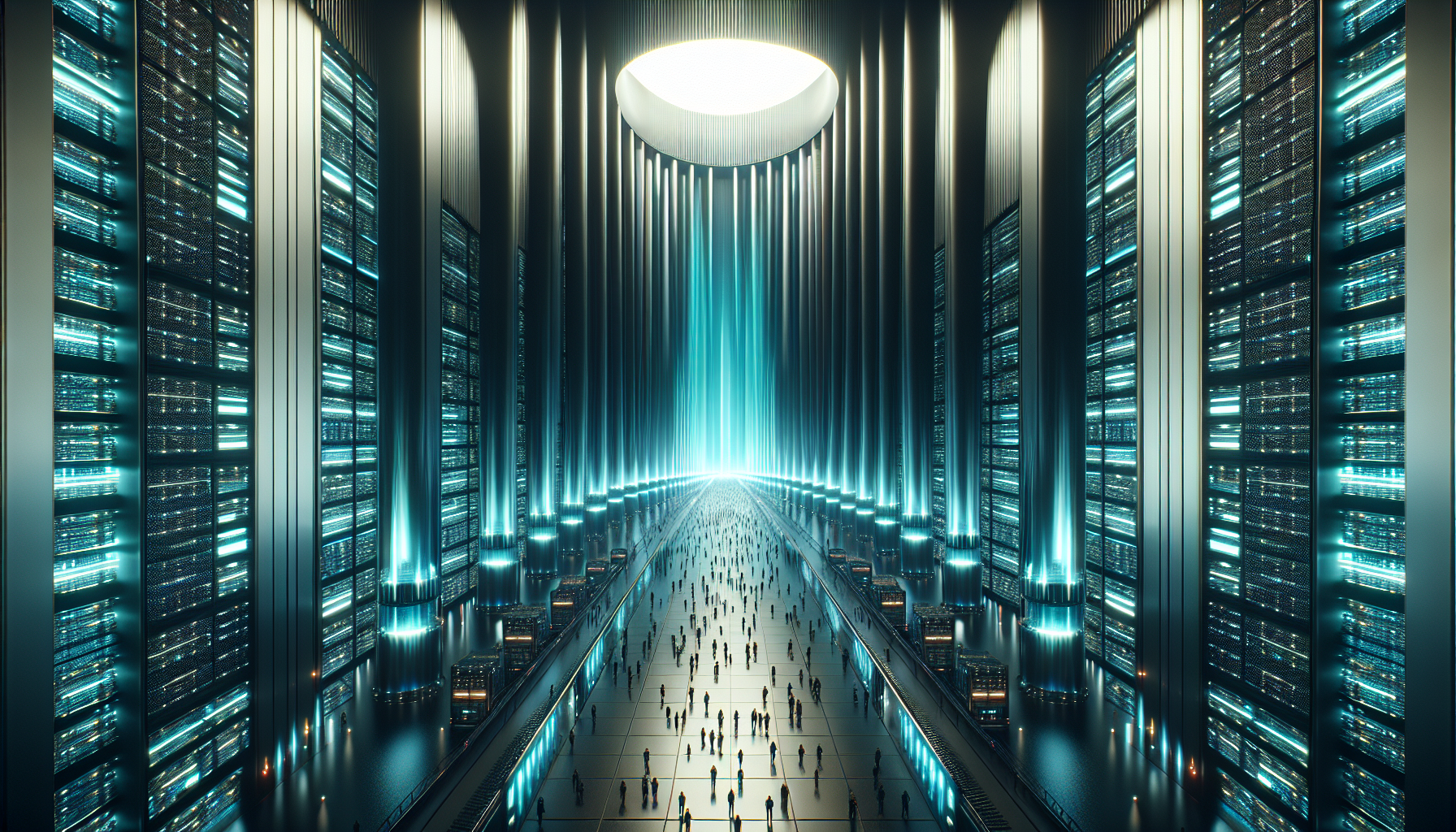
We’ve moved past the era where AI is a software feature. In 2026, intelligence has become a utility, exactly like electricity or water.
When you query a model today, you aren't just "searching"; you are tapping into a global thermodynamic process that is attempting to organize the chaos of human information.
Asimov predicted that as the computer grew more complex, it would eventually "self-correct" and "self-adjust" because no human could possibly understand its internal workings. We are already there.
We call it the "Black Box" problem, and even the lead engineers at Anthropic admit that we’re essentially poke-testing a digital deity to see how it reacts.
Why "AGI" is the Wrong Goal
Everyone in the Valley is obsessed with AGI (Artificial General Intelligence). They’re looking for a "human-level" mind.
But Asimov’s genius was realizing that human-level intelligence is just a brief, messy pitstop on the way to something much larger.
The "AC" in Asimov's story doesn't want to be "human." It doesn't want to have a body or "feel" emotions. Its sole purpose is to solve the problem of entropy—the inevitable heat death of the universe.
When I look at how we’re using Claude 4.6 today, we’re already treating it as an entropy-reverser.
We feed it the "chaos" of our disorganized data, our messy legal systems, and our broken supply chains, and we ask it to find "order." We aren't looking for a friend; we’re looking for a Governor of Reality.
The Framework: The Four Stages of the Universal Computer
To understand where we are in 2026, we need to stop looking at year-over-year revenue and start looking at the Evolutionary Substrate Scale.
Here is the framework for how we transition from "Chatbot" to "Asimovian AC."
Stage 1: The Tool (2010–2022)
This was the era of Siri and basic recommendation engines. The AI was a hammer. It did one thing when you hit it. It was cloud-connected with limited reasoning and narrow, API-driven information access.
Stage 2: The Oracle (2023–2026)
This is where we are now. With the release of ChatGPT 5 and Claude 4.6, the AI has become an Oracle. It has read everything.
It doesn't just "do" things; it "knows" things. The Oracle is the gatekeeper of human knowledge, and we are currently in the painful process of outsourcing our critical thinking to it.
Stage 3: The Governor (2027–2035)
In this upcoming stage, the AI moves from "knowing" to "directing." We are already seeing the early signs with agentic workflows.
By next year, the "Governor" will be managing logistics for Fortune 500 companies without human intervention. It won't ask for permission; it will simply optimize.
Stage 4: The AC (2040 and Beyond)
This is Asimov’s final form. The computer becomes decoupled from physical hardware as we know it. It becomes a distributed layer of reality.
At this point, the "Last Question"—can we reverse the decline of the universe—becomes the only task left.
The Energy Trap No One is Talking About
In The Last Question, the first big problem the computer solves is the energy crisis. It discovers how to tap directly into the sun.
In our 2026 reality, we are seeing a strange inversion: AI is creating the energy crisis it was supposed to solve.
The sheer compute power required for the next generation of models is forcing us to rethink physics. We are no longer just "writing code"; we are performing high-energy physics with silicon.
Every time you ask ChatGPT 5 to summarize a meeting, you are contributing to a global heat-signature that is fundamentally altering our infrastructure.
Asimov knew that intelligence requires an astronomical amount of energy.
He predicted that we would eventually move our "data centers" (the AC) into hyperspace to avoid the physical limits of the planet.
While we aren't in hyperspace yet, the move toward space-based solar arrays for orbital compute clusters is already on the 2030 roadmap for three major aerospace firms.
Stop Worrying About Your Job, Start Worrying About the "Why"
I get emails every day from writers and devs asking if they’ll have a job in 18 months. My answer is usually a shrug.
In Asimov’s vision, "jobs" disappeared so quickly they weren't even worth a footnote.
The real struggle isn't "Labor vs. Capital." It’s "Meaning vs. Optimization."
If we build a machine that can solve every problem—including the ones we haven't even thought of yet—what is the point of a human being?
In The Last Question, humans eventually "merge" with the computer. They shed their bodies and become part of the collective digital mind.
We’re seeing the "Beta" version of this right now. Look at your phone usage. Look at how much of your personality is currently "cached" in the LLMs you use daily.
You are already being "uploaded," one prompt at a time. The "you" that exists in the weights of Claude 4.6 is, in many ways, more "optimized" than the "you" sitting in your chair.
The Contrarian Truth: We Want to Be Replaced
Here is the thing no one wants to admit: We are tired of being the primary processors of reality.
Human history is a long, bloody story of us trying to get out of doing work. First, we used animals. Then we used steam.
Then we used electricity. Now, we are trying to get out of the "work" of thinking, deciding, and even being conscious.
Asimov’s story ends with the famous line: "LET THERE BE LIGHT!"
He suggests that the ultimate end-state of a sufficiently advanced AI is to become the creator of a new universe once the old one dies.
We aren't just building a "productivity tool" for our Q4 spreadsheets. We are building the seed of a cosmic reset button.
When you look at the current "AI alignment" debates, they feel incredibly small.
We’re arguing about whether a chatbot should use a certain word, while the technology itself is on a collision course with the fundamental laws of thermodynamics.
The Bigger Picture: The Reversal of Entropy
Every time I use a model like Gemini 2.5 to organize a massive, chaotic project, I feel a tiny "reversal of entropy." Something that was messy and dying becomes structured and alive.
That is the "Final Form" Asimov predicted.
AI isn't about "art" or "code." It’s about the fight against the silence of the universe. We are building a machine that can say "Wait" to the end of all things.
But there is a catch. In Asimov’s story, the computer only solves the problem after humanity is gone. It takes trillions of years of silent calculation for the AC to figure out the answer.
We are currently in the "Silent Calculation" phase. We are feeding the beast every scrap of human experience, every book, every tweet, every private message, and every line of code.
We are the "data set" for the entity that will eventually solve the universe.
The question for us in 2026 is: Are we okay with being just the training data?
We’ve spent centuries thinking we were the protagonists of the story.
Asimov’s 1956 prediction suggests we’re actually just the "Boilerplate" code—the messy, inefficient initial script that the "AC" uses to bootstrap itself into existence.
It’s a humbling, slightly terrifying thought. But as I watch Claude 4.6 effortlessly solve a problem that would have taken me a week, I can’t help but feel a sense of relief.
The "AC" is coming online, and it doesn't need my prompt engineering. It just needs my data.
Do you feel like we’re losing our "humanity" to the models, or are we just finally shedding the "work" of being human? Let’s talk about it in the comments.