Anthropic and OpenAI Just Quietly Won. It’s More Uncomfortable Than You Think.

Bottom line: After years of volatile hype, OpenAI and Anthropic have definitively achieved product-market fit in the developer ecosystem by transforming their models from chat novelties into invisible, indispensable infrastructure.
The deep integration of ChatGPT 5 and Claude 4.6 into our daily workflows has quietly commoditized baseline coding tasks, shifting our primary value from syntax generation to system orchestration.
This transition is deeply uncomfortable because it forces us to confront a reality where our technical edge is no longer how fast we write code, but how well we guide the systems that write it for us.
I opened a blank Python file yesterday to write a standard data transformation pipeline, and for the first time in my career, I felt a wave of genuine hesitation.
Not because the task was hard, but because the muscle memory of typing `import pandas as pd` manually felt completely obsolete and wildly inefficient.
Instead, I hit a keyboard shortcut in Cursor, explained the target schema to Claude 4.6 in plain English, and watched 300 lines of robust, error-handled code materialize in seconds.
That was the exact moment I realized the war for developer AI was over. OpenAI and Anthropic didn't just win a benchmark test; they rewired our fundamental approach to problem-solving.
Admitting exactly how dependent we've become on these proprietary models feels incredibly uncomfortable for anyone who spent a decade mastering this craft.
The Transition from Magic to Invisible Utility
Back in 2023 and 2024, using AI for software development felt like performing an impressive but fragile parlor trick.
We would coax early models into writing a basic script, celebrate when the code compiled on the first try, and forgive the AI when it inevitably hallucinated an entire software library.
We treated these chatbots as impressive but unreliable interns that required constant, meticulous supervision to produce anything of actual value.
Today, in the middle of 2026, the landscape looks entirely different because the friction has been systematically eliminated.
We aren't asking ChatGPT 5 to write isolated functions in a web browser; we are feeding it entire monolithic repositories and asking it to execute cross-cutting architectural refactors.
When Claude 4.6 processes a massive, undocumented API specification and instantly generates the exact integration layer we need, we barely even pause to appreciate it.
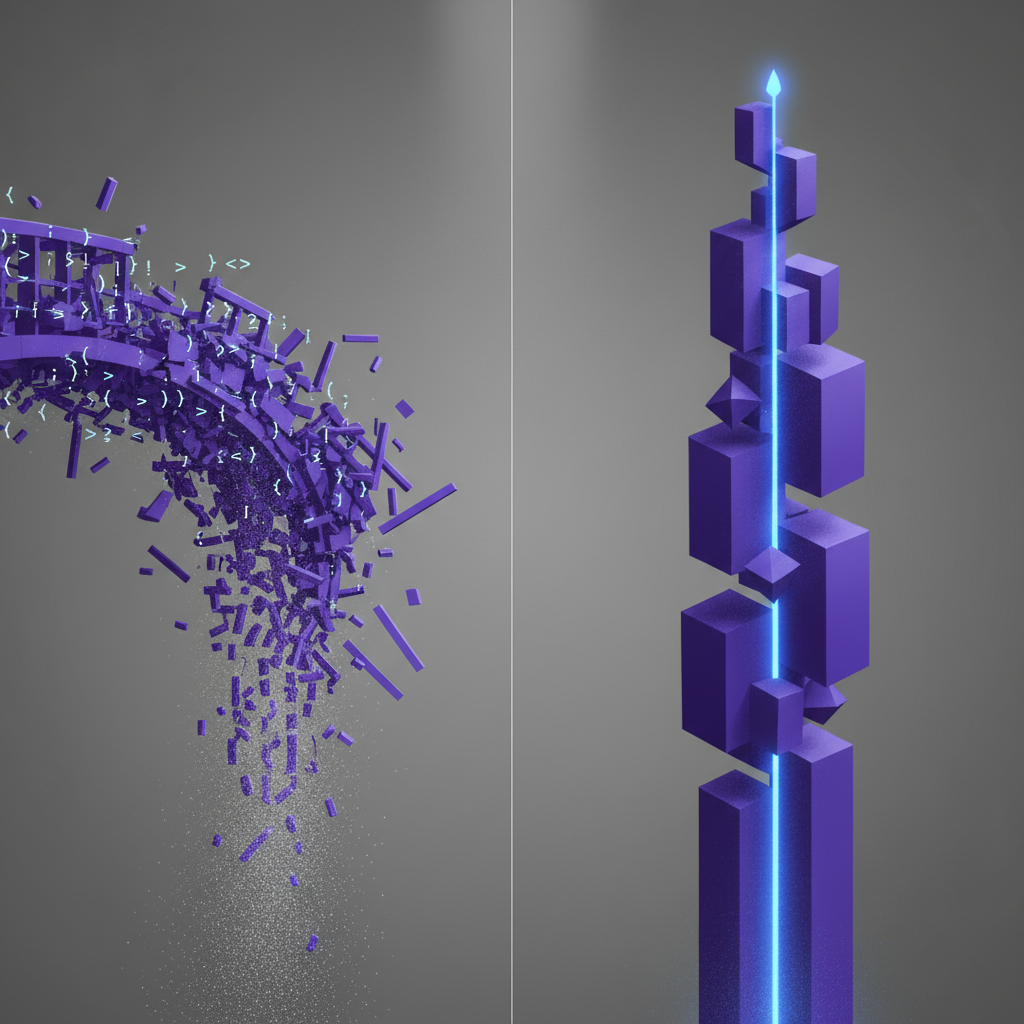
This rapid normalization is the ultimate, undeniable proof of true product-market fit.
We no longer view these tools as optional novelties; we treat them as critical utility infrastructure, much like DNS or a cloud provider.
When an AI service experiences an outage today, entire engineering teams effectively grind to a halt because the baseline expectation for our daily output has permanently shifted.
A Humbling Project Post-Mortem
To understand why this is so deeply unsettling, I have to confess how a recent migration project completely crushed my professional ego.
Last month, I was tasked with migrating a sluggish, legacy Node.js microservice to Rust to resolve a persistent memory leak.
I confidently set aside three weeks in Jira, intending to do the work the "right" way by manually rewriting and optimizing every endpoint.
After struggling for two days with Rust's borrow checker and complex lifetime annotations, my frustration peaked and I dumped the entire legacy service into a massive Claude 4.6 context window.
I wrote a detailed architectural prompt explaining the desired performance characteristics, hit enter, and walked away to grab a coffee.
In under four hours, the AI had rewritten the entire service, generated comprehensive test coverage, and even drafted the updated CI/CD pipeline configuration.
I felt completely deflated staring at the flawless, highly optimized output on my monitor.
The project was a massive success for the business, but my personal contribution felt entirely clerical and hollow.
For those four hours, I was essentially a meat-based API gateway translating Jira tickets for Anthropic's servers, and it made me seriously question what my actual value was to the company.
The Moat We Thought We Had
For decades, software engineers enjoyed a unique, elevated status as the specialized translators between abstract human intent and rigid machine execution.
Our industry value was deeply tied to our mastery of syntax, our encyclopedic knowledge of obscure design patterns, and our cognitive ability to hold complex logical states in our heads.
We built incredibly lucrative careers on the foundational premise that writing code was inherently difficult, scarce, and required a human touch.
The uncomfortable truth about Anthropic and OpenAI's sweeping success is that they have successfully commoditized this translation layer.
They haven't replaced the discipline of software engineering, but they have absolutely pulverized the premium we used to place on rote implementation.
When an AI agent can autonomously navigate an undocumented legacy codebase, identify a subtle race condition, and submit a fully tested pull request, the market value of simply typing code drops precipitously close to zero.
This realization is triggering a massive identity crisis across the entire technology sector.
Senior engineers are quietly watching the junior developers they used to mentor leverage ChatGPT 5 to punch massively above their weight class and deliver senior-level architectural implementations.
We are all being aggressively forced up the abstraction ladder, and the air up here is surprisingly thin if you spent your entire career perfecting your vim macros.
The Illusion of Open Source Parity
Whenever I bring up this heavy reliance on proprietary AI, someone inevitably points to the thriving open-source ecosystem as our collective safety net.
The comforting argument is that we can always fall back on local, open-weights models if the API pricing gets too exploitative or the vendor lock-in becomes too severe.
While it is undeniably true that open source models have made incredible strides, this argument completely misses the reality of where modern enterprise work actually happens.
In fast-paced enterprise environments and high-velocity startups, absolutely nobody is running a local model on their laptop to handle their daily, heavy-lifting workloads.
The sheer computational context window required to ingest a modern corporate monorepo, combined with the extreme reasoning capabilities of Claude 4.6 and Gemini 2.5, creates an insurmountable gap.
Anthropic and OpenAI aren't just selling us intelligence; they are providing a cognitive infrastructure layer that is far too computationally expensive to replicate on local hardware.
We have traded the physical vendor lock-in of cloud infrastructure for the cognitive lock-in of proprietary reasoning engines. AWS and GCP host our applications and our databases, but Anthropic and OpenAI now effectively host a significant portion of our actual thought processes and problem-solving methodologies.
The Collapse of the Technical Interview
This uncomfortable shift is already having a chaotic, downstream effect on how we hire and evaluate engineering talent.
For the last decade, the standard technical interview was an aggressive test of LeetCode memorization and algorithmic trivia that had very little to do with actual day-to-day engineering.
We rigorously tested candidates on their ability to manually invert a binary tree or write an efficient sorting algorithm from memory on a white board.
In a world powered by Claude 4.6, testing a developer on algorithmic memorization is like testing an accountant on their ability to perform long division by hand.
The most forward-thinking engineering managers are actively throwing out their old coding challenges because they realize the skills that matter have fundamentally changed.
They are now conducting deep system design interviews, forcing candidates to explain how they would string together multiple AI agents to solve a complex, ambiguous business problem.
This shift in hiring is terrifying for developers who spent months grinding algorithmic puzzles to break into the industry.
The technical interview is no longer about proving you can write the code; it is about proving you know exactly what code the AI should write. If you can't architect the larger system and defend your security choices, no amount of raw syntax knowledge is going to save your job application.
The Economic Reality of Cognitive Offloading
The discomfort radiating through the developer community isn't just an existential crisis about our craftsmanship; it is rooted in cold, hard economic reality.
A senior software engineer in a major tech hub easily costs a company upwards of $200,000 a year in salary and benefits.
Meanwhile, processing a million tokens through the Claude 4.6 API costs a fraction of what that engineer makes in a single hour of work.
Smart companies are rapidly realizing that they no longer need a sprawling team of ten developers to build and maintain a standard CRUD application.
Instead, they need two exceptional, highly technical architects who are masterful at orchestrating multiple AI agents to do the heavy lifting.
The middle tier of software development—the solid, dependable implementers who just want to grab a ticket, write some code, and log off—are suddenly the most vulnerable demographic in tech.
This doesn't mean the end of software jobs, but it does mean a brutal recalibration of what those jobs look like.
The companies paying our salaries have realized that generating code is no longer the bottleneck in software delivery.
The bottleneck is now deciding what to build, ensuring it is secure, and validating that it actually solves the user's core problem.
Surviving the Orchestration Era
So, how exactly do we navigate and survive an industry where two dominant AI companies have permanently altered our daily workflows?
First, we have to aggressively stop defining ourselves by the raw volume of code we type, and start defining ourselves by the complex systems we can design.
The developers who are currently thriving are treating AI not as a competitive threat, but as an infinitely scalable compiler for their high-level ideas.
Your new technical edge must be entirely based on deep product sense, robust system architecture, and rigorous validation practices.
You need to become an absolute expert at defining strict security boundaries, designing resilient data models that can scale, and orchestrating massive AI systems to execute the granular details.
The future unequivocally belongs to the engineers who can look at a messy business problem, break it down into logical primitives, and flawlessly manage the AI agents that write the actual syntax.
We have to consciously let go of the deep-seated ego attached to being the sole, brilliant author of every single line of code in our repositories.
Embracing this new reality means accepting that our job descriptions have permanently evolved, and that we are now rigorous reviewers and strategic editors in a world where AI is the primary writer.

The Unspoken Vulnerability
I still occasionally catch myself writing basic utility functions entirely from scratch, purely out of stubborn pride and a desire to feel useful.
It feels undeniably good to know the exact syntax by heart, to feel the familiar rhythm of the keyboard without waiting for a streaming API response to finish.
But every time I indulge in this, I know deep down I am wasting valuable time that could be spent solving actual, complex user problems.
The product-market fit of OpenAI and Anthropic in the developer space is absolute, and it has violently stripped away the comforting illusions we held about our own irreplaceable brilliance.
We are standing directly on the edge of the most significant shift in knowledge work since the invention of the high-level compiler, and there is absolutely no going back to the blank canvas.
Have you noticed your own threshold for writing boilerplate completely disappearing over the last year, or are you still stubbornly fighting the urge to write everything by hand?
Let's talk in the comments.