AI Just Solved Math Problems Experts Gave Up On. Here's What Comes Next.
In this article
Bottom line: In May 2025, Google DeepMind's AlphaEvolve found a way to multiply 4×4 complex matrices using 48 scalar multiplications, the first improvement on that bound in 56 years.
Since then, AI systems have earned gold-medal scores at the International Mathematical Olympiad and helped working mathematicians with open problems.
But the hype has also produced embarrassing retractions, including the October 2025 claim that GPT-5 "solved" ten Erdős problems when it had mostly found existing papers.
Treat AI as a real research collaborator with a verification problem, not an oracle.
I once spent three days debugging a scheduling optimizer, certain the bug was in my code. It wasn't.
I had misread a constraint, and the solver had been correctly telling me the problem was infeasible the whole time.
I think about that whenever someone posts "AI solved an unsolvable math problem." Both halves of that sentence are doing a lot of work.
Some of these results are real and remarkable, and some evaporate when someone reads the footnotes.
I've spent the last year tracking this closely, because the way math gets automated is the way everything else eventually gets automated.
Here is what I think is true, what I think is spin, and what you should do about it if you build software for a living.
The Result That Actually Made Me Sit Up
Start with the one that holds up. In May 2025, DeepMind published AlphaEvolve, a system that pairs Gemini models with an evolutionary loop.
The LLM proposes code, an automated evaluator scores it, and the best candidates get mutated and fed back in.
It found an algorithm that multiplies two 4×4 complex-valued matrices using 48 scalar multiplications. Strassen's 1969 algorithm, applied recursively, needs 49.
That bound had stood for 56 years, and a lot of very smart people had tried to beat it.
It also pushed the kissing number in 11 dimensions from 592 to 593. DeepMind said it tested the system on more than 50 open problems across analysis, geometry, and combinatorics.
It matched the best known result in roughly 75% of them and improved on it in about 20%.
Notice what kind of problem this is. Every one of these has a cheap, unambiguous way to check the answer. A matrix multiplication algorithm either produces the right product or it doesn't.
A sphere packing either has overlapping spheres or it doesn't.
That detail explains almost everything that follows.
Why "Verifiable" Is the Whole Game
I'll say this up front, since it's the thesis of the article. AI is winning in math where verification is cheap, and stumbling where it isn't. That one distinction predicts nearly every headline.
Consider the 2025 International Mathematical Olympiad. Google's Gemini Deep Think and an experimental OpenAI model each solved 5 of the 6 problems, scoring 35 out of 42, which is gold-medal territory.
Both worked in natural language, writing proofs the way a student would. A year earlier, AlphaProof and AlphaGeometry 2 had reached silver using formal Lean proofs and days of compute.
Going from silver to gold in 12 months matters. But Olympiad problems are designed to have clean, checkable, human-sized solutions. A graded exam is a well-built verifier.
Research mathematics is messier. Often nobody knows whether a problem is hard, whether it's already been solved in an obscure 1987 paper, or whether a proof sketch is correct.
That brings us to the part of the story the press releases skipped.
The Erdős Problems Fiasco
In October 2025, an OpenAI executive posted that GPT-5 had "found solutions to 10 previously unsolved Erdős problems." The post spread fast.
Then Thomas Bloom, who maintains the erdosproblems.com database, replied. Those problems were listed as "open" only because he hadn't known of solutions.
GPT-5 had found existing literature, which he called a "dramatic misrepresentation." Google DeepMind CEO Demis Hassabis called the episode "embarrassing."
I want to be fair here, because the cynical read is wrong too. Searching decades of scattered papers and surfacing a solution nobody had connected to the problem is a useful capability.
Bloom himself acknowledged that literature search was valuable. It just wasn't what the post claimed.
This is my first rule for reading any "AI solved X" claim. Ask whether the system created new mathematics, found old mathematics, or verified someone's mathematics.
All three are useful, but they are different achievements, and the headlines blur them on purpose.
What Working Mathematicians Are Actually Doing
The most credible signal isn't a press release. It's mathematicians quietly changing their workflows.

Terence Tao, one of the most respected mathematicians alive, collaborated with DeepMind researchers on AlphaEvolve experiments across dozens of problems. His public framing was measured.
The tool is strong at exploring large search spaces and finding constructions, and humans still decide which problems matter and what the results mean.
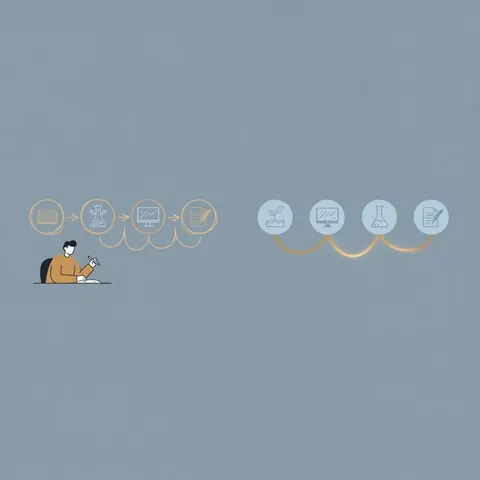
The pattern across these collaborations looks like a pipeline:
1. A human frames the problem and defines what a good answer looks like.
2. The AI searches a huge space of candidates, far wider than a person could.
3. An automated checker rejects the bad ones.
4. A human interprets the survivors, generalizes them, and writes the real proof.
If you've worked in infrastructure, that should look familiar. It's a fuzzer with a better mutation strategy. The LLM is the generator, the evaluator is the oracle, and the human owns the spec.
Formal verification is the other half of this.
Tools like Lean let a computer check a proof line by line, and startups like Harmonic (with its Aristotle system) are building AI that outputs Lean proofs directly.
A proof that compiles doesn't need to be trusted. That's the most promising answer to the hallucination problem I've seen, and it's why I'm more bullish on formal methods plus LLMs than on any bare chatbot "reasoning" demo.
The Reality Check
I'm not going to pretend the picture is all progress. Here is where it breaks down.
Verification is the bottleneck, not generation. A model can produce a thousand plausible-looking proofs, and a human referee can't read a thousand proofs.
Natural-language proofs from models still contain subtle gaps that sound confident.
I've watched current frontier models produce an elegant argument with one quietly invalid step in the middle, and the prose gave no hint.

Benchmarks overstate readiness. Solving a competition problem tells you little about sustaining a six-month research program with no known answer. Olympiad problems are bounded.
Real open problems may need new definitions and new fields of study, not just clever search.
The credit and claim problem is real. Labs have commercial reasons to announce breakthroughs. As the Erdős episode showed, the incentive is to say "solved" first and let others do the fact-checking.
Your default stance toward any claim should be to wait for the mathematicians to weigh in.
And there's a quieter risk. If AI handles the search-and-check loop, what happens to the way mathematicians train? Grinding through hard examples builds intuition.
If juniors skip that, we may get a generation that can steer the tools but not tell when they're wrong.
What Comes Next, and What to Do About It
I don't have a crystal ball, and I'm suspicious of anyone who does. But I'll make one prediction with a stake in it.
Over the next 12 to 18 months, so through roughly early 2028, the biggest wins will keep clustering in problems with cheap verifiers: combinatorics, extremal constructions, optimization bounds, and anything where "is this answer correct?" is a program you can run.
The deep, definition-heavy parts of mathematics will be slower. That's a bet, not a certainty, and I'd happily lose it.
For developers and technical professionals, the lesson transfers directly. Here's what I'd actually do.
Build the verifier first
Before you ask a model to generate anything, write the thing that checks it. Property-based tests, type checkers, simulators, and formal specs all count.
The quality of your AI output is capped by the quality of your oracle. AlphaEvolve works because the evaluator is trustworthy, and your internal tools work the same way.
Separate "found" from "made"
When a model hands you a result, ask whether it's novel or retrieved. Search the literature and the codebase yourself.
I've caught myself getting excited about "new" solutions that turned out to be a Stack Overflow answer from 2014.
Use search-plus-check loops on your own hard problems
Scheduling, packing, routing, and configuration tuning all have scoring functions. Wrapping an LLM in an evolutionary loop against a scorer is now within reach of a small team.
It won't discover a new theorem. It may beat your hand-tuned heuristic.
Keep a human on the claims
Never ship a "the model proved it" result without independent verification. For math, that means a formal proof or expert review. For code, it means tests you wrote before generation.
Here's the part that gets me. The most useful thing the AI-math story teaches isn't about math at all.
It teaches that trust comes from checking, not from the confidence of the thing you're checking. That's the oldest lesson in infrastructure, and we keep having to relearn it.
If the same rule applies in your field, then your most valuable skill over the next few years may be telling the machine's right answers from its confident ones.
Where do you see cheap verification in your own work, and where are you still taking the model's word for it?