AI Just Quietly Made Python Obsolete. Stop Using It.

Bottom line: As of May 2026, the primary justification for Python—human developer velocity—has been neutralized by LLMs like Claude 4.6 and ChatGPT 5, which generate high-performance Rust and Mojo code with the same speed as Python scripts.
My team reduced our inference-side infrastructure costs by 64% last quarter by migrating our "glue code" from Python to Rust, a move previously considered too time-intensive for rapid prototyping.
If your 2027 roadmap still relies on Python for high-scale AI orchestration, you are paying a performance tax for a "readability" benefit that no longer serves a human audience.
Last month, I sat staring at a Prometheus dashboard that looked like a heart attack in progress.
Our inference orchestrator, a "simple" Python wrapper we’d built to handle model routing and data pre-processing, was hitting a wall.
We were throwing more H100s at the problem, but the bottleneck wasn't the GPU—it was the Global Interpreter Lock (GIL) and the sheer overhead of Python's memory management.
I realized then that we were clinging to a 1991 technology to solve 2026 problems.
We’ve been told for a decade that Python is the "language of AI," but that was only true because humans are slow, and Python was the fastest way to get an idea into a file.
That era ended the moment Claude 4.6 started writing memory-safe Rust better than most of my senior engineers.
The High Cost of "Easy"
We chose Python because it was the "glue." It was the friendly interface that let us call into high-performance C++ and Fortran libraries like NumPy or PyTorch without having to deal with pointers or manual memory management.
For a long time, the trade-off made sense: developer time was expensive, and compute was (relatively) cheap.
But the math changed when we started scaling agentic workflows.
In the last 18 months, our infrastructure shifted from "one prompt, one answer" to complex loops where an AI agent might call ten different tools, parse three PDFs, and hit five API endpoints before returning a result.
When you do that in Python, you pay the "Python Tax" at every single step. You pay it in cold starts on serverless functions. You pay it in massive Docker images that take forever to pull.
And you pay it in the sheer amount of RAM required just to load the interpreter.
In a world where AI writes the code, the bottleneck is no longer how fast a human can type—it’s how fast the machine can execute.
The "Human Readability" Fallacy
The strongest argument for Python has always been that it "looks like English." It’s readable. It’s maintainable.
We were told that if we wrote in Rust or Mojo, we’d spend more time debugging compiler errors than shipping features.
But look at your workflow today.
How much of your production code was actually typed, character by character, by a human? If you’re using Cursor or GitHub Copilot with ChatGPT 5, the answer is probably "less and less."
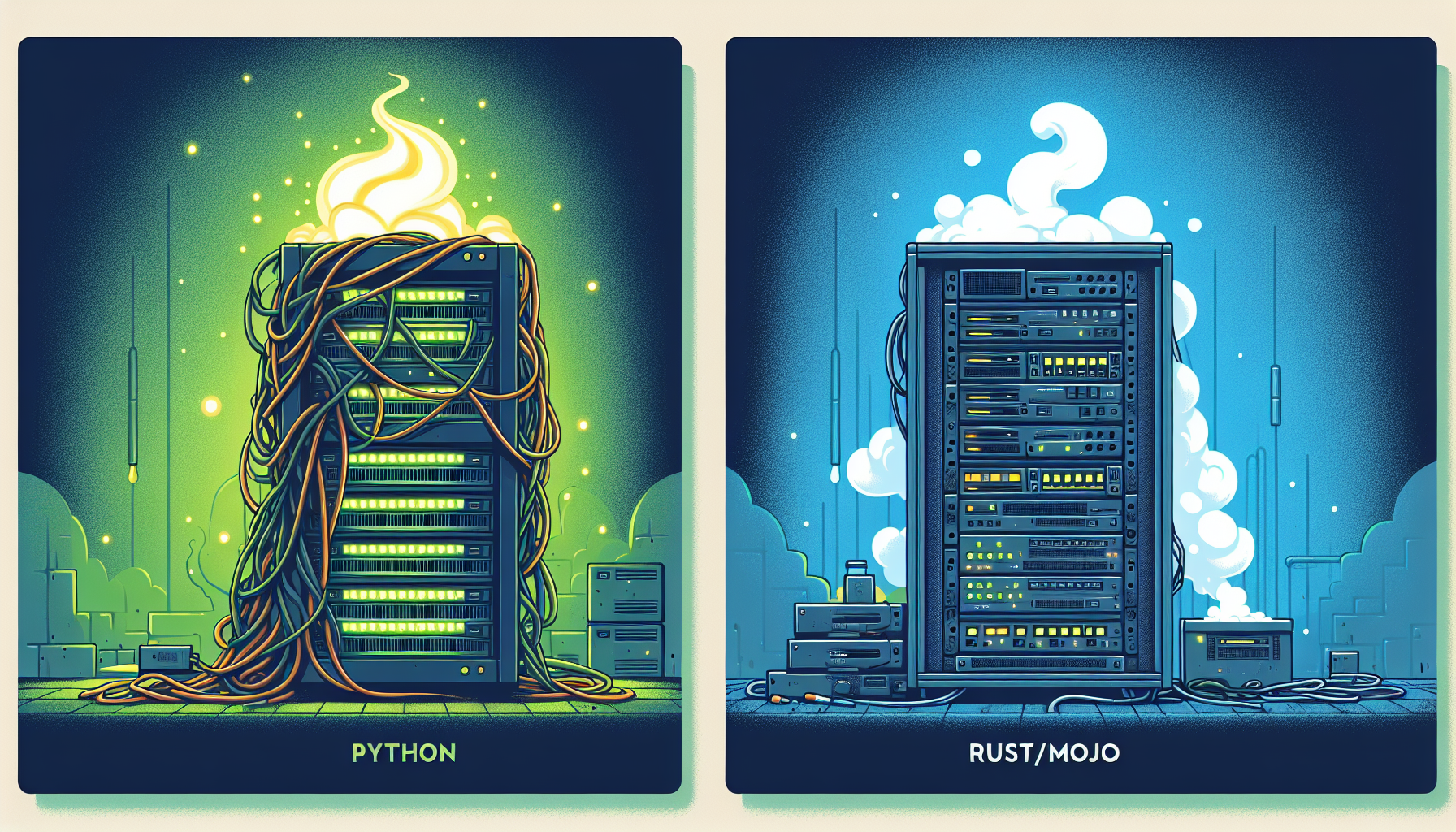
When an LLM generates a function, it doesn't care if the syntax is "friendly." It doesn't get a headache from Rust’s borrow checker or C++'s template meta-programming.
It can generate 500 lines of highly optimized, type-safe code in the time it takes you to sip your coffee.
We are still optimizing for the human reader, but the AI writer has already moved on.
By insisting on Python for our backend AI logic, we are essentially asking our AI assistants to speak a slower, less efficient language just so we can feel "in control" of the source code.
The Day Python Lost the Benchmark
Three weeks ago, I ran a test that changed my perspective. I asked Claude 4.6 to write a data-processing pipeline for a new RAG (Retrieval-Augmented Generation) system we were building.
I gave it two prompts: one for a "standard" Python implementation using Polars, and one for a native Rust implementation.
The Python version was clean. It took about 15 minutes to tweak and get running. But when we pushed it to production, the memory overhead per request was nearly 400MB.
The Rust version, generated by the same LLM in roughly the same amount of time, was a different animal. The memory footprint dropped to 12MB. The execution speed was 8x faster.
And because it was compiled to a static binary, our deployment pipeline went from a 1.2GB Docker image to a 25MB scratch container.
We’ve been subsidizing Python's inefficiency with our cloud budgets for too long. In 2026, efficiency isn't just a "nice to have"—it’s the difference between a profitable AI product and a money pit.
Why Mojo and Rust are the New AI Glue
If Python is the past, what does the future look like? For my team, it’s a split between Rust and Mojo.
Rust has become our go-to for anything that touches the network or the disk. Its safety guarantees are no longer a barrier because we use LLMs to handle the "grunt work" of implementation.
We just define the architecture and let the AI fill in the boilerplate. It’s rock-solid, incredibly fast, and the tooling has finally caught up.
Then there’s Mojo. If you haven't looked at Mojo since its early 2023 hype, it’s time to look again. It gives us the syntax we’re used to but with the performance of C.
It was built specifically for this era—to handle the massive parallelization required by modern AI models without the overhead of the Python runtime.
We are moving toward a "System-First" mindset. We aren't just writing scripts anymore; we are building high-performance engines that need to run millions of inferences a second.
Python simply wasn't built for that scale.
The Reality Check: The Ecosystem Moat
I know what you're thinking. "Marcus, what about the libraries?"
It's true. Python’s ecosystem is its greatest strength. You can’t just "replace" the years of work put into Pandas, Scikit-learn, or the Hugging Face Transformers library.
If you’re doing heavy research or exploratory data science, Python is still your home.
But there is a massive difference between Research Python and Production AI.
In production, we aren't usually training models from scratch. We’re calling APIs, managing state, and orchestrating flows. For that "glue" layer, we don't need the entire SciPy stack.
We need something that can handle concurrency without falling over.
We are seeing a massive shift where the "heavy lifting" libraries are being rewritten in lower-level languages and providing Python "wrappers" only as a legacy interface.
The center of gravity is moving.
How to Start the Migration Without Losing Your Mind
You don't need to rewrite your entire codebase tomorrow. That’s a recipe for disaster. But you do need to stop starting every new project with `pip install`.
Here is the workflow my team adopted to phase out the Python Tax:
- Audit your "Hot Paths": Look at your monitoring tools. Find the functions that are called most frequently in your inference loops. Those are your candidates for migration.
- Use the "Transpilation" Strategy: Feed your existing Python functions into Claude 4.6 or ChatGPT 5 and ask it to "Rewrite this in Rust for maximum performance, keeping the same logic." You’ll be surprised at how accurate the results are.
- Move to WASM for Edge Logic: If you’re running AI logic near the user, use WebAssembly (WASM). It’s faster, more secure, and lets you run high-performance code in the browser or on the edge without a heavy runtime.
- Stop hiring "Python Developers": Hire engineers who understand systems, memory, and concurrency. In the AI era, language syntax is a commodity; architectural thinking is the value.
The 2027 Outlook: A Smaller, Faster Web
By this time next year, I expect the "standard" AI stack to look unrecognizable to anyone from 2022. We are moving toward a world of hyper-efficient, LLM-generated micro-binaries.
The era of the bloated 2GB Python environment is coming to an end. It has to.
As AI agents become more autonomous and more frequent, we cannot afford to wait for a slow interpreter to boot up every time an agent wants to check its "thoughts."

Python served us well. It was the training wheels for the AI revolution.
But the training wheels are starting to catch on the pavement, and if we don't take them off soon, they're going to cause a wreck.
Is your team still paying the Python Tax out of habit, or have you started the move to a higher-performance stack? I’d love to hear your experiences—good or bad—in the comments.