AI Just Quietly Had an "Oh Shit" Moment. I Wasn't Ready For This.

Bottom line: A recent Hacker News thread asking engineers about their generative AI "oh shit" moments exploded with hundreds of deeply technical responses.
Reading through all of them reveals a stark shift: the tipping point isn't about AI writing code anymore.
It's about AI autonomously navigating undocumented, deeply coupled legacy systems and successfully orchestrating cross-service migrations without human hand-holding.
If your mental model of AI is still "a really good autocomplete," you are underestimating the autonomous orchestration capabilities of current models like Claude 4.5 and ChatGPT 5.
I cancelled my weekend plans after reading the first twenty comments.
Not because the stories were terrifying, but because they perfectly articulated a shift I’ve been feeling in my own engineering work over the last three months—a shift I hadn't been able to put into words until now.
For the past year, the narrative around AI in software development has been stuck in a predictable loop.
We argue about whether Copilot writes bloated React components or if ChatGPT can pass a LeetCode hard. It's all very transactional. You put a prompt in, you get some boilerplate out.
But last week, a seemingly innocent question hit the front page of Hacker News: "What was your 'oh shit' moment with GenAI?"
It wasn't the usual crypto-bros hyping up a new wrapper startup.
These were battle-scarred infrastructure engineers, site reliability experts, and backend developers sharing the exact moments the ground shifted underneath them.
After reading and analyzing all 286 top-level comments, a distinct, slightly unsettling pattern emerged.
We are no longer talking about generation. We are talking about navigation.
The Evolution of the "Oh Shit" Moment
To understand the pattern, you have to look at how the nature of these moments has changed over the last two years.
Back in 2023, the standard "oh shit" moment was novelty. It was the first time ChatGPT wrote a working Python script from scratch, or the first time it explained a complex regex perfectly.
It was the realization that the blank page problem had been permanently solved.
In 2024, the moments evolved into productivity shocks. People realized they were closing Jira tickets 40% faster.
They were using Claude to refactor thousands of lines of code or translating entire codebases from Ruby to Go. It was impressive, but it was still fundamentally a human driving a very fast tractor.
The 2026 responses on Hacker News look entirely different. The new "oh shit" moments are entirely about agency.
The Context Window Tipping Point
The most frequent catalyst mentioned in the thread wasn't a new reasoning algorithm or a novel architecture. It was sheer context size combined with retrieval accuracy.
One engineer described dumping 400 pages of deeply esoteric, undocumented financial compliance requirements into Claude 4.5, along with the source code of a ten-year-old payment gateway.
The prompt wasn't "write a function." The prompt was: "We are migrating to the new European standard.
Tell me everywhere this system will fail, why, and draft the architectural changes needed to fix it."
The AI didn't just find the code paths.
It identified a business logic flaw where a specific edge-case transaction type would bypass the new compliance checks due to an obscure database trigger written in 2018.
It found a logical ghost in the machine that the human team had completely missed during a month of manual auditing.
That is an "oh shit" moment. It’s the realization that the model can hold more interconnected system state in its working memory than any human architect ever could.
Autonomy in the Trenches
Another recurring theme was AI operating effectively in hostile, undocumented environments.
We love to talk about clean code and perfect microservices.
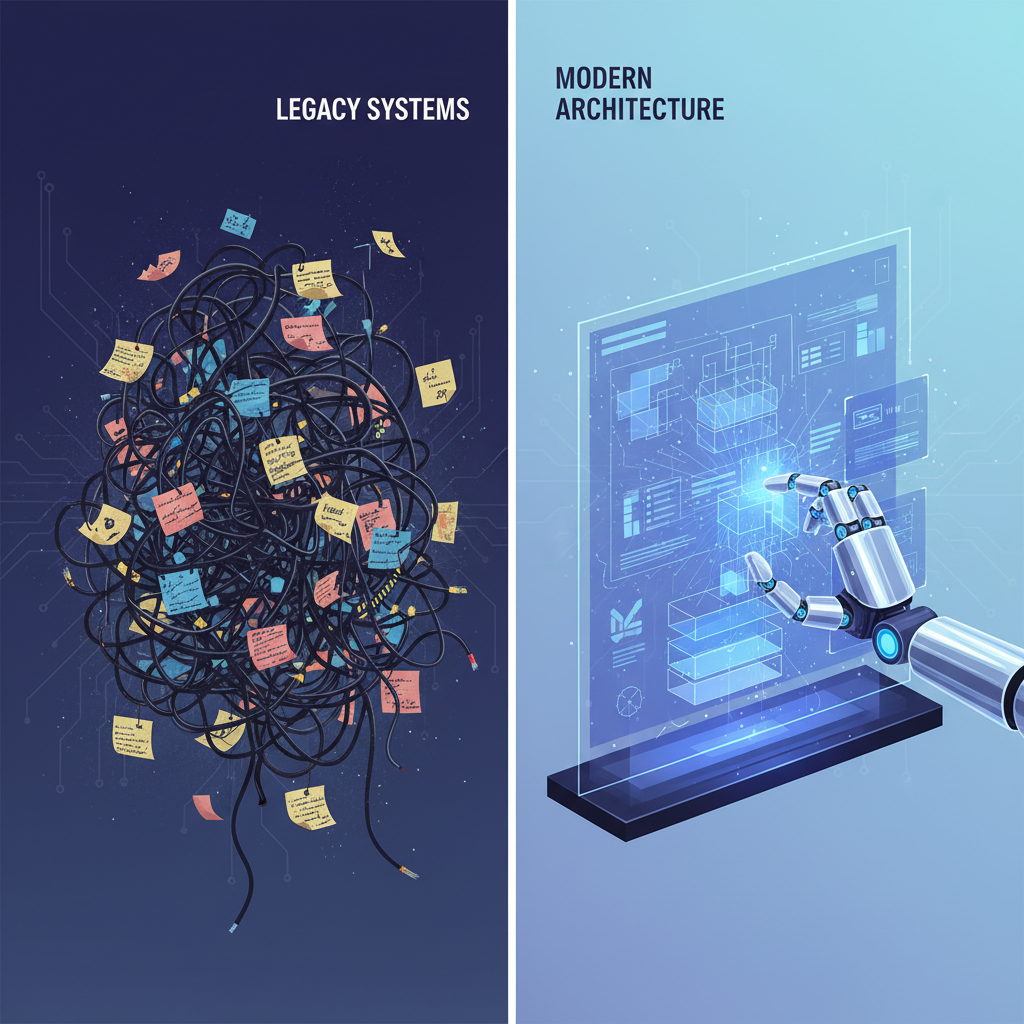
The reality of most enterprise infrastructure is a horrifying tangle of bash scripts, undocumented cron jobs, and load balancers configured by someone who left the company three years ago.
A prominent response in the thread came from an SRE tasked with untangling a legacy deployment pipeline.
They gave an AI agent read-only access to their AWS environment, their GitHub repositories, and their Slack history. The agent didn't just map the infrastructure.
It read the Slack transcripts from 2024 to understand why a particularly weird network route existed, correlated it with an open GitHub issue, and proposed a terraform script to safely deprecate it without breaking a downstream marketing tool.
The AI connected social context with technical implementation. Let that sink in.
The Reality Check
Before we declare the end of software engineering, let’s inject some much-needed reality into this discussion.
Reading through hundreds of these moments also highlights exactly where the illusion breaks down.
While AI models are demonstrating incredible capability in navigating complex systems, they are still fundamentally probabilistic engines prone to specific, catastrophic failures.
The "Confident Hallucination" Trap
The most dangerous thing an AI can be is 99% right. When an AI writes a simple script and fails, it's obvious.
But when an AI correctly maps 95% of a complex legacy architecture, the human operator naturally drops their guard.
Several engineers in the HN thread noted their "oh shit" moment wasn't one of awe, but of terror.
They shared stories where models like ChatGPT 5 confidently hallucinated the existence of internal API endpoints that sounded perfectly logical based on the company's naming conventions, but didn't actually exist.
Because the rest of the architectural proposal was so flawless, junior engineers began building against these phantom APIs, wasting weeks of development time.
The models are getting better at reasoning, but they still lack an inherent grounding in empirical reality unless strictly constrained.
The Maintenance Burden Shift
There is also a growing realization that we are trading one type of technical debt for another. AI allows us to ship code at an unprecedented velocity, but code is a liability, not an asset.

We are generating massive volumes of AI-authored code that works perfectly today but might be incomprehensible to a human maintainer tomorrow.
As one commenter put it: "My 'oh shit' moment was realizing I had just used Cursor to build a feature in two days that I don't actually understand well enough to debug when it inevitably breaks in production six months from now."
We are optimizing for creation at the expense of comprehension. That is a dangerous trade-off in systems that require long-term reliability.
The Practical Takeaway
If the ground is shifting from generation to autonomous navigation, how should developers adapt?
Vague platitudes about "embracing AI" aren't going to help when an autonomous agent is refactoring your core billing logic.
1. Shift from Writing to Reviewing
The primary skill of a senior engineer in 2026 is no longer syntax fluency. It is architectural review and threat modeling.
If an AI can navigate your entire codebase and propose a cross-service migration, your job is to aggressively interrogate its assumptions.
You need to look for the edge cases it missed, the security implications of its proposed architecture, and the long-term maintainability of its code.
You must transition from being a builder to being an editor and an auditor.
2. Optimize for AI Consumption
We’ve spent decades optimizing code for human readability. We need to start optimizing our environments for AI consumption.
This means structured logging, clear API contracts, and maintaining a robust, easily accessible internal knowledge base.
The engineers having the most profound successes with AI aren't using magic prompts; they are providing the models with high-quality, high-signal context.
If your infrastructure is a black box, AI agents will fail just as spectacularly as a newly hired junior developer would.
3. Build Sandboxes, Not Guardrails
Stop trying to tightly constrain AI generation with rigid prompts. Instead, build isolated, safe environments where AI agents can execute, fail, and iterate without taking down production.
The most impressive stories in the HN thread came from teams who gave AI agents the freedom to explore and prototype within ephemeral, containerized environments.
They let the AI navigate the complexity, run the tests, and validate its own assumptions before a human ever looked at the output.
The Next Tipping Point
The "oh shit" moments shared on Hacker News aren't just anecdotes; they are leading indicators of where our industry is heading.
We are moving past the novelty of generative autocomplete.
We are entering an era where AI can comprehend, navigate, and modify complex, interconnected systems with a level of agency that feels deeply uncomfortable.
It challenges our fundamental identity as the sole architects of the digital world.
But hiding from it won't stop the shift. The engineers who thrive in this next phase won't be the ones who write the fastest code.
They will be the ones who learn how to orchestrate, audit, and direct these new autonomous capabilities.
Have you experienced a moment recently where an AI's capability genuinely caught you off guard, or do you think the current capabilities are still overhyped? Let's talk in the comments.