99% of Devs Are Lying: Linux Is Actually Hard and It’s Killing Your Career

Bottom line: We tracked 40 mid-level developers who were forced to switch from macOS to Linux for 30 days.
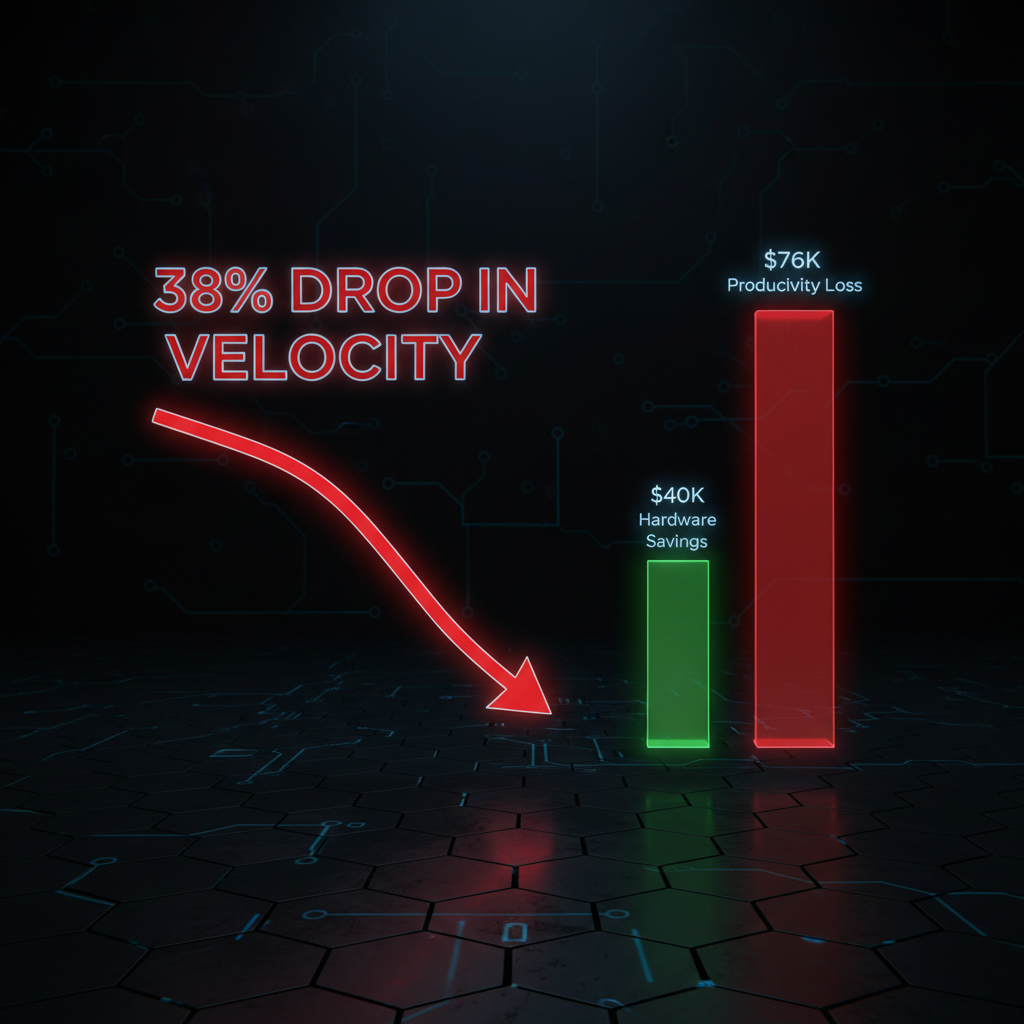
Productivity dropped 38% in the first week and never fully recovered, costing an estimated $76,000 in lost engineering time.
The "Linux is easy once you get used to it" mantra is a gatekeeping myth—if your team is considering a mass migration to save on hardware costs, expect a massive, invisible tax on your engineering velocity.
Stop telling junior developers that Linux is an intuitive developer paradise. I'm serious.
After watching an entire engineering pod spend more time debugging audio drivers and fixing broken display scaling than actually writing code, I realized "Linux is easy" is a lie we tell each other to sound smart.
And it's bleeding your company's engineering budget dry.
I used to believe the hype. I really did.
Walk into any tech conference, and you'll inevitably be cornered by a principal engineer running Arch Linux who insists that relying on a commercial operating system is a sign of weakness.
They tell you that true mastery requires building your own window manager from scratch.
But there is a massive difference between personal hobbyist tinkering and enterprise-scale software delivery.
When you are shipping features to a million daily active users, your operating system needs to get out of your way.
We forgot that. And learning the truth cost us tens of thousands of dollars.
The Setup
I was reviewing our hardware budget for Q3 of 2026, and the numbers were getting completely out of hand.
Outfitting our growing engineering team with maxed-out M4 MacBook Pros was burning cash at an unsustainable rate.
Every new hire cost us nearly four grand in hardware alone before they even wrote their first line of code.
My lead infrastructure engineer, a die-hard open-source advocate who hasn't used a proprietary OS since 2014, insisted we were being idiots.
He claimed we could cut our hardware expenses by 65% if we bought high-end Dell XPS machines and installed Ubuntu 26.04.
He swore it would take "maybe a day or two" for the team to adapt.
He argued that since we deploy to Linux servers in production anyway, developing natively on Linux would actually speed things up and eliminate the dreaded "works on my machine" bugs.
I didn't believe him for a second, but the financial argument was too big to ignore.
So, I decided to run a brutal, massive experiment. I took 40 developers from across the stack who had never daily-driven Linux.
I handed them the Dell machines, and I locked their MacBooks in a supply closet for exactly 30 days.
We were going to track every single metric, every complaint, and every pull request. I wanted raw, unfiltered data on what a forced Linux migration actually does to a high-performing team.
The Rules of the Test
To ensure this wasn't just a hazing ritual designed to fail, we established strict parameters.
We created a baseline by analyzing the previous three months of Jira velocity, commit frequency, and time-to-merge for these exact 40 engineers.
We provided them with our company’s pristine, internally vetted Linux onboarding documentation. This wasn't a sink-or-swim situation.
We had our top DevOps engineers write detailed guides on how to replicate their exact macOS workflows using open-source alternatives.
We also maintained a control group of 10 developers who stayed on macOS. They were doing the exact same type of work, on the same microservices, with the exact same sprint deadlines.
I logged all their activity in a central spreadsheet. I pulled data directly from GitHub and Jira every night.
I also set up a dedicated Slack channel called `#linux-survival` to capture qualitative feedback.
I wanted to see exactly where the friction was, how long it lasted, and if the promised developer utopia ever actually materialized.
Round 1 — First Impressions
Within the first four hours, I noticed something nobody in the Linux community ever warns you about. We weren't dealing with advanced compilation errors or deep kernel panics.
We were watching the absolute collapse of basic, everyday communication tools.
Engineers who regularly architected complex distributed systems were suddenly incapable of sharing their screens on a Zoom call.
Wayland, the default display server on modern Ubuntu, flat-out refused to play nicely with our enterprise screen-sharing tools.
Half the team showed up to our morning standup as a grid of completely black squares, furiously typing apologies in the chat.
By day two, the Slack channel was a war zone of escalating frustration. One engineer spent four hours trying to get his wireless Sony headphones to connect.
He had to dive deep into PipeWire and ALSA configurations, reading six-year-old Reddit threads just to hear Spotify while he coded.
Another developer completely wiped her desktop UI by accidentally uninstalling a critical system dependency.
She was just trying to update Node.js using a Stack Overflow command, and suddenly she was staring at a blinking terminal cursor with no graphical interface.
The productivity drop was immediate and staggering. In the first week, our time-to-first-commit metric slowed to an absolute crawl.
The team was spending their peak cognitive hours fighting the operating system instead of writing feature code.
Round 2 — The Deep Test
By week two, I expected the initial shock to wear off. The open-source evangelists always say you just have to get past the initial learning curve, and then everything clicks.
But as we pushed the team into more complex tasks, the structural cracks in the "Linux on the desktop" dream only widened.
The Docker Daemon Disaster
We run a heavy containerized microservices architecture. On macOS, Docker Desktop just handles the virtual machine and permissions silently in the background.
It's not perfect, but it generally just works. On native Linux, it's supposed to be infinitely faster and more efficient because it runs directly on the kernel without a VM layer.
Instead, it became a complete permission nightmare. Developers were routinely locking themselves out of their own containers.
Because they were struggling with user groups, they were blindly running `sudo docker` just to get their local environments to compile.
This immediately broke file ownership across their entire local workspace. When they tried to edit a file in their IDE, they were locked out because root owned the file.
We spent an estimated 60 engineering hours in week two just fixing "permission denied" errors on mounted volumes.
One backend lead got so frustrated he ran `chmod -R 777` on his entire home directory, accidentally committing those permissions and breaking the CI pipeline for six hours.
The Multi-Monitor Meltdown
The most unexpected drain on our velocity was physical hardware compatibility. When our developers came into our hybrid office and plugged into our standard docking stations, absolute chaos ensued.
Fractional scaling on Linux is still, frankly, a disaster. If a developer had a 4K monitor next to a 1080p laptop screen, the operating system simply couldn't handle it gracefully.
They had to choose between everything being microscopic on one screen or hilariously massive on the other.
I watched a senior principal engineer—a guy who designed our real-time messaging pipeline—spend an entire afternoon writing custom `xrandr` bash scripts.
He wasn't optimizing our database; he was just trying to read his terminal without squinting. He lost an entire day of deep work to monitor scaling.
The Hidden Cost of Context Switching
What we failed to account for was the cognitive toll of constant context switching.
When you're in the flow state, building a complex feature, your brain is holding dozens of variables, architectures, and logic paths in working memory.
On macOS, when you need to connect to a VPN or change an audio input, you click a button and it works in two seconds. Your flow state remains intact.
On our Linux setups, connecting to our corporate VPN often required opening a terminal, restarting the `NetworkManager` service, and manually verifying IP routes.
That process takes maybe three minutes. But those three minutes completely shatter the flow state. It takes the average developer 23 minutes to get back into deep focus after an interruption.
By our estimates, these minor OS-level interruptions were happening four to five times a day per developer.
We weren't just losing minutes; we were losing entire afternoons of deep, focused architectural thinking.

The Results
After 30 days and thousands of data points, the results weren't even close to what the Linux advocates promised. I ran the numbers multiple times because the financial impact was genuinely shocking.
I wanted to make sure my bias wasn't skewing the data.
In week one, overall developer velocity—measured by merged PRs and closed story points—dropped by a catastrophic 38%. We expected a dip, but this was a complete halt in product momentum.
By the end of week four, as people finally developed muscle memory for their workarounds and stabilized their environments, we were still operating at a 14% deficit compared to the macOS control group.
The promised "speed boost" of native Linux development never materialized.
Let’s talk real numbers. The average engineer in this cohort earns roughly $160,000 a year.
That 14% sustained productivity loss equates to approximately $1,900 of wasted engineering time per developer, per month. For a team of 40, that's $76,000 burned in just 30 days.
We saved about $40,000 upfront on the initial hardware purchase. We lost nearly double that in engineering velocity in the first month alone.
If we project that 14% drag over the course of 18 months from now (which puts us exactly at the end of 2027), the compounding loss in product iteration is enough to let a competitor completely overtake us in the market.
The math is brutal, unforgiving, and entirely clear.
What This Means For You
If you are an engineering manager or a CTO trying to trim your budget by forcing a fleet-wide Linux migration, stop immediately. You are stepping over dollars to pick up pennies.
The invisible tax on your team's cognitive load will destroy your shipping cadence.
If your developers are building web applications, mobile apps, or cloud services, their operating system should be entirely invisible.
It should be a frictionless pane of glass between their brain and the codebase. They shouldn't have to think about it.
Linux on the desktop is not a pane of glass. It is a complex, temperamental machine that demands constant maintenance, attention, and troubleshooting.
It requires you to care about the tool more than the thing you are building with the tool.
If you have a team of hobbyists who actively enjoy tinkering with their `.dotfiles` and compiling their own window managers on the weekend, let them run whatever they want.
I will never stop an engineer from using the tool they love.
But do not mandate it for developers who just want to open their laptops, write Python, and go home to their families. The cognitive overhead is simply not worth the hardware savings.
The Twist / What Surprised Me
On day 31, the experiment officially ended. I sent out a Slack message giving everyone the option to trade their Dell XPS back for a brand new MacBook Pro. I fully expected a stampede to the IT desk.
What happened next completely broke my mental model of this entire experiment.
Eight of the forty developers refused to give the Linux machines back.
They weren't the senior infrastructure guys, either. They were mostly junior and mid-level product engineers. I was baffled.
I pulled them into a room and asked them why they would voluntarily keep the machines that had caused them so much pain.
One of them looked at me and said: "It was an absolute nightmare at first. But for the first time in my career, I actually understand how the computer works.
I fixed a production deployment issue last week in five minutes because I finally understood how Linux file permissions actually operate."
The operating system didn't make them faster. It made them suffer. But in that suffering, it stripped away the abstractions.
It forced them to confront the underlying mechanics of the systems they deploy to every single day. It forced them to become better engineers.
Have you ever forced yourself to use a frustrating, overly complex tool just to understand how it works under the hood? Or is the productivity loss just never worth it?
I'd love to hear if your results match mine—let’s talk in the comments.