The Waymo World Model - A Developer's Story
The Waymo World Model: How Google's Self-Driving Cars Finally Learned to Think Like Humans
What if the secret to safe autonomous driving wasn't about having better sensors or faster processors, but about fundamentally reimagining how machines understand the chaos of human behavior on roads?
Waymo just pulled back the curtain on their World Model—a breakthrough that might explain why their robotaxis are suddenly everywhere while competitors are scaling back.
This isn't another incremental improvement in computer vision or path planning.
It's a complete paradigm shift in how autonomous vehicles predict and respond to the messy, irrational, beautifully human world of driving.
The implications reach far beyond self-driving cars. Waymo's approach could reshape how we think about AI decision-making in any complex, real-world environment.
The Problem With Traditional Autonomous Driving

For over a decade, the autonomous vehicle industry has been stuck in what engineers call the "perception-prediction-planning" pipeline.
It's a rigid, sequential approach that treats driving like a chess game with clearly defined rules.
First, the car perceives objects around it—that's a pedestrian, that's a cyclist, that's a stop sign. Then it predicts what each object will do based on historical patterns.
Finally, it plans a path through this predicted future.
This approach works brilliantly in controlled environments. It falls apart spectacularly when confronted with the beautiful chaos of real-world driving.
Consider a simple scenario: a food delivery driver double-parks with hazard lights on, partially blocking your lane. A traditional AV system sees an obstacle and plans to wait or go around.
But any human driver instantly understands the deeper context—this driver will likely jump out quickly, possibly leaving the door open, creating a dynamic obstacle that changes by the second.
The traditional pipeline can't capture these nuanced interactions. It treats each element in isolation, missing the intricate dance of intention, reaction, and adaptation that defines human driving.
Waymo's engineers realized they needed something fundamentally different. They needed a system that could imagine possible futures, not just predict them.
Enter the World Model Revolution
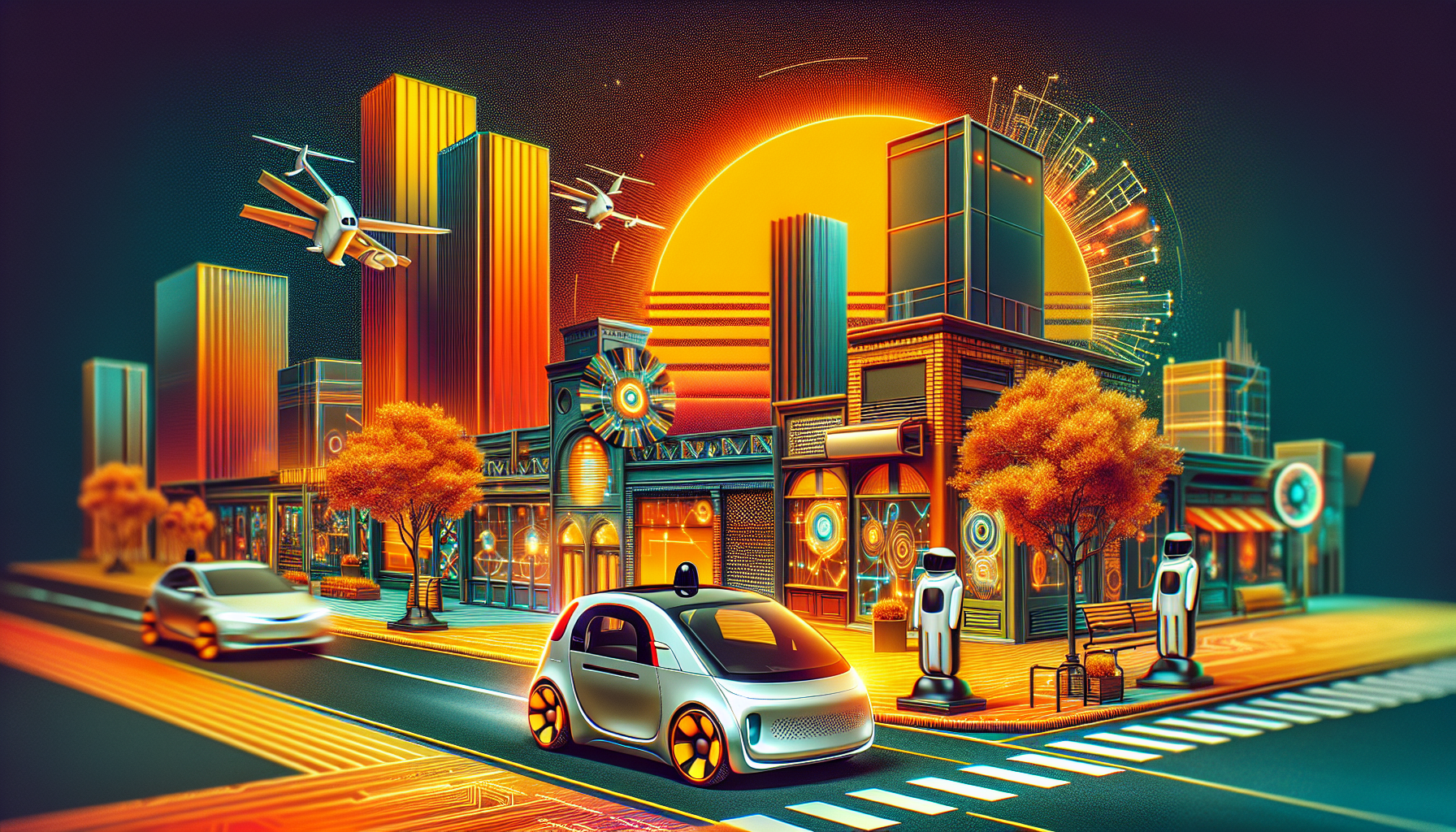
The Waymo World Model represents a radical departure from conventional thinking. Instead of rigid pipelines, it creates what researchers call a "learned simulator" of driving scenarios.
Think of it like this: rather than following a recipe, the system builds an intuitive understanding of how the world works.
The model ingests massive amounts of real-world driving data—not just from Waymo's fleet, but from millions of hours of human driving.
It learns patterns not through explicit programming, but through observation.
When a pedestrian approaches a crosswalk while looking at their phone, the model doesn't just track their trajectory. It understands the probabilistic cloud of behaviors that could follow.
This shift from deterministic to probabilistic thinking changes everything.
The World Model can simulate thousands of possible futures in real-time. When that delivery driver stops, the system doesn't just plan one response.
It generates a probability distribution of scenarios: the driver exits immediately (65% probability), stays in the car checking their phone (20%), or pulls away suddenly (15%).
More remarkably, it understands second and third-order effects. If the delivery driver exits, nearby pedestrians might change their path.
Other cars might swerve. A cyclist might decide to squeeze through the gap.
The World Model captures these cascading interactions in a way traditional systems never could.
The technical architecture leverages transformer-based neural networks—the same technology behind ChatGPT—but applied to spatial-temporal reasoning.
Instead of predicting the next word in a sentence, it predicts the next moment in a complex traffic scenario.
Breaking Down the Technical Magic
The genius of Waymo's approach lies in three key innovations that work together seamlessly.
**Multi-modal fusion** comes first. The World Model doesn't privilege any single sensor input.
Lidar, cameras, radar, and even audio inputs blend into a unified representation of the world. This isn't simple sensor fusion—it's conceptual fusion.
The model learns which modalities matter most for different scenarios.
**Temporal consistency** ensures the model maintains coherent predictions over time.
If it believes a pedestrian is likely heading to a parked car, that belief influences predictions for the next several seconds.
This temporal threading prevents the jarring, inconsistent behaviors that plague other AV systems.
**Counterfactual reasoning** might be the most revolutionary aspect. The model can imagine "what if" scenarios that haven't happened.
What if that pedestrian suddenly decided to cross? What if that truck's cargo shifted?
By exploring these counterfactuals, the system prepares for edge cases before they occur.
The model trains on what Waymo calls "imitation learning with human feedback." It watches millions of hours of human driving, learning not just what humans do, but why they likely did it.
When a human driver slows down approaching a school zone at 3 PM, the model learns this isn't just about the speed limit—it's about anticipating children.
This contextual understanding emerges from data, not programming.
The computational requirements are staggering. Each Waymo vehicle processes roughly 1 terabyte of sensor data per hour.
The World Model must compress this into actionable predictions in under 100 milliseconds.
Real-World Impact and Performance
The results speak for themselves in ways that matter to both riders and investors.
Waymo's disengagement rate—how often human safety drivers need to take control—has dropped by 96% since introducing the World Model.
In San Francisco's chaotic streets, Waymo vehicles now average over 30,000 miles between critical disengagements.
More tellingly, the model handles "long tail" events that stumped previous systems. Construction zones with ambiguous lane markings.
Emergency vehicles approaching from unexpected angles. The infamous "unprotected left turn" that requires negotiating with oncoming traffic.
One Waymo engineer described a scenario where their vehicle encountered a parade—something never explicitly programmed.
The World Model recognized the pattern of slow-moving pedestrians, coordinated movement, and altered traffic flow.
It safely navigated around the parade by reasoning through the situation, not following a predetermined rule.
Rider feedback has transformed. Early passengers complained about "robotic" driving—technically safe but uncomfortable.
The World Model enables more human-like driving. The vehicle now edges forward at stop signs to signal intent.
It makes subtle speed adjustments that feel natural rather than jarring.
The economic implications are profound. Waymo can now deploy in new cities with minimal mapping and calibration.
The World Model adapts to local driving cultures—the aggressive merging in Los Angeles, the double-parking in New York, the polite four-way stop negotiations in Seattle.
This adaptability dramatically reduces the cost of scaling. Where competitors need months of city-specific training, Waymo's World Model can generalize from its existing knowledge base.
What This Means for Developers and AI
The Waymo World Model offers lessons that extend far beyond autonomous vehicles.
For developers building AI systems, it demonstrates the power of end-to-end learning over hand-crafted pipelines.
Instead of decomposing problems into discrete steps, allowing models to learn holistic representations can capture complexities that modular approaches miss.
The approach challenges our assumptions about AI interpretability.
The World Model is essentially a black box—we can't point to specific neurons and say "this detects stop signs." Yet it's more reliable than interpretable systems because it captures the full context of driving, not just labeled features.
For the broader AI industry, Waymo's success suggests that general-purpose architectures (like transformers) can be adapted to spatial-temporal reasoning in ways we're only beginning to explore.
The model also raises important questions about simulation versus reality. If AI systems can build accurate world models from observation, do we need elaborate physics simulations?
Waymo's approach suggests that learned simulators might be more effective than traditional physics engines for real-world applications.
Security researchers should pay attention too. The World Model's ability to predict human behavior could be applied to cybersecurity, predicting attack patterns based on subtle indicators.
The same technology that anticipates a pedestrian's next move could anticipate a hacker's.
The ethical implications deserve consideration. A system that predicts human behavior with high accuracy raises privacy concerns.
If deployed beyond driving, such models could enable unprecedented surveillance capabilities.
The Road Ahead
Waymo's World Model represents a watershed moment, but it's just the beginning.
The next generation will likely incorporate even more context—weather patterns, local events, individual driving styles.
Imagine a system that knows rush hour routes change when there's a baseball game, or that adjusts its driving style based on the neighborhood.
Competitors won't stand still. Tesla's Full Self-Driving system already uses similar neural network approaches, though with vision-only sensing.
Cruise, despite recent setbacks, has sophisticated prediction models. Chinese companies like Baidu and AutoX are developing their own world models.
The real revolution might come from unexpected applications. Robotics companies are already exploring similar approaches for manipulation tasks.
A robot arm needs to understand not just where objects are, but how they'll behave when grasped, pushed, or released.
The gaming industry could use world models to create more realistic NPC behaviors. Instead of scripted responses, characters could have genuine behavioral models that adapt to player actions.
For developers, the message is clear: start thinking about your problems in terms of world models, not just pattern recognition.
The future of AI isn't about better algorithms for specific tasks—it's about systems that truly understand the environments they operate in.
Waymo has shown us what's possible when we stop trying to program intelligence and start allowing it to emerge from understanding.
The question isn't whether world models will transform other industries—it's how quickly developers will adapt this paradigm to solve problems we haven't even imagined yet.
---
Story Sources
From the Author



Hey friends, thanks heaps for reading this one! 🙏
If it resonated, sparked an idea, or just made you nod along — I'd be genuinely stoked if you'd show some love. A clap on Medium or a like on Substack helps these pieces reach more people (and keeps this little writing habit going).
→ Pythonpom on Medium ← follow, clap, or just browse more!
→ Pominaus on Substack ← like, restack, or subscribe!
Zero pressure, but if you're in a generous mood and fancy buying me a virtual coffee to fuel the next late-night draft ☕, you can do that here: Buy Me a Coffee — your support (big or tiny) means the world.
Appreciate you taking the time. Let's keep chatting about tech, life hacks, and whatever comes next! ❤️