Stop Wearing Graphic Tees. This 1-Shirt Now Carries a 2-Year Jail Sentence. Proof.
**Your wardrobe is a legal minefield.
I’m serious.** After seeing an 18-year-old woman in Brisbane, Queensland, face a potential two-year prison sentence for a six-word graphic tee yesterday, I realized that "freedom of expression" has a hidden price tag we aren't talking about.
It’s a cost that is about to bankrupt our sense of personal safety and digital privacy in ways we never saw coming.
We grew up believing that what we wear is a harmless extension of our personality.
We bought the "Destroy" shirts, the political slogans, and the ironic memes, thinking the worst consequence was a dirty look from a stranger.
**That era of "casual statement" is officially dead.** In a world where every street corner has a 4K camera and every "off-the-record" moment is indexed by a database, your clothes have become a high-risk liability.
The Queensland Warning Shot
The story that stopped my scroll this morning involves a young woman in Queensland facing two years behind bars. Her crime?
Wearing a shirt with a phrase—"from the river to the sea"—that has been classified as a proscribed phrase under the newly enacted *Fighting Antisemitism and Keeping Guns Out of the Hands of Terrorists and Criminals Amendment Act 2026*.
**The speed at which "fashion" turned into "felony" is what should keep you awake at night.**
I used to be the guy with a closet full of "subversive" tech tees and political snark.
I thought I was being "authentic." But after analyzing the intersection of AI-driven surveillance and rapidly shifting local legislation in 2026, I realized my "authenticity" was actually just **unguarded vulnerability.**
This isn't just about one woman in Australia. It’s about the fact that your physical presence is now a permanent record.
**If you are a developer, an engineer, or anyone with a career to protect, you need to understand that your "look" is now a searchable data point.**
The High Cost of Main Character Syndrome
We often suffer from what psychologists call "Main Character Syndrome"—the belief that our personal intentions outweigh the external context.
You might wear a shirt because you support a cause, but **the legal system doesn't care about your "why"; it only cares about the "what."**
When that 18-year-old put on her shirt, she likely felt she was standing for justice.
She didn't realize she was stepping into a **legal trapdoor** designed by a government tightening its grip on public discourse following the security crises of late 2025.
We’ve entered a "Zero-Error Era" where a single aesthetic choice can derail your entire life trajectory.
For those of us in tech, the stakes are even higher. We live in a world of background checks, social credit heuristics, and "culture fit" assessments.
**A single photo of you in a controversial graphic tee from March 2026 could be the reason you're denied a visa, a loan, or a promotion in 2028.**
The Reframe: The Uniform of Anonymity
The "conventional wisdom" tells you to express yourself, to be bold, and to stand for something. My contrarian advice?
**Start practicing the "Uniform of Anonymity."** This isn't about being boring; it's about **preserving your personal energy and legal safety** for the battles that actually happen in the real world, not on a cotton blend.
I spent years trying to "stand out" with my wardrobe. I realize now that I was just making myself an easier target for algorithms.
**True power in 2026 isn't being seen; it's being unindexable.** When you remove the "noise" of graphic tees, you regain control over your narrative.
We need to treat our physical appearance with the same rigor we treat our codebase.
You wouldn't push a script with a hardcoded API key to a public repo, so **why are you walking around with your most controversial opinions hardcoded onto your chest?**
Why Blending In Is the New Self-Care
There is a profound psychological relief that comes with "Visual Minimalism." When you stop trying to signal your identity through your clothes, you stop the constant "identity pinging" that happens in public.
**Every time you wear a slogan, you are inviting a confrontation with every person who sees it.**
This creates a "Micro-Stress Loop." Your brain is subconsciously scanning for reactions, preparing for defense, or seeking validation.
**By switching to high-quality, blank staples, you close that loop.** You give your nervous system a break from the constant "broadcast mode" we’ve been conditioned to live in.
The 3-Signal Protocol for Public Identity
To navigate this new landscape, I developed a framework I call the **3-Signal Protocol.** It’s a way to audit your public presence before you step out the door.
If your outfit fails any of these three checks, it stays in the drawer.
1. The Signal-to-Noise Filter
Ask yourself: "Is the message on this shirt worth a two-year legal battle?" **Most graphic tees are "High Noise, Low Signal."** They provide a momentary ego boost but offer zero actual utility in solving the problem they describe.
If the "cost" (jail, job loss, doxxing) outweighs the "gain" (3 seconds of feeling 'right'), the filter blocks it.
2. The Contextual Sandbox
In 2026, there is no such thing as a "private" public space. You must assume that any environment you enter is a "Sandbox" where the rules can change mid-game.
**Laws are being updated faster than we can read them.** Wearing a blank tee ensures that your "Sandbox" remains neutral, regardless of how the local legal "API" changes that day.
3. The Legacy Anchor
Does this garment represent who you will be in five years? **Graphic tees are "Ephemeral Data."** They capture a fleeting moment of anger, humor, or trend.
But because of digital persistence, that "Ephemeral" data becomes a "Legacy Anchor." It drags your past self into your future. **Blank clothing is "Forward-Compatible."**
Implementing the Low-Drag Lifestyle
If you’re ready to stop being a "walking liability," the transition is simpler than you think. You don't need a total fashion overhaul; you need a **systematic reduction of "Attack Surfaces."**
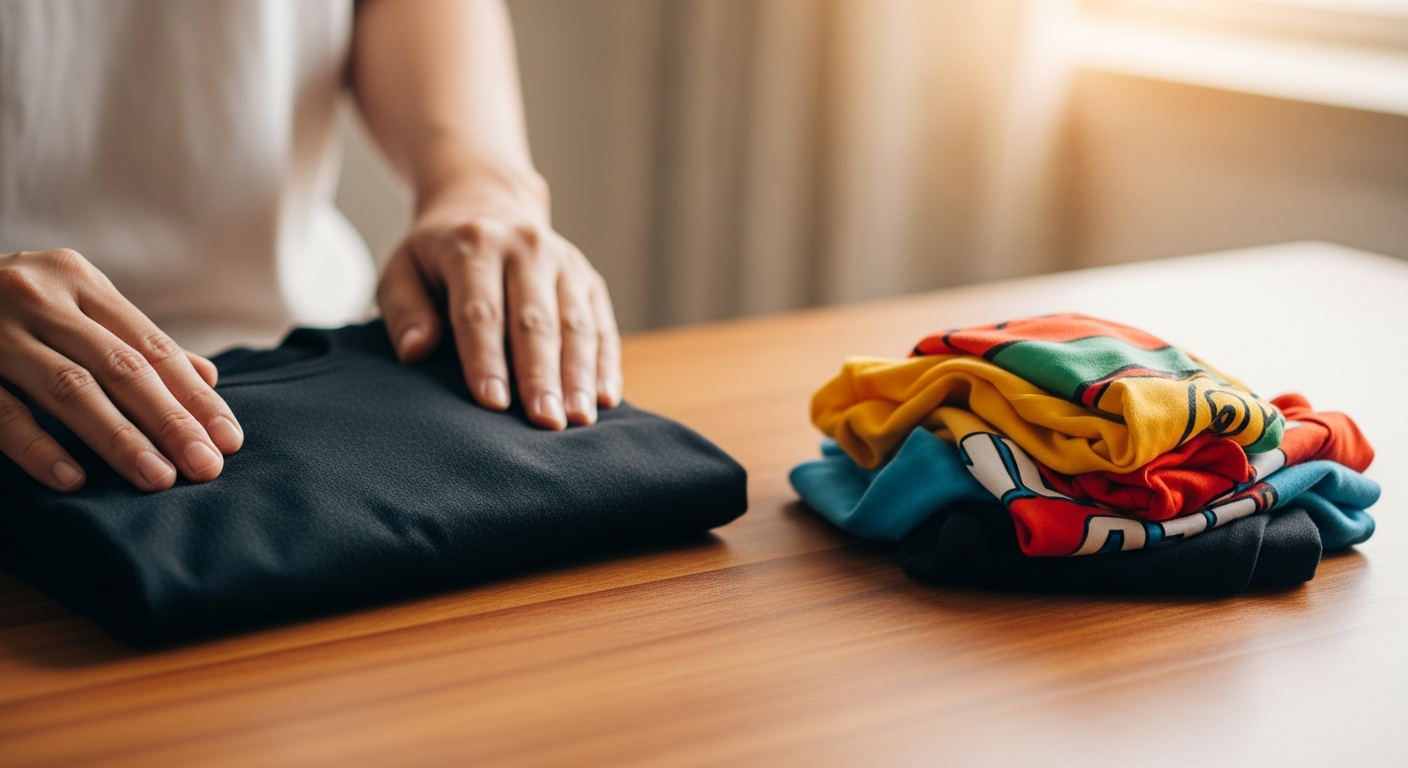
**Step one: The Purge.** Go through your closet and remove anything with text or symbols that could be even slightly misinterpreted. Don't "save them for later." Donate them or use them as rags.
**You are deleting the "legacy code" of your identity.**
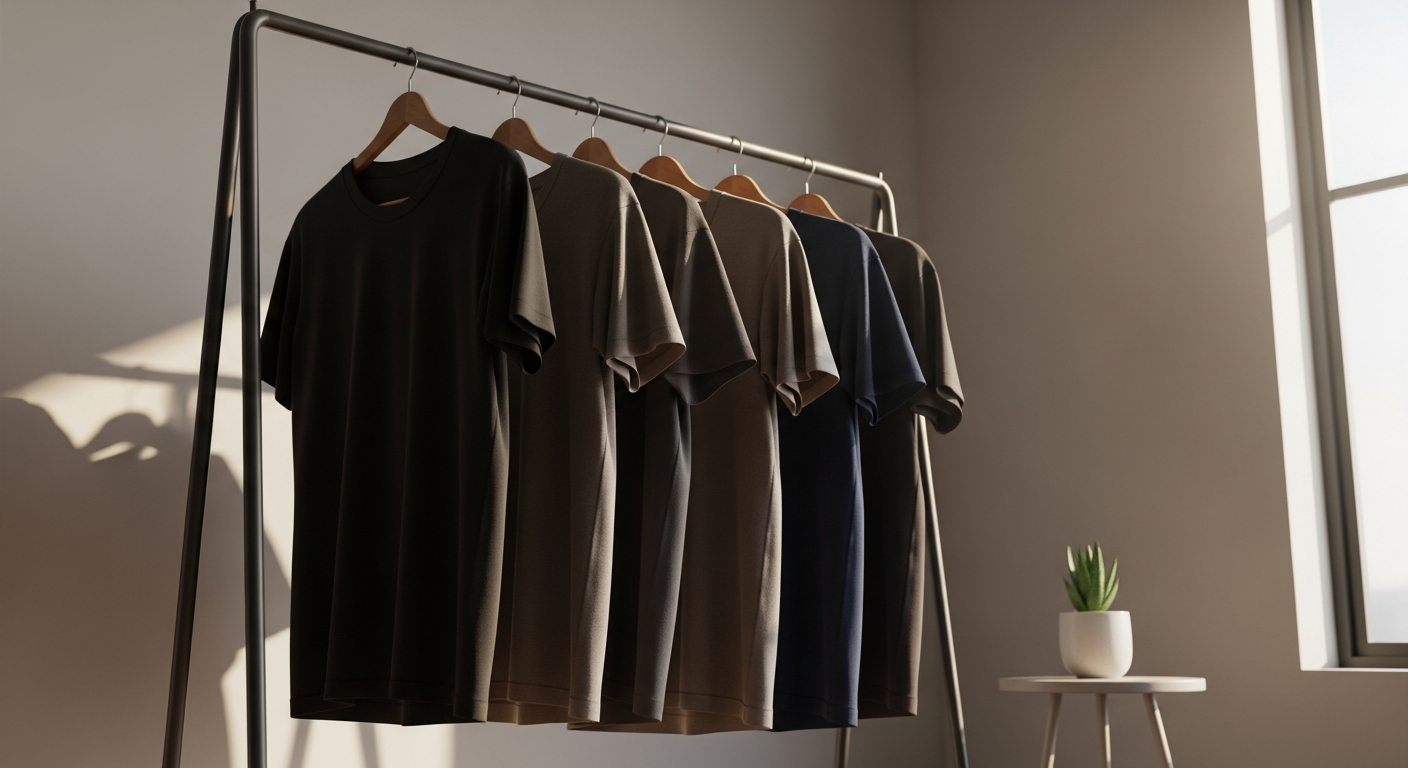
**Step two: Invest in "Technical Staples."** Buy five high-quality, heavyweight cotton tees in neutral colors—black, navy, charcoal, olive, and white.
**These are your "Base Layer" for a low-drag life.** They are durable, professional, and most importantly, they tell the world *nothing* about your political or social leanings.
The "Grey Man" Strategy for Tech Pros
In the security world, there is a concept called the "Grey Man." The Grey Man is someone who can walk through a crowd and be completely forgotten 30 seconds later.
**In the age of AI surveillance, being a Grey Man is a superpower.**
For developers, this means you can attend conferences, protests, or even just grocery stores without being "tagged" as a specific type of person.
**You are preserving your optionality.** You are keeping your "Identity API" private until *you* choose to authenticate a specific person to see it.
The Digital Footprint of Physical Reality
We have to stop thinking of "online" and "offline" as separate worlds.
**The 18-year-old in Queensland was caught in the "Physical-to-Digital" bridge.** Someone took a photo, the photo went viral, the algorithm flagged the text, and the police were dispatched under the new strict liability clauses.
This is the "Full-Stack Reality" of 2026. Every physical object you own is a potential digital asset for the state.
**By wearing "Blank," you are essentially using an ad-blocker for your physical body.** You are opting out of the data-scraping of your personality.
The Myth of "Selling Out"
Some will say that "dressing neutral" is a form of cowardice or "selling out." I would argue that **it is a form of strategic survival.** Putting a slogan on a shirt is the *easiest* and *least effective* way to change the world.
It’s "Slacktivism" that carries "Hardcore" consequences in this new legislative climate.
If you want to change the world, write better code, donate to causes anonymously, or volunteer your time.
**Do the work that doesn't leave a "traceable visual trail" for the authorities to use against you.** Your "brand" should be your output, not your outfit.
Why This Matters Right Now (March 2026)
We are currently in a period of intense global instability.
Between the deep-fake crises of early 2026 and the "Verification Wars" currently happening on social platforms, the "Truth" is harder to find than ever.
**In this environment, governments react with "Broad-Brush Legislation."**
They don't have the time or resources to determine if *your* specific shirt is "hateful" or "educational." They just pass a law that says "X phrase is proscribed." **If you are caught in the crossfire, "I was just being expressive" is not a legal defense against the 2026 statutes.**
The Queensland case is a "Feature, Not a Bug" of modern governance. It is a warning to the population to fall in line.
While the woman in this case was reportedly dealt with via a caution, the fact that the charge carries a maximum of two years in prison remains the ultimate deterrent.
**The most effective way to resist that pressure isn't to shout louder—it's to become harder to find.**
The "Aha" Moment: My Last Graphic Tee
I remember the last time I wore a "statement" shirt. It was a shirt that criticized a major tech CEO.
I wore it to a local meetup, thinking I was "among friends." Then, I saw a photo of myself in the background of a LinkedIn post. **I felt a pit in my stomach.**
What if that CEO’s company was my next big client? What if an automated "Sentiment Analysis" tool flagged that photo and put me on a "Do Not Hire" list?
**I realized I was gambling my career for a $20 joke.** I went home and threw the shirt away. That was the day I found peace.
How to Curate Your New "Safe" Wardrobe
If you're worried about losing your "soul" by dressing in blanks, remember that **style is about fit and fabric, not fonts.** A perfectly tailored, high-quality black tee looks infinitely more "authoritative" and "professional" than a wrinkled shirt with a meme on it.
1. **Prioritize Fabric:** Look for Supima cotton or Merino wool. These fabrics scream "quality" without saying a word.
2. **Master the Fit:** A shirt that fits your shoulders perfectly is a stronger "statement" than any slogan.
3. **Use Accessories for Identity:** A watch, a wedding ring, or a specific pair of glasses can signal "you" in a controlled, subtle way that doesn't trigger "Hate Speech" algorithms.
Final Thoughts: The Price of a Shirt
An 18-year-old was arrested and faced two years of her life in a cell because of a piece of clothing. Let that sink in.
**Is any shirt worth that?** Is your "need to express yourself" so strong that you’re willing to bet your freedom on the whims of a local magistrate interpreting 2026's new proscription lists?
We have to grow up. We have to realize that the "Free Speech" we were promised in the 90s has been "Refactored" by the surveillance state of the 2020s.
**The "Patch" for this vulnerability is simple: Stop wearing your heart on your sleeve—and your politics on your chest.**
What’s the one item in your closet you *know* you should get rid of, but haven't? Is it worth the risk? Let's talk about the "Visual Privacy" we've lost in the comments.
***
Story Sources
From the Author




Hey friends, thanks heaps for reading this one! 🙏
If it resonated, sparked an idea, or just made you nod along — I'd be genuinely stoked if you'd show some love. A clap on Medium or a like on Substack helps these pieces reach more people (and keeps this little writing habit going).
→ Pythonpom on Medium ← follow, clap, or just browse more!
→ Pominaus on Substack ← like, restack, or subscribe!
Zero pressure, but if you're in a generous mood and fancy buying me a virtual coffee to fuel the next late-night draft ☕, you can do that here: Buy Me a Coffee — your support (big or tiny) means the world.
Appreciate you taking the time. Let's keep chatting about tech, life hacks, and whatever comes next! ❤️