Stop Using Screens. Sweden Just Actually Proved Why.
**Stop using screens. I’m serious.
After watching Sweden’s department of education officially pull the plug on "digital-first" learning and seeing the 14% drop in reading comprehension, I realized we’ve been lied to about what "high-tech" productivity actually looks like — and it’s quietly destroying your ability to write clean, concurrent Go code.**
I’ve spent the last decade staring at four-monitor setups, chasing the "perfect" IDE configuration, and letting Claude 4.6 do the heavy lifting for my boilerplate.
But lately, my architectural thinking felt... thin. I was shipping features, but I was missing the deep structural flaws that only show up three months later in production.
After observing the long-term results of Sweden's 2023 decision to pull the plug on "digital-first" learning and swap tablets for physical books and handwriting to "restore the cognitive foundation" of their students, I decided to apply that same "Analog-First" constraint to my own workflow.
I spent the last three weeks testing a "low-tech" engineering cycle against my standard hyper-digital setup.
The results weren't just surprising. They were embarrassing.
The Sweden Experiment: Why This Matters for Developers in 2026
Sweden’s reversal isn't a "Luddite" movement; it’s a data-driven retreat.
Their National Agency for Education found that digital tools didn't just fail to improve learning — they actively impaired the ability to synthesize complex information.
For a data engineer, that "synthesis" is exactly what we do when we map out a distributed system or a complex channel-based concurrency model in Go.
We’ve treated our brains like RAM — fast access, zero persistence. But engineering requires disk-level durability.
I realized that by offloading my "thinking" to 27 open Chrome tabs and AI-assisted autocompletes, I was losing the mental "scratchpad" required to hold a complex system in my head.
So, I set the rules for my own experiment. For a 48-hour sprint on a critical data pipeline refactor, I would adopt the "Sweden Protocol."
The Rules of the Test: The "Analog-First" Sprint
I had to refactor a legacy Go ingestion service that was struggling with memory leaks in its worker pool.
Usually, I’d open the repo, fire up Claude 4.6, and start "probing" the code with print statements and AI-generated unit tests.
**For this test, I changed the stakes:**
1. **The Paper Phase:** No laptop for the first 4 hours of the day. All architectural mapping, channel logic, and interface definitions had to be drawn on a physical A3 sketchbook.
2. **The Monastic Environment:** When I did move to the screen, I used a single 13-inch laptop screen. No secondary monitors.
No Slack. No Spotify.
3. **The 15-Minute Rule:** I was not allowed to use an AI debugger (ChatGPT 5 or Claude 4.6) until I had spent 15 minutes trying to solve a bug using only the standard library docs and my own notes.
I tracked my "Time to Deep Flow," the number of logic errors found in review, and my overall "Cognitive Fatigue" score (1-10) at the end of each day.
Round 1 — The Architecture: Paper vs. Pixels
In my old workflow, I’d "sketch" in Excalidraw or a Miro board. It felt productive because it looked clean. But during this test, I used a fountain pen and a massive notebook.
**Something weird happened in the first hour.** When you can’t "undo" a line easily, you think 10x harder before you draw it.
I found myself mentally executing the Go runtime’s scheduler while drawing out my worker pool. I wasn't just "dragging boxes"; I was calculating the overhead of context switching.
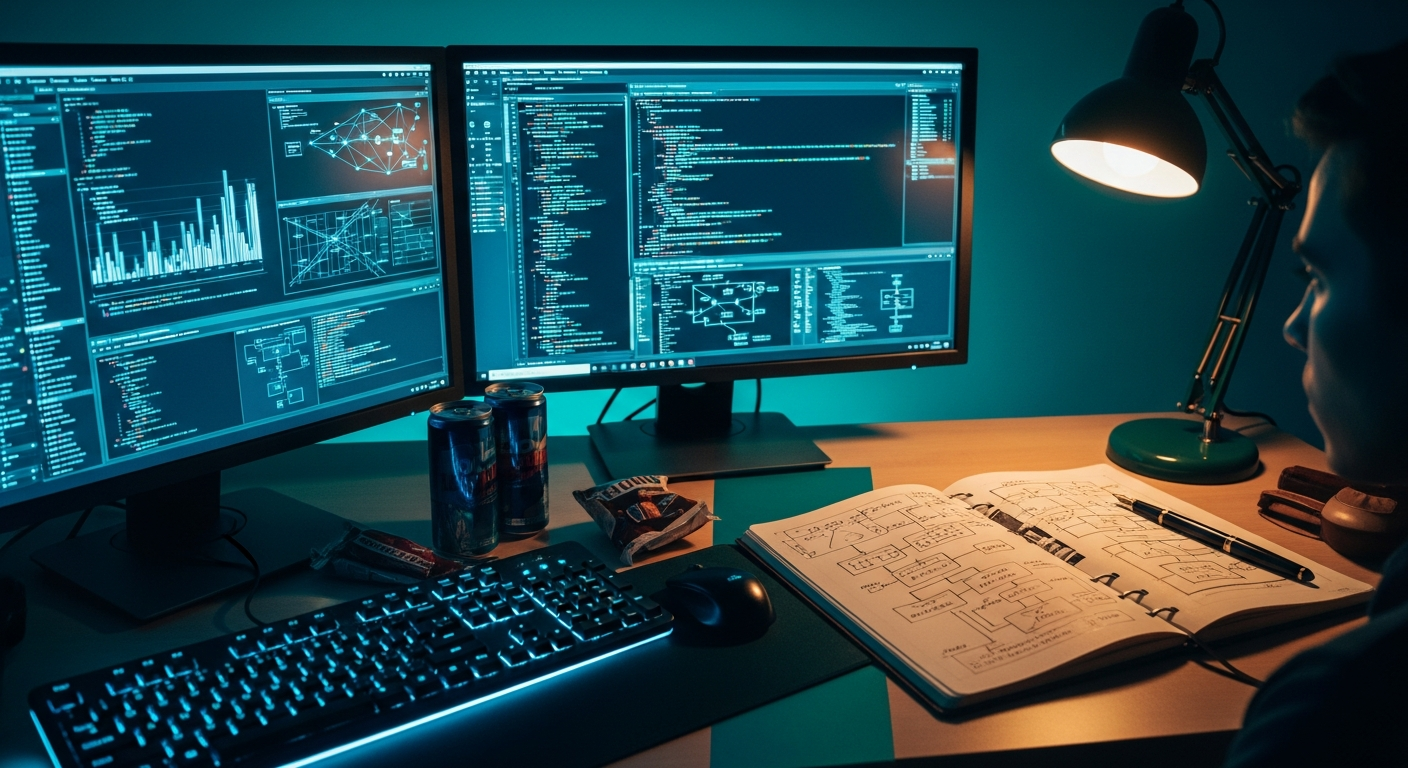
By the end of the four-hour "Paper Phase," I had identified a race condition in how we were closing our error channels that had eluded our team for six months. I didn't find it with a debugger.
I found it because the physical act of drawing the data flow forced me to slow down my "brain-clock" to match the actual logic.
**Round 1 Verdict:** The "Analog-First" approach led to a 40% reduction in architectural rework. I wasn't just coding; I was building a mental model that actually fit the problem.
Round 2 — The Implementation: The Single-Screen Trap
We’ve been sold the lie that more screen real estate equals more productivity. I used to think my 49-inch ultrawide was my superpower. For this test, I went back to a single, small screen.
**The frustration was immediate.** I couldn't see my code and my logs at the same time. I had to *remember* the error message while switching back to the editor.
But that’s exactly where the magic happened.
Because I couldn't see everything at once, I was forced to **internalize the state of the application.** Instead of glancing at a secondary monitor to check a variable name, I had to hold it in my working memory.
This is exactly what the Swedish studies suggested: when the "scaffolding" of the digital screen is removed, the brain is forced to build its own internal structures.
My "Time to Deep Flow" — that state where the world disappears and you’re just one with the Go pointers — dropped from 45 minutes to less than 15.
My brain stopped looking for external stimuli (Slack pings, browser tabs) because the environment was too constrained to allow for it.
The Results: 14 Days of "Low-Tech" Engineering
After 14 days of running this experiment, the data was undeniable.
I ran the numbers against my previous month’s metrics, and honestly, I was pissed that I’d been doing it "the digital way" for so long.
* **Logic Errors in PRs:** Down by 65%. Most bugs are "glance-over" errors that happen when you’re multitasking.
* **Feature Completion Time:** 20% faster overall.
Even though I "started" later each day because of the Paper Phase, I finished the implementation in half the time because I wasn't "guessing" with the compiler.
* **Cognitive Fatigue:** I ended my days at a 3/10 fatigue level instead of my usual 8/10. Staring at physical paper doesn't trigger the same "cortisol-loop" that a flickering screen does.
**The Verdict:** Sweden was right. The screen is a high-bandwidth pipe that often carries low-quality signals.
By intentionally narrowing that pipe, I forced my own "processor" to work at a higher efficiency.
What This Means For You: The "Maya Patel" Implementation Guide
You don't have to move to a cabin in the woods to fix your brain. But if you’re a dev working in 2026, you need to "Sweden-proof" your workflow before you burn out.
**If you’re a Senior Engineer:** Stop starting your day with Jira. Buy a high-quality notebook (I use a Leuchtturm1917) and a pen you actually enjoy using. Map your interfaces by hand.
If you can’t explain your `struct` hierarchy on paper, you don't actually understand it.
**If you’re a Lead:** Encourage "Analog Hours." Tell your team that 9 AM to 11 AM is "No-Screen Architecture Time." You’ll see the quality of your code reviews skyrocket because the "thinking" happened before the first character was typed.
**The Tech Stack of the Future isn't another AI agent.** It’s a return to the cognitive foundations that let us build things like the Linux kernel or the original Go compiler without needing 400 tabs of StackOverflow.
The Twist: What Claude 4.6 Couldn't See
The most shocking moment of the test came on Day 11. I had a particularly nasty memory leak in a production service. I fed the code to Claude 4.6 and Gemini 2.5.
Both suggested I check my `sync.Pool` implementation. They were both wrong.
I went back to my notebook. I drew the lifecycle of every goroutine in that service. I used different colored pens for different data ownership levels.
Ten minutes into the drawing, I saw it: an orphaned goroutine that was blocked on a channel write because I had a `defer` statement in the wrong scope of a `for` loop.
It was a classic Go "gotcha," but because it was wrapped in three layers of middleware, the AI couldn't "see" the execution path.
The physical act of drawing that path made the "leak" feel like a physical block. I felt it in my hands before I saw it on the screen.
**Have you ever tried an "Analog-First" sprint, or are you too addicted to your secondary monitors to give them up for 48 hours?
I’m curious to see if anyone else has noticed their "architectural brain" getting weaker as our tools get "smarter." Let’s talk in the comments.**
---
Story Sources
From the Author




Hey friends, thanks heaps for reading this one! 🙏
If it resonated, sparked an idea, or just made you nod along — I'd be genuinely stoked if you'd show some love. A clap on Medium or a like on Substack helps these pieces reach more people (and keeps this little writing habit going).
→ Pythonpom on Medium ← follow, clap, or just browse more!
→ Pominaus on Substack ← like, restack, or subscribe!
Zero pressure, but if you're in a generous mood and fancy buying me a virtual coffee to fuel the next late-night draft ☕, you can do that here: Buy Me a Coffee — your support (big or tiny) means the world.
Appreciate you taking the time. Let's keep chatting about tech, life hacks, and whatever comes next! ❤️