Stop Using Realtors. This 5-Day ChatGPT Secret Changes Everything

**James Torres** — Systems programmer and AI skeptic. Writes about Rust, low-level computing, and ChatGPT.
Stop Using Realtors. This 5-Day ChatGPT Secret Changes Everything
**Stop paying 6% to have someone open a door for you. I’m serious.**
Last week, a guy in Florida sold his $750,000 home in five days using nothing but a ChatGPT 5 account and a $500 drone. He didn’t hire a "listing specialist." He didn’t pay a buyer’s agent commission.
He bypassed the entire professional industrial complex that has spent the last century convincing you that selling a house is more complicated than launching a SpaceX Falcon 9.
He saved $45,000 in commissions.
To put that in perspective for my fellow systems engineers, that’s roughly the cost of a fully loaded workstation and a year's supply of high-end espresso, or about 25% of a senior dev's annual take-home.
And the real estate industry is absolutely sweating because they realize the "expertise" they’ve been gatekeeping is nothing more than a series of repetitive tasks that an LLM can now perform with 99.9% accuracy.
I usually spend my time complaining about memory leaks in C++ or why your "AI-powered" app is just a wrapper for a basic API call.
But when I saw this Florida story trending on r/ChatGPT with 1,500+ upvotes, I had to look under the hood.
What I found wasn't just a "lucky break"—it was a repeatable algorithm for disrupting the most bloated middleman industry in America.
The $100 Billion Gatekeeper Myth
For decades, the National Association of Realtors (NAR) has maintained a stranglehold on the American dream.
They’ve built a moat of "proprietary" contracts, "exclusive" MLS access, and a narrative that selling a home without a professional is a recipe for legal disaster.
They want you to believe that their 60-hour certification course makes them more qualified to handle a transaction than a person who can debug a race condition in a distributed system.
It’s a lie. In 2026, the real estate market is no longer a game of "who you know." It’s a game of data distribution and pattern matching.
Most realtors spend 90% of their time on marketing themselves and 10% on actually selling your house.
They use the same templated descriptions, the same three photographers, and the same "standard" contracts they downloaded from their brokerage's intranet.
You aren't paying for their genius; you’re paying for their membership in a guild that refuses to let go of the 20th century.
The "Florida Secret" isn't about being a salesman.
It’s about using ChatGPT to automate the three pillars of a real estate transaction: **Valuation, Presentation, and Legal Validation.** When you remove the human ego and the 6% friction, the market moves faster than a Redis cache.
The 5-Day Algorithm: How He Did It
This wasn't a "post it and pray" strategy. The user—let's call him "LogicPrevails"—treated the sale like a sprint.
He broke the process down into a five-day sequence that turned his ChatGPT 5 instance into a high-powered brokerage.
Day 1: The Valuation Engine (Zero Hallucination)
Most people ask a realtor for a "Comparative Market Analysis" (CMA). The realtor looks at three houses that sold nearby, adds some "vibes" based on the kitchen backsplash, and gives you a number.
LogicPrevails didn't do that. He fed ChatGPT 5 the raw transaction data from his county’s public records for the last six months.
He used a custom GPT designed for data analysis to run a regression on price per square foot, adjusted for interest rate fluctuations and seasonal demand.
**The AI found a pricing "sweet spot" $12,000 higher than what Zillow’s Zestimate suggested.** Why?
Because the LLM was able to weight the "proximity to the new tech hub" more accurately than a static algorithm. He set a price that was aggressive enough to spark a bidding war but backed by hard data.
Day 2: The Visual Optimization (Neural Staging)
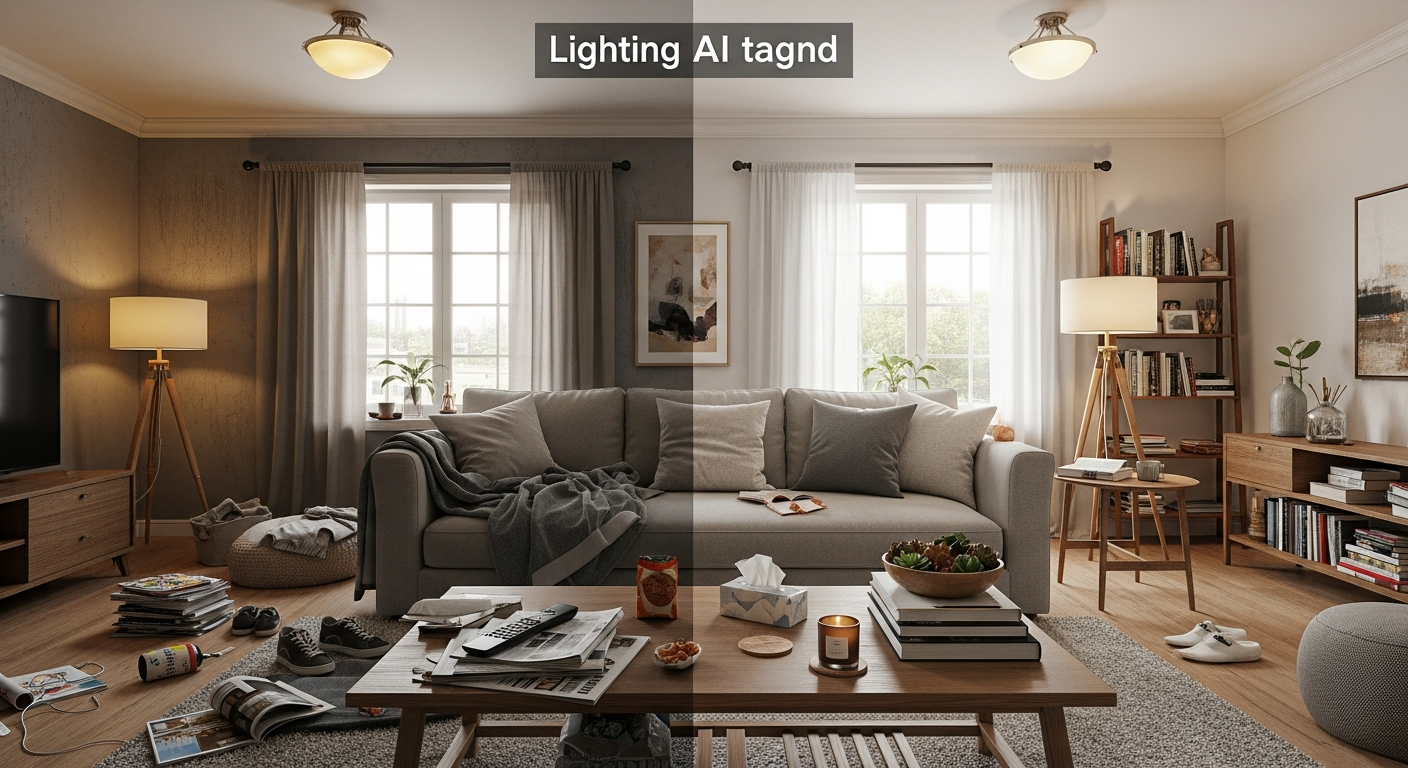
Instead of paying $3,000 for a staging company to move beige furniture into his living room, he took high-resolution photos with his phone and used an AI image editor to "virtually stage" the entire house.

He then used ChatGPT to analyze the photos and suggest "micro-fixes." The AI pointed out that his curb appeal was being killed by a specific type of overgrown shrub and a weathered front door.
Total cost of fixes: $200 at Home Depot. The AI didn't just give advice; it acted as a creative director with a library of "top-performing architectural digests" in its training data.
Day 3: The High-Conversion Listing Copy
Realtors love adjectives. "Charming," "Breathtaking," "Hidden Gem." These words are noise.
LogicPrevails instructed ChatGPT to write a listing description based on **Search Engine Optimization (SEO) for the major portals (Zillow, Redfin, Realtor.com).** He fed it the "Persona" of his ideal buyer: a mid-level remote worker with two kids and a dog.
The resulting copy focused on fiber-optic availability, the specific "Quiet Zone" of the backyard, and the proximity to the top-rated elementary school.
It wasn't "poetic"—it was a targeted advertisement designed to trigger the notification filters of the exact right buyers.
Day 4: The Automated Legal Review
This is where the FUD (Fear, Uncertainty, Doubt) kicks in. "But the contracts! You'll get sued!"
LogicPrevails used a RAG (Retrieval-Augmented Generation) setup to upload his state’s specific residential sales statutes and the standard "For Sale By Owner" (FSBO) contract.
He had ChatGPT 5 review the buyer's offer for "predatory clauses" or "unusual contingencies."
**The AI caught an inspection contingency that was worded so broadly it would have let the buyer walk away for a chipped tile.** He used the AI to draft a counter-offer that tightened the window for inspections to 48 hours.
He then spent $500 to have a flat-fee real estate attorney spend 30 minutes giving it a final "human" stamp of approval. Total legal spend: $500. Realtor "value" for the same service: $22,500.
Day 5: The Negotiation Bot
When the offers came in—and they came in fast because the price was data-driven—he didn't get emotional.
He used a negotiation framework prompt (based on Chris Voss’s *Never Split the Difference*) to handle the back-and-forth.
The AI told him exactly when to stay silent and when to push for a "non-refundable earnest money deposit" to weed out the looky-loos.
By 5:00 PM on Friday, he had a signed contract at $15,000 over asking.
Why Real Estate Agents Are Actually Terrified
The industry's response to these stories is always the same: "A realtor provides a personal touch and handles the stress."
**Since when is "handling stress" worth $45,000?**
As a systems guy, I look at efficiency. A realtor is a high-latency, high-cost hop in the network.
They introduce "brokerage speak" and personal biases into a transaction that should be purely about value exchange.
The "stress" they claim to mitigate is often stress *they create* by being slow to respond or pushing you to accept a lower offer so they can collect their check and move on to the next lead.
In March 2026, LLMs have reached a level of "reasoning" that far exceeds the average professional's ability to stay objective. ChatGPT 5 doesn't care about its commission.
It doesn't have a quota to hit.
It doesn't get "tired" of showing your house. It is a tireless, perfectly informed advocate that works for the price of a monthly subscription.
We are seeing the "de-skilling" of the real estate profession in real-time.
Just as Shopify made it possible for anyone to run a global storefront without a team of web developers, LLMs are making it possible to handle a six-figure asset transfer without a "luxury brand" brokerage.
The Real Problem: The MLS "Ghetto"
If AI is so good, why isn't everyone doing this? Because the real estate industry still controls the "database."
The Multiple Listing Service (MLS) is the industry's last stand.
They try to prevent FSBO listings from appearing alongside "professional" ones, or they hide the "commission for buyer's agent" field to discourage other realtors from showing your house.
It’s an anti-competitive practice that would make a 1990s Microsoft executive blush.
But even this is failing. Sites like Zillow and Redfin have democratized the data. Buyers don't wait for their realtor to send them an email anymore; they have "New Listing" alerts on their phones.
They see your house at the same time the "professionals" do.
If your house is priced correctly (thanks to AI) and looks better than the competition (thanks to AI), the buyers will demand to see it.
No buyer's agent is going to risk losing a client by refusing to show a "perfect" house just because they aren't getting a guaranteed 3% kickback.
What You Should Do Instead of Calling a Realtor
If you're thinking about selling your home in 2026, don't start by interviewing agents. Start by building your stack.
1. **Get a ChatGPT 5 or Claude 4.6 account.** You need the high-reasoning models for the contract review and data analysis.
2. **Use a Flat-Fee MLS service.** For about $300-$500, these companies will put your listing on the official MLS without taking a commission. This solves the "visibility" problem.
3. **Hire a $500 Real Estate Attorney.** Use them only for the final review and the escrow/closing process. This provides the legal safety net without the "sales" markup.
4. **Invest in "Neural Staging."** Use AI to make your home look like a Pinterest board. Humans are visual creatures; if the thumbnail looks like a dream, they'll show up.
5. **Be the "Host," not the "Salesman."** When people come to see the house, let the house speak for itself.
Give them a QR code that links to an AI-powered chatbot that can answer questions about the HVAC age, the property taxes, or the local transit times.
The Uncomfortable Truth
The era of the "Generalist Middleman" is over. Whether it's travel agents, stockbrokers, or now realtors, the value of "access to information" has dropped to zero.
We are entering an era of **Personal Sovereignty.** You own the data. You own the asset. And now, you own the tools to execute the transaction.
The only thing standing between you and an extra $40,000 is the fear that you "aren't an expert."
But let me ask you this: If a guy in Florida can sell a house in five days using a chatbot, what's your excuse?
Are you really willing to work for an extra six months just to pay for someone else’s gold-plated business card and a Lexus lease?
The "Realtor Secret" is that there is no secret. There’s just a process, and the process has been automated.
**Have you tried using AI to bypass a major life expense, or are you still paying the "middleman tax"? Let's talk about the most bloated industries left to disrupt in the comments.**
---
Story Sources
From the Author




Hey friends, thanks heaps for reading this one! 🙏
If it resonated, sparked an idea, or just made you nod along — I'd be genuinely stoked if you'd show some love. A clap on Medium or a like on Substack helps these pieces reach more people (and keeps this little writing habit going).
→ Pythonpom on Medium ← follow, clap, or just browse more!
→ Pominaus on Substack ← like, restack, or subscribe!
Zero pressure, but if you're in a generous mood and fancy buying me a virtual coffee to fuel the next late-night draft ☕, you can do that here: Buy Me a Coffee — your support (big or tiny) means the world.
Appreciate you taking the time. Let's keep chatting about tech, life hacks, and whatever comes next! ❤️