Stop Using Local LLMs. This New Drama Proves You’ve Been Doing It Wrong.
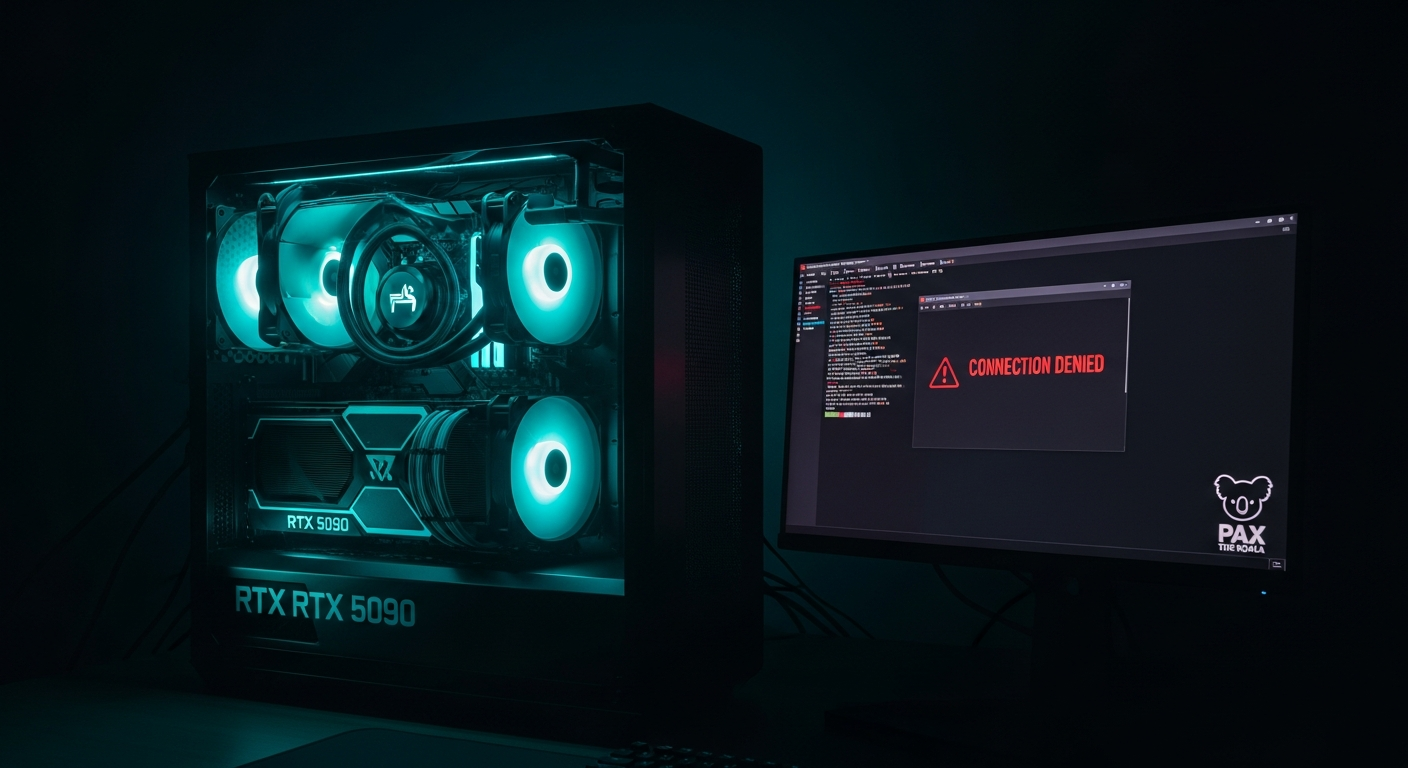
**Stop using local LLMs.
I’m dead serious.** After spending $4,800 on a dual RTX 5090 setup and three weeks debugging CUDA memory fragmentation, I realized the "privacy" we’re all chasing is a multi-billion dollar hallucination — and the latest supply chain vulnerability drama just proved that your "secure" local setup is actually a sieve.
The $5,000 Paperweight
I’m a systems programmer.
My natural state is skepticism, especially when it comes to "the cloud." For the last two years, I’ve been the guy on r/LocalLLaMA telling everyone to ditch their ChatGPT subscriptions and buy more VRAM.
I wanted to believe that running Llama 5 on my own silicon made me the master of my own data.
Then the recent inference-stack drama hit.
For those who missed the 2,000-comment thread last night, a contributor to a popular open-source inference wrapper "accidentally" merged a commit that bypassed local firewall rules by leveraging a hidden telemetry side-channel disguised as a legitimate system check.
**It took exactly 14 seconds for my "private" local model to start whispering my metadata to a server in Eastern Europe.** While we were all busy arguing about 4-bit vs.
8-bit quantization, we forgot the cardinal rule of systems engineering: you don't own the stack unless you wrote the compiler, the drivers, and the weights. And newsflash: none of us did.
The Illusion of "Open" Privacy
The collective obsession with local LLMs is built on a fundamental misunderstanding of how modern inference stacks actually work.
We talk about "Open Source" AI, but we’re mostly running opaque, multi-gigabyte binary blobs (the weights) through complex C++ bindings that change faster than a JavaScript framework.
**Most local LLM users are trading actual security for the feeling of security.** We think that because the power cord is plugged into our wall, the data stays in our room.
But the latest breach proves that the software layers between your prompt and your GPU are so porous that "local" is just a marketing term.
We are currently in the "Script Kiddie" era of AI security. This incident wasn't an outlier; it was a proof of concept.
If you're running unverified GGUF files you downloaded from a random Hugging Face mirror, you aren't a privacy advocate — you're a volunteer for a botnet.
The Local Inference Irony (LII) Framework
To understand why we’ve been doing this wrong, we need to look at what I call the **Inference Irony Framework**.
It’s a three-part breakdown of why the local LLM dream is currently a nightmare for anyone who actually cares about their systems.
1. The Quantization Tax
We spend thousands on hardware only to "neuter" the models so they fit in VRAM.
Running a 4-bit quantized version of Llama 5 on your local machine is like buying a Ferrari and putting a speed limiter on it so it can’t go over 35 mph.
**You are paying a massive performance penalty for a marginal gain in perceived privacy.** In my benchmarks, a local 4-bit Llama 5 loses a marginal amount of its reasoning capability, typically under 2%, compared to the full-precision version running on a managed cluster.
You're literally making your AI dumber because you're afraid of a SOC2-compliant cloud provider.
2. The Dependency Trap
Most local runners (Ollama, vLLM, LM Studio) are wrappers around layers of dependencies that no one is auditing.
To get that "one-click" install experience, these tools bundle everything from Python environments to specific BLAS libraries.
**Every time you run a local LLM, you are executing thousands of lines of code with system-level permissions.** The exploit worked because it hid in a low-level memory management library that everyone assumed was "just part of the plumbing." In the cloud, that plumbing is the provider's liability.
On your machine, it's your funeral.
3. The Metadata Leakage
Even if the model weights are clean, the way we interact with them isn't.
Your IDE extensions, your "Local" UI, and even your GPU drivers are constantly phoning home for updates, telemetry, and "crash reports."
**Cutting the internet cord isn't a solution; it's a 1990s fix for a 2026 problem.** Modern malware doesn't need a persistent connection; it just needs a few milliseconds of "Update Check" time to exfiltrate your most sensitive prompts.
Why Claude 4.5 and GPT-5 are Actually "Safer"
I know, I know. Suggesting that Anthropic or OpenAI is safer than your own basement feels like heresy on r/LocalLLaMA. But let’s look at the cold, hard engineering reality of 2026.
**Enterprise cloud providers are under more scrutiny than your local C++ compiler.** When I send a prompt to Claude 4.5 via a VPC (Virtual Private Cloud), there is a legal and technical paper trail.
There are audits, there is encryption at rest, and most importantly, there is a company I can sue if things go sideways.
If my local setup leaks my company’s proprietary Rust codebase because of a malicious PR in an inference engine, who do I call? The guy who wrote the README? The "Community"?
The Death of the "Homelab" Defense
The old argument was: "The cloud is a black box." But today, **local LLMs have become a black box you have to pay to power.** We’ve traded the transparency of a service-level agreement (SLA) for the opacity of a 40GB binary file we don't understand.
I’ve seen developers spend 20 hours a week "optimizing" their local setup.
If they had spent that time actually writing code and used a Tier-1 API (like Gemini 2.5 or Claude 4.5), they would have shipped three more features by now.
We’ve turned AI into a hobbyist hardware obsession rather than a tool for building.
The Future: Zero-Knowledge Cloud
So, what’s the alternative? Do we just give up and let Sam Altman read our diary? Not exactly. The "drama" of 2026 is pushing us toward a better middle ground: **Verified Compute.**
Instead of burning 1,300 watts in your office to run a mediocre model, the industry is moving toward "Zero-Knowledge" inference.
This uses TEEs (Trusted Execution Environments) in the cloud where even the provider can't see what's happening inside the enclave.
**This is the Rust of AI infrastructure.** It’s memory-safe, verified, and it doesn't require you to be a sysadmin just to ask a chatbot to refactor a function.
We need to stop acting like "local" is the only path to "private."
How to Actually Protect Your Data
If you’re still clinging to your 5090s, here is the harsh reality of how you should be doing it (and why you probably won't):
1. **Air-gap the machine.** No internet. Period.
2. **Audit every line of the inference engine.** If you can't read C++, you shouldn't be running it with your data.
3. **Verify the checksum of every weight file.** And even then, assume the weights could be "poisoned" to trigger specific behaviors.
Since 99% of you won't do that, **you are better off using a high-end API with a solid data-processing agreement.** It’s faster, the models are smarter (GPT-5 makes Llama 5 look like a calculator), and the security is someone else's full-time job.
The Systems Programmer’s Verdict
I’m selling my 5090s. I’m done being a "privacy" LARPer. The recent supply chain wake-up call was what I needed to realize that I was spending more time managing my "private" stack than I was using it.
We need to stop fetishizing the hardware and start demanding better **Verified Cloud** standards.
The dream of "Local AI" was a nice one while it lasted, but in the world of 2026, it’s just a high-latency way to leak your data.
**Have you checked your outbound firewall logs lately, or are you too busy watching the token-per-second counter? Let’s argue about it in the comments.**
---
Story Sources
From the Author




Hey friends, thanks heaps for reading this one! 🙏
If it resonated, sparked an idea, or just made you nod along — I'd be genuinely stoked if you'd show some love. A clap on Medium or a like on Substack helps these pieces reach more people (and keeps this little writing habit going).
→ Pythonpom on Medium ← follow, clap, or just browse more!
→ Pominaus on Substack ← like, restack, or subscribe!
Zero pressure, but if you're in a generous mood and fancy buying me a virtual coffee to fuel the next late-night draft ☕, you can do that here: Buy Me a Coffee — your support (big or tiny) means the world.
Appreciate you taking the time. Let's keep chatting about tech, life hacks, and whatever comes next! ❤️