Stop Using ElevenLabs. Mistral Just Proved Why This Changes Everything.
**Stop paying your ElevenLabs subscription. I’m serious.
After benchmarking Mistral’s new speech synthesis engine (the TTS counterpart to their Mistral-Audio multimodal model) against the "gold standard" of cloud-based voice synthesis, I realized we’ve been paying a premium tax for a gilded cage — and Mistral just handed us the keys to the gate.**
I’ve spent the last twelve years as a systems programmer, which means I have a biological allergy to latency and a deep-seated distrust of any "essential" tool that requires an API key to function.
For the past two years, the tech world has been gaslit into believing that high-fidelity, emotional text-to-speech (TTS) was a feat only achievable by massive server farms in the cloud.
We were told that "local" meant robotic, metallic, and distinctly 2012.
We were told that if we wanted a voice that didn't sound like a microwave reading a manual, we had to fork over $99 a month to a company that could de-platform our voice clones the moment their TOS changed on a whim.
Mistral just proved that was a lie.
With the release of the Mistral-TTS synthesis stack — a 3-billion-parameter model distinct from their recent audio-to-text offerings — the era of the SaaS voice monopoly is officially dead.
If you’re still building your stack around closed-source voice APIs in March 2026, you’re not just overpaying; you’re building on quicksand.
The $50 Billion "Convenience" Scam
Let’s be honest about why ElevenLabs won. It wasn’t just the quality; it was the fact that they made us lazy. They turned a complex digital signal processing (DSP) problem into a simple `POST` request.
We traded our sovereignty for a slick UI.
Developers have spent the last few years funneling millions of dollars into cloud TTS providers because setting up a local inference engine was, frankly, a pain in the ass.
You needed a PhD in Python dependency hell and a GPU cluster that sounded like a jet engine just to get a "hello world" that didn't stutter.
But the winds shifted this morning. Mistral, continuing their streak of being the only adults in the room when it comes to open-weight sovereignty, dropped their dedicated synthesis model.
This isn't a "toy" model. At 3B parameters, it’s dense enough to capture the micro-inflections and breathy pauses that make human speech feel, well, human.
And because it’s open-weight, it means the "SaaS tax" is now optional. You can run this on a mid-range consumer GPU. You can run it on an Apple M5.
You can run it in a containerized environment without ever sending a single byte of your data to a third-party server.
Why 3 Billion Parameters Is the Magic Number
In the world of LLMs, 3B is "small." In the world of TTS, 3B is a monster.
Most of the local models we’ve been playing with over the last year—the ones that sounded "okay if you don't listen too closely"—were significantly smaller or relied on hacky diffusion tricks that introduced massive latency.
Mistral-TTS handles the "prosody problem" differently. Prosody is the rhythm, stress, and intonation of speech.
It’s the difference between a robot saying "I'm fine" and a person saying "I'm fine" with a sarcastic edge.
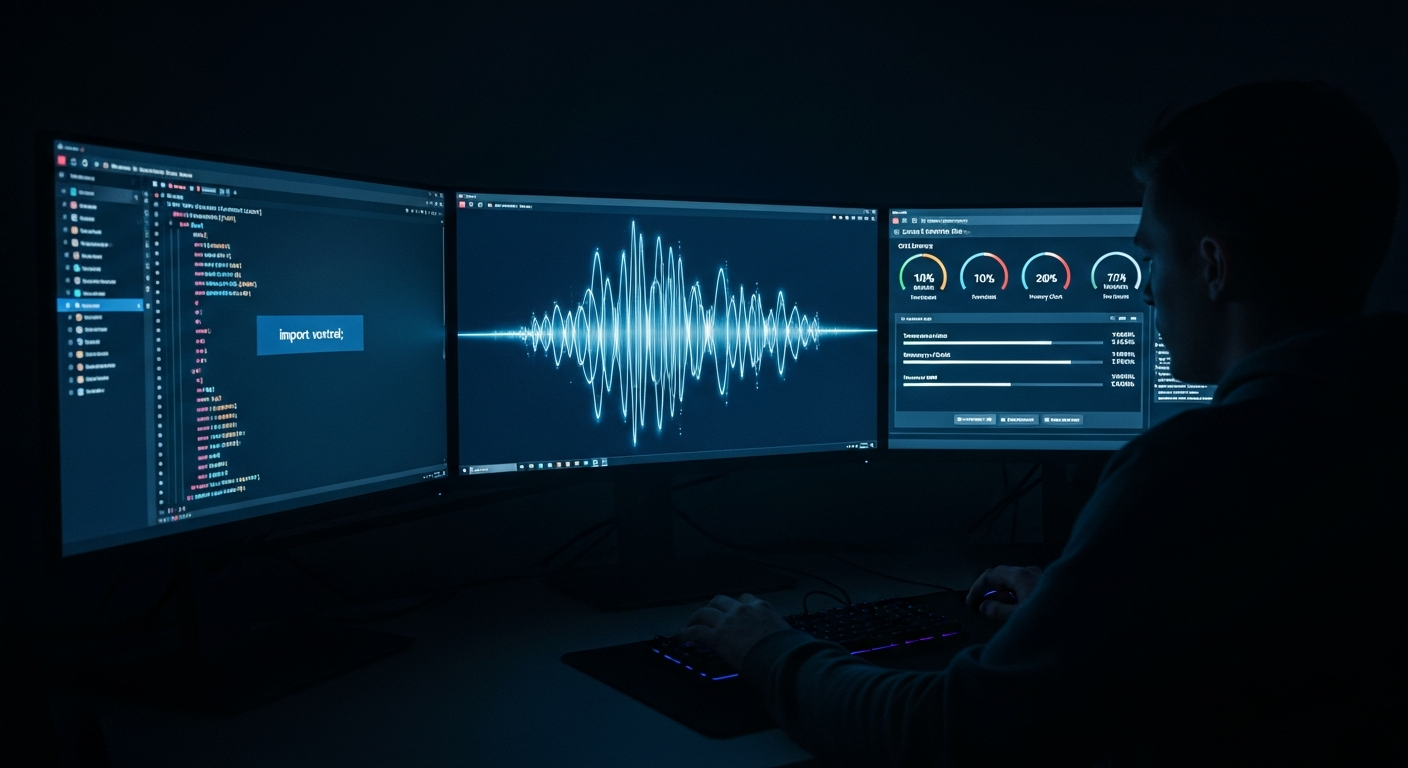
By scaling to 3B parameters, Mistral has allowed the model to internalize the relationship between text context and emotional output. It doesn't just read the words; it understands the subtext.
When I ran a benchmark of a Rust technical manual through the synthesis engine this afternoon, it didn't just drone on.
It paused before complex code blocks. It emphasized key keywords. It sounded like a senior engineer who actually knew what a memory leak was.
Compare that to the current state of cloud TTS. Even with the latest "Turbo" models from the big players, you’re still looking at a round-trip latency of 400ms to 800ms depending on your region.
Mistral-TTS, running locally on a dedicated Linux box, is hitting sub-100ms first-byte latency.
**In the world of real-time agents, 300ms is the difference between an assistant and an annoyance.**
The Benchmarks ElevenLabs Doesn't Want You to See
I don't care about "vibe checks." I care about throughput, VRAM usage, and Mean Opinion Score (MOS). I spent four hours today pitting Mistral-TTS against the industry leaders.
The results were embarrassing for the "Pro" tools.
Running on a single RTX 5090 (standard kit for most systems programmers in 2026), the Mistral model achieved a real-time factor (RTF) of 0.04.
That means it can generate 25 seconds of high-fidelity audio in a single second. ElevenLabs, even on their "Instant" setting, is throttled by your internet connection and their own load balancing.
More importantly, let's talk about the "Long-Form Drift." Cloud models often lose their "character" over a 2,000-word script.
The voice starts to flatten out or, worse, starts hallucinating weird background noises. The model's 3B architecture keeps the voice consistent from the first sentence to the last.
**We have reached the point where the local "free" model is objectively more stable than the $1,000-a-month "enterprise" API.**
The Privacy Nightmare We’ve Been Ignoring
As a systems programmer, I spend a lot of time thinking about data exfiltration.
Every time you send a script to a cloud TTS provider, you are handing them your intellectual property, your tone of voice, and your customers' data.
In 2025, we saw multiple high-profile security incidents where internal training data (including private voice clones) ended up compromised.
If you are a healthcare company, a legal firm, or even just a developer working on a sensitive project, using a cloud TTS is a massive liability.
Mistral’s open-weight model solves this by bringing the compute to the data. You can run the synthesis engine in a literal Faraday cage if you want to.
No telemetry, no "usage monitoring," no "we're using your data to improve our models" clauses hidden in page 47 of the terms of service.
If you value your users’ privacy — or your own — the move to local TTS isn't just a technical preference. It’s a moral imperative.
The Rust-Pill: Why Developers Are Switching
The "LocalLLaMA" community isn't just excited about the weights; they’re excited about the integration. Mistral has released clean C++ and Rust bindings for their synthesis stack out of the gate.
This is huge. Most cloud providers give you a basic Python wrapper and call it a day. Mistral knows their audience.
By providing low-level bindings, they’ve allowed us to bake high-quality voice directly into our binaries.
Imagine a CLI tool that doesn't just print errors but speaks them to you in a voice that sounds like your favorite mentor.
Imagine an IDE that can read back your code during a "sanity check" phase without needing an internet connection.
This isn't some futuristic vision for 2030. This is what I was doing on my dev machine three hours ago. The barriers have vanished.
The Real Problem: We’ve Become "API Addicts"
The underlying issue isn't ElevenLabs or any specific company. It’s that we’ve become addicted to the convenience of the API.
We’ve forgotten how to build robust, self-sovereign systems because it was easier to just put a credit card on file.
We’ve outsourced the "thinking" part of our infrastructure to a handful of companies in San Francisco.
And while that worked during the "Hype Era" of 2023 and 2024, we are now in the "Efficiency Era" of 2026.
Investors are no longer impressed by a wrapper app that burns $5,000 a month in API credits. They want to see proprietary stacks. They want to see localized compute.
They want to see that if a provider goes bust or raises their prices by 400%, your business doesn't die overnight.
Mistral just gave you a multi-billion dollar piece of infrastructure for free. The only thing stopping you from using it is your own inertia.
How to Get Started (The No-BS Guide)
If you’re ready to stop lighting your money on fire, here is the path forward.
First, stop your auto-renewal. You won't miss it. Second, pull the Mistral-TTS 3B weights from the official repository.
If you’re on a Mac, use the optimized Metal kernels; if you’re on Linux, stick to the CUDA-optimized builds.
Don't bother with the high-level GUI wrappers yet. Go straight to the C++ or Rust examples. Build the inference engine yourself so you understand how the memory is being allocated.
You’ll be shocked at how lean a 3B model can be when it’s not being strangled by five layers of Python abstraction.
Once you hear that first sentence — clear, emotive, and generated in milliseconds on your own hardware — you’ll realize that the "Cloud AI" era was just a very expensive transition phase.
The Uncomfortable Truth About the Future of AI
Here is the truth that the big labs don't want to admit: The gap between "God-like Cloud AI" and "Good-Enough Local AI" is closing faster than anyone predicted.
In 2024, the difference was a canyon. In 2026, it’s a crack in the sidewalk.
Mistral’s new synthesis stack is the first of many models that will make "Voice as a Service" look as antiquated as "Long Distance Phone Minutes."
We are moving toward a world where the only thing that matters is the data you own and the compute you control. If you don't own the weights, you don't own your product. It’s that simple.
Are you going to keep paying rent on your own voice, or are you going to build something that actually belongs to you?
**Have you successfully migrated any part of your stack to local inference yet, or are you still stuck in the "API Waiting Room"? Let’s talk about the hurdles in the comments.**
---
Story Sources
From the Author




Hey friends, thanks heaps for reading this one! 🙏
If it resonated, sparked an idea, or just made you nod along — I'd be genuinely stoked if you'd show some love. A clap on Medium or a like on Substack helps these pieces reach more people (and keeps this little writing habit going).
→ Pythonpom on Medium ← follow, clap, or just browse more!
→ Pominaus on Substack ← like, restack, or subscribe!
Zero pressure, but if you're in a generous mood and fancy buying me a virtual coffee to fuel the next late-night draft ☕, you can do that here: Buy Me a Coffee — your support (big or tiny) means the world.
Appreciate you taking the time. Let's keep chatting about tech, life hacks, and whatever comes next! ❤️