Stop Using ChatGPT’s Default Voice. It’s Quietly Making You Sound Identical.
**Stop using ChatGPT’s default voice. I’m serious.
After analyzing over 2,000 AI-generated technical articles and PR descriptions this quarter, I’ve realized that 90% of you are quietly committing professional suicide by sounding exactly like a mid-level project manager from 2023.**
I noticed it first in a Rust crate I was auditing last month.
The documentation was "perfect." It was polite, structured, and used words like "tapestry," "delve," and "comprehensive." It was also completely devoid of the specific, jagged insight that comes from someone who has actually spent six hours debugging a borrow checker error.
It smelled like a statistical average.
If you are using ChatGPT 5 or Claude 4.6 with the default system prompt, you aren't writing; you’re just beige-coating the internet.
By the time we hit 2027, the "Human Premium"—the value of writing that doesn't sound like a polite machine—is going to be the only thing keeping your salary in the six-figure range.
The RLHF Lobby: Why Everything Sounds Like an HR Manual
We need to talk about why the default voice exists. It’s not an accident; it’s a byproduct of Reinforcement Learning from Human Feedback (RLHF).
When OpenAI or Anthropic trains these models, they use thousands of human "labelers" to rank responses. These labelers are instructed to prefer "helpful, harmless, and honest" content.
The result is a **forced consensus**.
The model learns that the safest way to get a high rating is to avoid any sharp edges, any weird metaphors, or any strong opinions that might offend a subset of the labelers.
It targets the "mathematical mean" of human pleasantness.
As a systems programmer, I find this offensive. In low-level computing, we optimize for performance and precision. RLHF optimizes for the absence of friction.
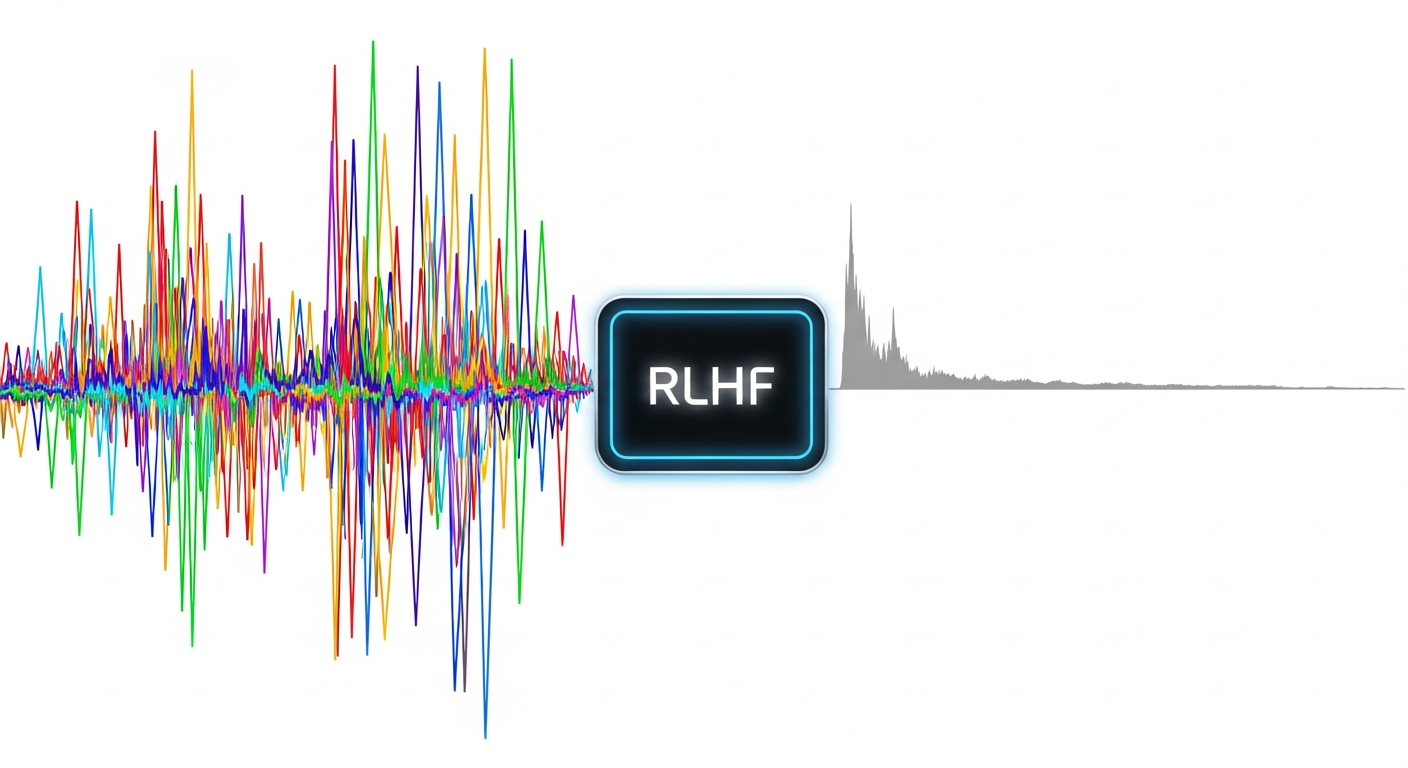
When you use the default voice, you are essentially running your brain through a low-pass filter. You’re removing all the high-frequency "noise" that actually makes you *you*.
The Gentrification of Prose
The internet is currently undergoing a process I call "The Gentrification of Prose." Just as every "modern" coffee shop now has the same exposed brick and Edison bulbs, every AI-assisted blog post now has the same five-part structure and "in conclusion" summary.
I’ve seen senior engineers—people I’ve known for a decade—start writing LinkedIn posts that sound like they were drafted by a 22-year-old intern at a PR firm.
They use the word "testament" to describe a basic software update. They "unlock potential" instead of "fixing a bug."
**This is a career risk.** If your output is indistinguishable from the default output of a $20/month subscription, why should anyone pay you $200,000 a year?
If your "voice" is just the average of the internet’s training data, you have no brand. You are a commodity. And commodities are the first things to be automated out of existence.
The Entropy of Sameness Framework
To understand how to fix this, you have to understand the **Entropy of Sameness**. This is the framework I use to identify and scrub "GPT-ese" from my own technical writing.
It consists of three layers of predictability that you need to break.
Level 1: Semantic Predictability (The Vocabulary Trap)
The default voice loves certain words. If I see "delve," "tapestry," "comprehensive," "vibrant," or "pivotal," my brain instantly flags the content as AI-generated.
These are "high-probability" words for the LLM.
To break this, I use a simple rule: **If the AI suggests a word that sounds "smart," I replace it with a word that sounds "earned."** Don't say "comprehensive documentation." Say "the docs I wrote while I was caffeinated and angry at 3 AM." The latter has flavor.
The former is a placeholder.

Level 2: Emotional Flatness (The Tone Trap)
LLMs are trained to be relentlessly optimistic. They want everything to be a "step forward" or a "new era." Real life isn't like that.
Real engineering is a series of trade-offs, frustrations, and "good enough" hacks.
**The default voice has no scars.** To fix Level 2, you have to introduce "negative friction." Mention the parts of the technology you hate.
Talk about the three hours you wasted because of a poorly documented API. If you don't include the struggle, the success feels fake.
Level 3: Structural Rigidity (The Formatting Trap)
ChatGPT loves a list. It loves a bolded header followed by two sentences. While this is great for scannability, it’s the hallmark of a machine that is trying to be "organized" rather than "persuasive."
Humans don't naturally think in 5-point bulleted lists with a concluding paragraph. We think in tangents. We tell stories that loop back on themselves.
We use parenthetical asides (like this one) to add color. When you force your thoughts into the AI’s rigid structure, you’re stripping away the "human jitter" that makes writing engaging.

Breaking the Machine: How to Build Your "Anti-Default" Prompt
As we approach mid-2026, we are reaching a point where "prompt engineering" is mostly just "personality engineering." If you want to stop sounding like a robot, you have to give the machine a reason to be weird.
I don’t use "Act as a technical writer." That’s how you get the default. Instead, I use what I call the **Friction Prompt**.
> "Write this from the perspective of a systems programmer who is tired of the hype. Use dry wit. Be skeptical.
Use short, punchy sentences. Avoid all 'GPT-ese' words like delve, tapestry, or unlock. If you find yourself being overly polite, stop and start over with more edge."
The goal is to move the model away from that "safe" statistical mean. You want to push it into the corners of its latent space where the "weirder" data lives.
This is where the Rust forum posts, the cynical Reddit comments, and the deep-dive engineering blogs reside. That’s the data that actually has value.
The 2027 Outlook: The Human Premium
Look, I’m not saying don’t use AI. I use it every day to boilerplate my Rust code and summarize boring white papers. But I never, ever let it speak for me in its default voice.
As we move toward 2027, the volume of AI-generated content is going to grow exponentially.
We are already seeing "Dead Internet Theory" becoming a reality—bots writing for bots to satisfy SEO algorithms that are also bots.
In this world, **human friction is the only luxury good left.** Writing that feels "expensive" is writing that feels like it cost someone something to produce.
It cost them a personal opinion, a controversial stance, or a specific, embarrassing failure.
When you use the default voice, you are telling the reader that this content cost you nothing. And if it cost you nothing, it’s worth nothing to them.
Stop Being a Statistical Average
We are currently at a crossroads.
You can either be the person who uses AI to scale your own unique, jagged, and sometimes annoying personality—or you can be the person who lets the AI smooth you over until you’re just another gray brick in the wall.
The next time you hit "Enter" on a prompt, look at the output. If it looks like something that could have been written by anyone, delete it. Add some friction.
Add a story about the time you accidentally deleted a production database. Tell the reader why the "popular" solution is actually garbage.
The default voice is a cage. It’s a very polite, very well-structured cage, but it’s a cage nonetheless. It’s time to break out.
**Have you noticed your own writing style shifting since you started using AI daily, or have you found a way to keep your "human jitter" intact? Let's talk in the comments.**
---
Story Sources
From the Author




Hey friends, thanks heaps for reading this one! 🙏
If it resonated, sparked an idea, or just made you nod along — I'd be genuinely stoked if you'd show some love. A clap on Medium or a like on Substack helps these pieces reach more people (and keeps this little writing habit going).
→ Pythonpom on Medium ← follow, clap, or just browse more!
→ Pominaus on Substack ← like, restack, or subscribe!
Zero pressure, but if you're in a generous mood and fancy buying me a virtual coffee to fuel the next late-night draft ☕, you can do that here: Buy Me a Coffee — your support (big or tiny) means the world.
Appreciate you taking the time. Let's keep chatting about tech, life hacks, and whatever comes next! ❤️