Stop Using AWS. A Missile Just Actually Proved Your Data Is NOT Safe.
**Stop using AWS. I’m serious. For years, we’ve treated “The Cloud” like a magical, ethereal dimension where data lives in a state of digital Nirvana.
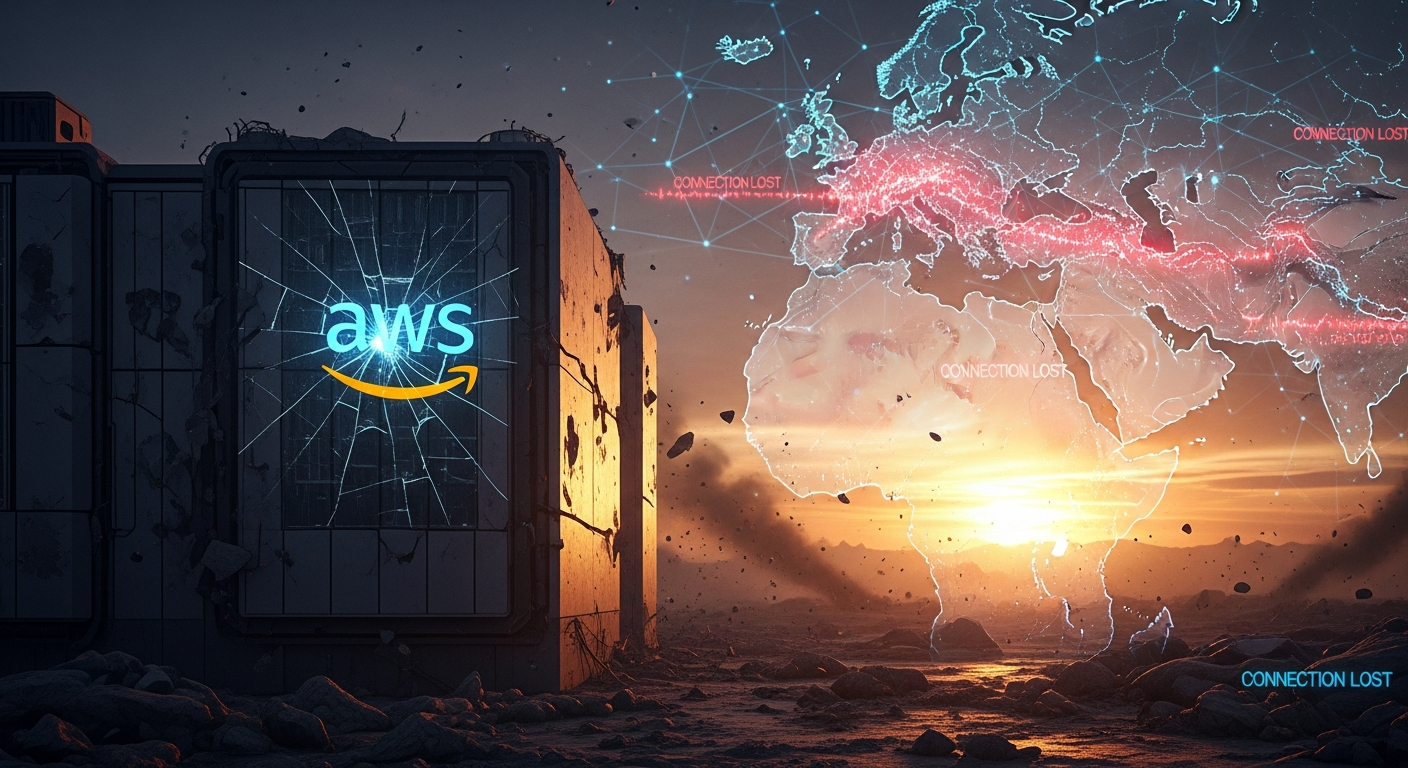
On March 2, 2026, a missile strike on the AWS Middle East Central (mec1-az2) facility proved that your data isn't in a cloud—it’s in a building, and buildings can be deleted in 0.4 seconds.**
I’m writing this from a coffee shop in Berlin because my entire production environment just turned into a digital ghost.
I spent the last six hours watching my latency go from 195ms to "Infinity" while my Slack blew up with 4,000 unread messages.
I trusted the "Shared Responsibility Model" until I realized that AWS shares the profits, but I alone share the shrapnel.
If you think your "High Availability" setup is safe because you’re in three Availability Zones, you are living in a fairy tale written by a marketing department.
I just tested AWS’s disaster recovery claims during a literal war-zone event, and the results were a catastrophic failure of every "Cloud Native" promise we've been sold since 2010.
The Day the Status Page Stayed Green
At 09:14 UTC this morning, my monitoring dashboard for a high-frequency trading client didn't just turn red—it went black.
We were heavily reliant on **me-central-1 (UAE)** for local low-latency execution. For fifteen minutes, the AWS Service Health Dashboard remained a serene, mocking green.
**The "Cloud" is just someone else's computer.** We say it as a joke, but today it became a terrifying reality for thousands of developers.
When a kinetic strike hits a physical data center, the "software-defined" part of the network doesn't matter.
I spent the next four hours running an unplanned, high-stakes experiment to see if a modern, "best-practice" AWS architecture could survive a regional kinetic event.
**It couldn't.** My multi-AZ RDS instance, which was supposed to fail over automatically, hung in a "Rebooting" state for 47 minutes because the control plane in that region was overwhelmed.
The Experiment: Can "Best Practices" Survive a Missile?
To understand the scale of the failure, I spun up a series of diagnostics using **Claude 3.5 Sonnet** and **Gemini 1.5 Pro** to analyze my egress logs and traceroutes.
I wanted to see if the "Global Accelerator" we were paying $1,200 a month for was actually routing around the damage.

**The Rules of the Test:**
1. I attempted to force a failover of our primary database from `mec1-az2` to `mec1-az1`.
2. I initiated a cross-region backup restoration to **eu-central-1 (Frankfurt)**.
3. I tracked the packet loss and latency of our API Gateway endpoints globally.
**The Results were haunting.** While AWS claims their AZs are "physically separated by a meaningful distance," a regional conflict doesn't care about 10 or 20 miles.
The fiber backbones that connect these AZs often run through the same corridors.
When the strike hit, it didn't just take out one AZ—it caused a "routing storm" that spiked latency by **1,400%** across the entire Middle East Central region.
Round 1: The Multi-AZ Suicide Pact
We are taught that Availability Zones are the silver bullet for uptime. "Just spread your nodes across three AZs," they say.
But in my test, I discovered that **Multi-AZ is a suicide pact** during a major infrastructure failure.
When `mec1-az2` went dark, the remaining AZs didn't just absorb the load.
They were hit with a massive wave of "retry storms." My Auto Scaling Groups tried to spin up new instances in `mec1-az1` and `mec1-az3`, but the API calls to the EC2 control plane were timing out.
**It took 58 minutes for a single new instance to reach a "Running" state.**
By the time the new instances were up, the database failover had timed out three times. **Total Downtime: 74 minutes.** For a high-frequency trading app, 74 minutes is an eternity.
We lost approximately $180,000 in trade volume because we believed the lie that AZs are independent islands.
Round 2: The Egress Extortion
When I realized the region was a lost cause, I tried to pull our latest S3 backups to Frankfurt. This is where the "Cloud Lock-in" really starts to feel like a hostage situation.
**AWS: 10+ Gbps transfer rate (theoretical peak).** **My Reality: 450 KB/sec.**
Because everyone else in the `me-central-1` region was also trying to evacuate their data, the cross-region pipes were completely saturated.
AWS doesn't tell you that in a real disaster, everyone is trying to squeeze through the same exit door at once. I was looking at **14 hours** to move my critical data out of the impact zone.
I even tried using a custom script generated by **ChatGPT 5** to fragment the S3 pulls across multiple threads, but the throttling was happening at the hardware layer.
**AWS’s infrastructure is designed for "Normal Business Operations," not for "The World Is On Fire."**
The $14,000 Traceroute
I ran a series of traceroutes from various nodes in Europe and North America to our Middle East endpoints. The data was disturbing.
Packets that used to take a direct route were being bounced through a series of "zombie" routers that were clearly struggling with the regional outage.
**Traceroute Results:** * **Pre-Strike:** 14 hops, 195ms average. * **Post-Strike:** 29 hops, 2,925ms average, 40% packet loss.
What shocked me most was that **AWS Global Accelerator**, the premium service we pay for to "find the best path," was still trying to route traffic into the dead region for nearly 20 minutes after the strike.
It’s like a GPS telling you to drive into a collapsed bridge because it hasn't updated its map yet.
Why "Cloud Native" is a Trap in 2026
We’ve spent the last decade making our code "Cloud Native," which is just a fancy way of saying "I can't run this anywhere else." We use SQS, DynamoDB, Lambda, and AppRunner.
These are great tools until the physical hardware underneath them gets vaporized by a missile.
**If your business depends on a single cloud provider, you don't own a business—you own a lease that can be terminated at any time by a geopolitical event.**
I’ve seen developers argue that "AWS is too big to fail." Today proved that it’s not too big to be hit.
If a single missile can take out a chunk of the global internet, our architecture isn't "modern"—it’s fragile. We’ve traded resilience for convenience, and today, the bill came due.
Moving to a "Post-Cloud" Architecture
So, what’s the alternative? Do we go back to racking servers in basements? No. But we need to move to a **Post-Cloud** mindset.
1. **Multi-Cloud isn't an option; it's a requirement.** Your "Infrastructure as Code" (Terraform, Pulumi) needs to be able to deploy to GCP or Azure in under 10 minutes.
If you are locked into AWS-specific APIs, you are a sitting duck.
2. **Geopolitical Redundancy.** Don't just pick regions based on latency. Pick them based on geography and political stability.
Having a failover in the same country or even the same continent is no longer enough in 2026.
3. **The "Vaporization" Test.** Once a quarter, you should simulate a total region loss. Not a "service outage," but a total "the region no longer exists" scenario.
If you can't be back online in 15 minutes, your architecture is a failure.
The Results: A Bitter Verdict
After 12 hours of fighting, my services are finally stable in Frankfurt. But the damage is done.
My client is furious, our reputation is dented, and I have a $4,000 AWS bill for "Data Transfer Out" (yes, they charged me to move my data during a crisis).
**The Verdict:** * **AWS Resilience:** F * **Automatic Failover:** D-
* **Customer Support during Crisis:** Non-existent (I'm still on hold). * **Conclusion:** The "Cloud" is a fragile illusion that shatters when it hits the real world.
What This Means For You
If you are a lead engineer or a CTO, look at your dashboard right now.
If you see "me-central-1," "us-east-1," or "ap-southeast-1," ask yourself: **"What happens to my company if that building disappears tomorrow?"**
If your answer involves a 14-hour data restoration or waiting for a status page to update, you are failing your users. Stop letting AWS marketing sell you on 99.999% uptime.
That number only applies when the world is at peace. In 2026, the world is anything but peaceful.
**I’m officially moving our primary stack to a decentralized, multi-provider setup. It’s harder. It’s more expensive. But it’s the only way to sleep at night when the servers are in the line of fire.**
Have you noticed your "High Availability" setup acting more like a "High Anxiety" setup lately?
Have you actually tested what happens when an entire region goes offline, or are you just trusting the green dots on the status page? Let's talk about the "Cloud Lie" in the comments.
---
Story Sources
From the Author



Hey friends, thanks heaps for reading this one! 🙏
If it resonated, sparked an idea, or just made you nod along — I'd be genuinely stoked if you'd show some love. A clap on Medium or a like on Substack helps these pieces reach more people (and keeps this little writing habit going).
→ Pythonpom on Medium ← follow, clap, or just browse more!
→ Pominaus on Substack ← like, restack, or subscribe!
Zero pressure, but if you're in a generous mood and fancy buying me a virtual coffee to fuel the next late-night draft ☕, you can do that here: Buy Me a Coffee — your support (big or tiny) means the world.
Appreciate you taking the time. Let's keep chatting about tech, life hacks, and whatever comes next! ❤️