Stop This 'Quiet' Money Fixation. It’s Actually Destroying Every Millennial Dad.

Stop This 'Quiet' Money Fixation. It’s Actually Destroying Every Millennial Dad.
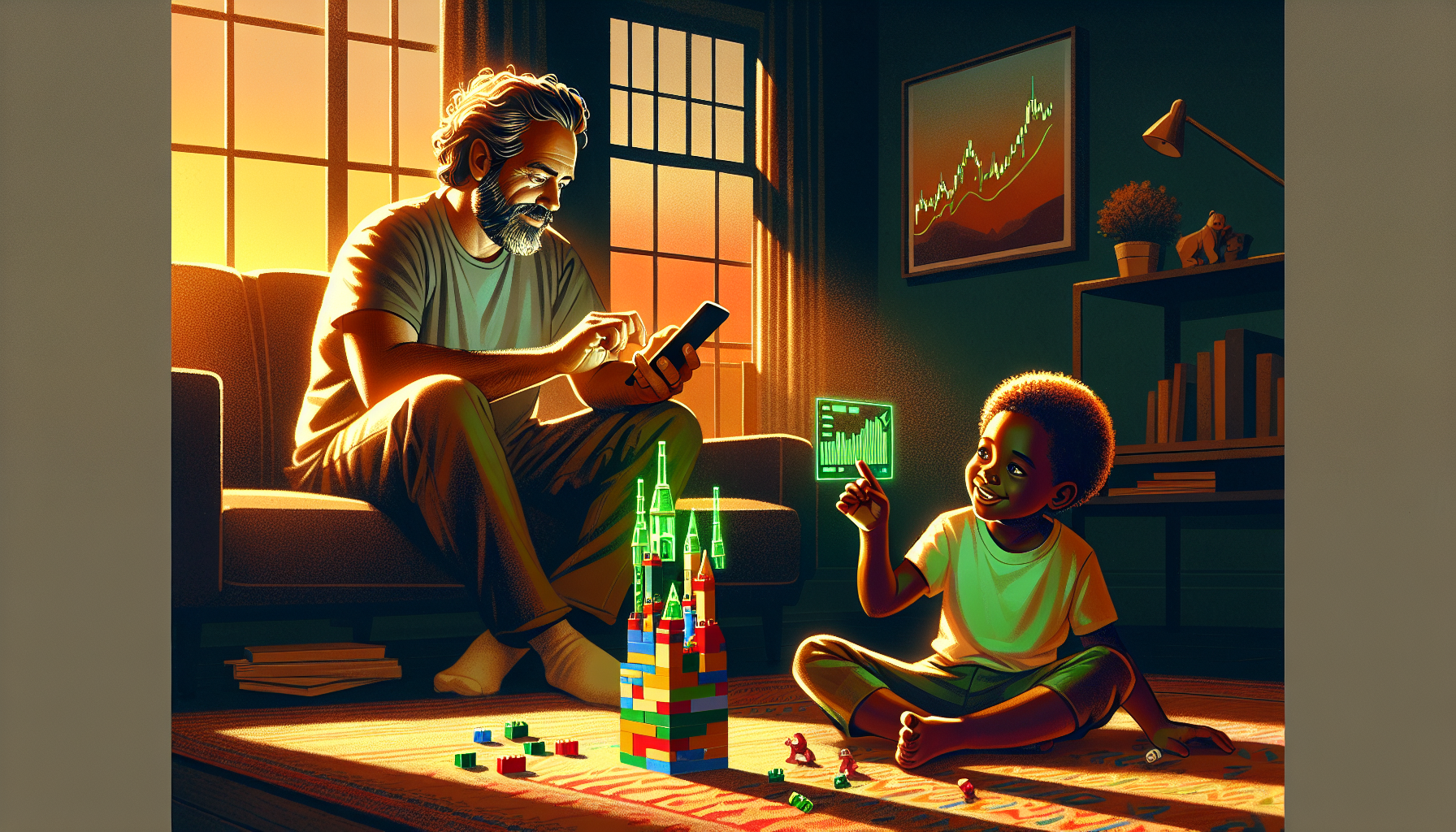
I watched my son build a Lego tower for forty-five minutes last Saturday, but I wasn’t actually there.
Physically, I was on the living room rug, but mentally, I was deep inside a spreadsheet I’d refreshed six times since breakfast.
**I was calculating the compound interest on a portfolio that won't be "ready" until 2045, while the human being I care about most was asking me to look at his "super-cool" tower.**
This is the "quiet" money fixation. It’s not the flashy, Lamborghini-buying greed of the 80s or the crypto-bro hysteria of the early 20s.
**It’s a low-grade, constant hum of financial anxiety that has become the background noise of millennial fatherhood in 2026.** We aren't trying to be rich; we are trying to be "safe," and that distinction is exactly what’s killing our ability to actually live.

The Optimization Trap: Why 2026 Feels So Precarious
For those of us in tech, the pressure has reached a boiling point. We’ve watched the industry shift from "software is eating the world" to "AI is rewriting the stack" in the span of three years.
**With Claude 4.6 and ChatGPT 5 handling the heavy lifting of architectural design and unit testing, the career path that felt like a guaranteed win in 2018 now feels like a moving target.**
We respond to this uncertainty by trying to "optimize" our way out of fear. We tell ourselves that if we can just hit a certain net worth by 2028, we’ll finally be able to breathe.
**We treat our lives like a DevOps pipeline where every dollar is a resource to be allocated for maximum efficiency, forgetting that a childhood isn't a project to be "shipped."**
This fixation is "quiet" because we don't talk about it at the playground.
We talk about school districts and sleep schedules, but internally, we are running Monte Carlo simulations on our retirement accounts.
**We are the first generation to have real-time access to our entire financial existence in our pockets, and it has turned us into high-frequency traders of our own peace of mind.**
The 2008 Ghost That Never Left the Room
Most millennial dads entered the workforce or finished college right as the 2008 financial crisis hit. We saw the "guaranteed" path crumble in real-time.
**That trauma didn't disappear; it just mutated into a desperate need for a financial moat that is never wide enough.** We don't trust the institutions, so we put the entire burden of safety on our own shoulders.
In 2026, that burden is heavier than ever because the definition of "enough" keeps moving.
Between the rising costs of "the basics" and the pressure to provide a curated, high-achieving life for our kids, the goalposts aren't just shifting—they’re on a high-speed rail.
**We are working longer hours to buy things we don't have time to use, to save for a future we are too tired to imagine.**
I’ve met dozens of senior engineers and product leads who are making more money than their parents ever dreamed of, yet they feel poorer.
**They are obsessed with "Side Hustles" and "Passive Income" not because they want a yacht, but because they are terrified of the day the AI-driven layoffs finally hit their department.** It’s a survival mechanism that has outlived its usefulness and started attacking the host.
The "Invisible" Cost of the Spreadsheet
The real tragedy of this fixation isn't just the stress; it's the cognitive load.
**Every minute you spend checking the markets or researching "tax-loss harvesting" is a minute of emotional presence you are stealing from your family.** Your kids don't need a dad with a perfect 401k; they need a dad who can finish a story without glancing at a notification from his brokerage app.
When we are fixated on the "number," we stop seeing people as people and start seeing them as expenses or investments.
**We find ourselves sighing at the cost of a summer camp not because we can't afford it, but because we’re mentally calculating how many shares of an index fund that money could have bought.** That’s a miserable way to live, and our kids can feel the friction.
Moreover, this fixation creates a "comparison debt." We look at the dads on Instagram who seem to have the high-growth career *and* the perfect minimalist home *and* the time for 5 AM rucks.
**We assume they’ve solved the money puzzle, so we double down on our own spreadsheets, trying to find the "missing link" that will finally make us feel successful.**
Introducing the POP Protocol: Presence Over Portfolio
If we want to break this cycle, we need a framework that isn't about "doing more," but about "being more." I call it the **POP Protocol (Presence Over Portfolio)**.
It’s a three-step system designed to move you from a state of financial hyper-vigilance to a state of intentional living.
Step 1: The Spreadsheet Sabbath
You need to implement a hard rule: **No financial apps, market checks, or "optimization" research from Friday at 5 PM until Monday at 9 AM.** In our world of 24/7 connectivity, we’ve forgotten that most financial decisions don't need to be made on a Saturday morning.
Use this time to "delete the cache" of your brain.
If a financial worry pops up, write it down on a physical piece of paper and tell yourself, "I will deal with this on Monday." **By creating a container for your anxiety, you prevent it from leaking into your weekend and poisoning your time with your kids.**
Step 2: The "Enough" Audit
Most of us are chasing a number that we haven't actually defined. We just want "more" because "more" feels safer.
**The Enough Audit requires you to sit down—ideally with your partner—and define exactly what a "good life" looks like for your family in 2026.**
Does it mean a house with a yard? Does it mean being able to take a month off in 2027?
**Once you define "Enough," anything above that isn't "safety"—it’s just noise.** When you know your target, you can stop running the race at 100mph and start walking at a pace that allows you to actually see the scenery.
Step 3: Micro-Experiences over Macro-Savings
We are obsessed with the "Macro"—the big retirement, the college fund, the legacy.
But life is lived in the "Micro." **The POP Protocol suggests taking 5% of the money you were planning to "optimize" or "reinvest" and spending it immediately on a low-friction family experience.**
I’m not talking about a Disney trip that requires six months of planning.
I’m talking about the "Yes Day." **The Friday night where you say yes to pizza, the movies, and staying up late, without once checking the bank account.** These micro-moments are the things your kids will actually remember; they won't remember the year you successfully rebalanced your Roth IRA.
Real-World Application: The "Sunday Scary" Reframe
I used to spend my Sunday nights in a state of dread, staring at my calendar and my bank balance. I felt like I was "behind," even though by every objective metric, I was doing fine.
**Now, when that "quiet" fixation starts to creep in, I use a technique called "The Five-Year Flash-Forward."**
I ask myself: "In five years, will I remember the $2,000 I saved by skipping this family weekend, or will I remember the look on my daughter’s face when she finally learned to ride her bike?" **The answer is always the same.** The money is a tool, not the destination.
For the developers reading this: your value isn't your ability to ship code faster than an LLM.
**Your value is your ability to solve human problems, and the most important "human problem" you have is being present for the people who love you.** Don't let the pursuit of "future safety" rob you of your "current life."
Defining "Enough" in an Era of "More"
We live in a world designed to make us feel inadequate. Every algorithm is tuned to show us what we’re missing.
**To be a sane millennial dad in 2026 is to be a rebel—it’s to look at the "More" culture and say, "Actually, I have what I need."**
This doesn't mean being financially irresponsible. It means being **emotionally responsible**. It means recognizing that your kids' childhood is a non-renewable resource.
**You can always make more money in 2030, but you can't go back and play blocks with your four-year-old once they’re fourteen.**
The "quiet" fixation is a thief. It steals the present and sells it back to you as a "secure future" that may never arrive. **Stop checking the Vanguard app on a Tuesday night.
Put the phone in a drawer. Sit on the rug.** The ROI on that thirty minutes is higher than any index fund in history.
**Have you noticed yourself "checking out" mentally to check your finances lately, or is it just me?
I’d love to hear how you’re balancing the pressure to provide with the need to be present — let’s talk in the comments.**
---
Story Sources
From the Author




Hey friends, thanks heaps for reading this one! 🙏
If it resonated, sparked an idea, or just made you nod along — I'd be genuinely stoked if you'd show some love. A clap on Medium or a like on Substack helps these pieces reach more people (and keeps this little writing habit going).
→ Pythonpom on Medium ← follow, clap, or just browse more!
→ Pominaus on Substack ← like, restack, or subscribe!
Zero pressure, but if you're in a generous mood and fancy buying me a virtual coffee to fuel the next late-night draft ☕, you can do that here: Buy Me a Coffee — your support (big or tiny) means the world.
Appreciate you taking the time. Let's keep chatting about tech, life hacks, and whatever comes next! ❤️