Stop Procrastinating. My Dad’s Secret 2-Minute Rule Actually Changes Everything

**Lena Morales** — Former therapist turned writer. Covers self-help, habits, and mental clarity.
Stop Procrastinating. My Dad’s Secret 2-Minute Rule Actually Changes Everything
**I deleted every productivity app on my phone last month. All of them.
What happened over the next 30 days rewired how I think about focus — and exposed the $70+ billion industry that's been lying to us about why we can't seem to just start the work.**
For years, I sat in a clinical office listening to high-performers complain about "burnout," when what they were actually experiencing was the paralyzing weight of a thousand unstarted tasks.
We’ve been conditioned to believe that procrastination is a character flaw or a lack of discipline.
We buy the planners, we download the AI-powered schedulers, and we wait for the "motivation" to strike like lightning.
But as a former therapist, I’m going to tell you something that the "optimization" gurus won't: **Procrastination isn't a time-management problem; it's an emotion-regulation problem.** Your brain isn't avoiding the task; it's avoiding the feelings of inadequacy, boredom, or fear associated with the task.
I spent a decade studying the neurobiology of avoidance, but the most effective cure I ever found didn't come from a textbook.
It came from my dad, a man who never owned a smartphone until 2019 and whose "system" consisted of a yellow legal pad and a blunt refusal to overthink.
He called it his **"Just Touch It" rule**, and in the spring of 2026, it is officially the only thing keeping my career afloat.
The Horror Movie Living in Your To-Do List
We treat our to-do lists like horror movies where we never actually see the monster.
When you look at a task like "Prepare Q1 Financial Report," your amygdala—the part of your brain responsible for the fight-or-flight response—registers a threat.
It doesn't see a spreadsheet; it sees a potential for failure, a weekend of lost sleep, and the judgment of your peers.
In response, your brain "protects" you by suggesting a hit of easy dopamine instead.
Suddenly, checking your email for the fourteenth time or reorganizing your desktop icons feels like a survival mechanism.
This is what we call **productive procrastination**, and it is the most dangerous form of avoidance because it feels like work.
Research in *The Journal of Clinical Psychology* suggests that chronic procrastinators (which now includes about 26% of the adult population in 2026) have higher levels of cortisol even when they aren't working.
**The "cost" of not doing the thing is actually higher than the effort required to do it.** We are literally stressing ourselves into early graves to avoid 15 minutes of focused effort.
Why Your "Optimization" Apps Are Making You Worse
The $70+ billion productivity industry relies on "meta-work"—the act of organizing work rather than doing it.
I’ve seen patients spend three hours setting up a Notion dashboard only to feel too exhausted to actually write the blog post they were planning.
By the time you’ve categorized, tagged, and color-coded a task, you’ve exhausted your prefrontal cortex’s limited daily energy.
My dad’s method bypasses this entire energy drain.
He didn't believe in "systems" because he understood that **friction is the enemy of initiation.** If you have to open an app, log in, and navigate three menus to see what you need to do, you've already given your brain five "exit ramps" to go check Instagram instead.
He lived by a simple, almost aggressive rule: **If you’re thinking about it, just touch it for two minutes.** Not "finish it." Not "do it well." Just touch it.
This isn't just a quirky dad-ism; it’s a clinical workaround for the "Wall of Awful"—that emotional barrier that makes a simple task feel like climbing Everest.
The Physics of the Atomic Start
There is a concept in physics called static friction. It is significantly harder to get a heavy object moving from a standstill than it is to keep it moving once it’s in motion.
Your brain works the exact same way. The hardest part of any task—from writing a line of code to doing the dishes—is the **transition from "not doing" to "doing."**
My dad’s 2-minute rule is designed to hack this transition. The rule is simple: **You must commit to doing the task for exactly 120 seconds.** After that, you are legally and morally allowed to stop.
There is no catch. If you want to walk away after two minutes, you can.
Why does this work? Because it shrinks the "threat" perceived by the amygdala. Your brain can’t really be afraid of two minutes of work.
It’s too small to be scary. By lowering the bar to the floor, you bypass the emotional resistance that causes the freeze response. **The goal isn't the work; the goal is the initiation.**
Introducing the "Initiation Protocol"
To make this work in a modern, 2026 tech environment, I’ve refined Dad’s rule into a three-step framework I call the **Initiation Protocol.** I use this with every client I coach, and I used it this morning when I didn't want to get out of bed to write this.
1. The Atomic Declaration
Instead of saying "I need to write this article," you must declare an atomic action that takes less than 30 seconds to start. "I am going to open a blank Google Doc and type a title." That’s it.
**If the description of the task sounds like a project, your brain will reject it.** Make it a single physical movement.

2. The 120-Second "No-Judgment" Timer
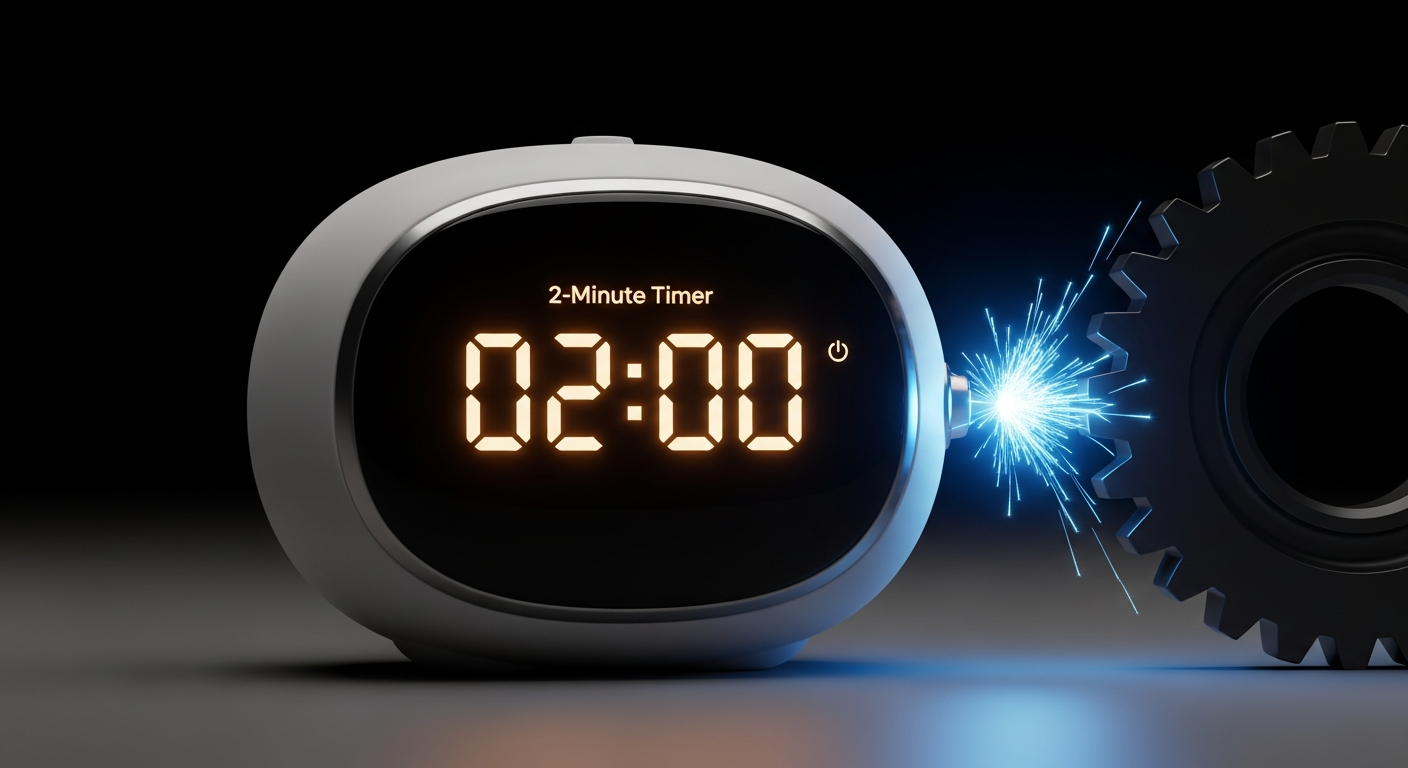
Set a physical timer—not one on your phone where notifications live. For the next two minutes, you are in a "no-judgment zone." You don't have to be good; you just have to be present.
If you’re a developer, you aren't writing "perfect" code; you’re just typing comments. **Quantity of presence matters more than quality of output during the initiation phase.**
3. The Momentum Audit
When the timer goes off, you must ask yourself: "Am I in motion?" 95% of the time, the answer is yes.
Once the Zeigarnik Effect kicks in—a psychological phenomenon where our brains want to finish what we've started—the "threat" has vanished.
The monster in the horror movie turned out to be a hand puppet.
Procrastination Is a Form of Self-Harm
As a therapist, I have to be blunt here: **Chronic procrastination is a form of self-harm.** Every time you break a promise to yourself, you chip away at your self-trust.
You begin to develop an identity as "someone who doesn't finish things." That identity is more damaging to your career than any missed deadline.
When my dad was fixing an old engine in the garage, he didn't wait until he felt "inspired" by the carburetor.
He would walk out, pick up a wrench, and say, "I'm just going to loosen one bolt." Half the time, he’d come back in four hours later, covered in grease, with a working engine.
He understood that **action creates motivation, not the other way around.** We’ve been taught to wait for the feeling before we act.
But in reality, the "feeling" of motivation is a byproduct of progress. Even the smallest amount of progress—loosening one bolt—releases a small hit of dopamine that fuels the next two minutes.
The 2026 Focus Crisis Is Real
We are currently living through what sociologists are calling the "Great Fragmentation." With the rise of wearable AI and constant "context-switching," our collective attention span has dropped to about 47 seconds.
In this environment, a 2-minute rule isn't just a tip; it's a survival strategy.
If you try to "focus" for four hours, you will fail. The world is designed to stop you from doing that. But you can always find two minutes.
**The 2nd-minute is the gateway to the 20th-minute.** By mastering the art of the "short start," you become immune to the distractions that are currently dismantling everyone else's productivity.
I’ve seen this rule save marriages (starting the "hard" conversation for two minutes) and save startups (writing the first line of the pitch deck).
It works because it respects human biology instead of trying to override it with "willpower." Willpower is a finite battery; the 2-minute rule is a solar panel.
Stop Waiting for the "Right" Time
There is no "perfect" state of mind for doing hard work. If you wait until you feel ready, you will be waiting until the heat death of the universe.
My dad’s secret wasn't that he was more disciplined than anyone else—it was that he was **willing to be mediocre for two minutes.**
Most of us are procrastinating because we are perfectionists. We are so afraid of doing a "bad" job that we choose to do "no" job. But you can't edit a blank page.
You can't fix a car you haven't touched. You can't debug code that doesn't exist.
**Your only job today is to be "in motion" for 120 seconds.** Pick the one thing on your list that is currently making your stomach knot up. Don't look at the whole project. Just touch it.
Open the file. Write one sentence. Loosen one bolt. The version of you that exists two minutes from now will know exactly what to do next.
**What is the one "monster" task you've been avoiding all week? If you committed to just "touching it" for two minutes right now, what would those first 120 seconds look like?
Let’s hold each other accountable in the comments.**
---
Story Sources
From the Author



Hey friends, thanks heaps for reading this one! 🙏
If it resonated, sparked an idea, or just made you nod along — I'd be genuinely stoked if you'd show some love. A clap on Medium or a like on Substack helps these pieces reach more people (and keeps this little writing habit going).
→ Pythonpom on Medium ← follow, clap, or just browse more!
→ Pominaus on Substack ← like, restack, or subscribe!
Zero pressure, but if you're in a generous mood and fancy buying me a virtual coffee to fuel the next late-night draft ☕, you can do that here: Buy Me a Coffee — your support (big or tiny) means the world.
Appreciate you taking the time. Let's keep chatting about tech, life hacks, and whatever comes next! ❤️