Stop Ignoring the Strait Warning. It’s Actually Worse Than You Think.
**Stop ignoring the Strait warning. I’m serious.
After watching the global markets react to the President’s latest ultimatum, I realized our "digital-first" economy is actually a house of cards built on a 15-mile-wide strip of water — and the collapse is going to cost you more than just a higher gas bill.**
I spent most of 2025 telling anyone who would listen that our supply chains were finally "resilient." I pointed to the new chip factories in Ohio and the diversification of our lithium sourcing.
I thought we had finally learned our lesson from the 2020s and built a world that could withstand a few localized shocks.
I was wrong. I was looking at the spreadsheets and ignoring the geography.
When President Trump dropped that "Open the Strait" bomb on r/popular this morning, it wasn't just another viral soundbite to be memed into oblivion.
It was the sound of the 20th century violently colliding with the 2026 tech stack, and most of us are completely unprepared for the impact.
The reality is that we’ve spent the last decade making ourselves more dependent on physical transit than at any point in human history.
We think because we use **Claude 4.6** and host our apps on **Gemini 2.5’s** edge network that we are somehow "above" the messy world of tankers and blockades. We aren't.
In fact, the more "AI-native" we become, the more we are tied to the very Straits that are currently being threatened with "Hell."
The 30% Problem You’re Ignoring
When you hear "The Strait," your brain probably defaults to oil. You think about the price of a gallon of gas or the cost of heating a home.
That’s the old-school way of looking at it, and it’s why so many smart people are underestimating the current warning.
**The Strait of Hormuz and the Bab-el-Mandeb aren't just oil arteries; they are the central nervous system of the global hardware trade.** Over 30% of the world’s liquefied natural gas (LNG) and a massive chunk of the raw materials required for semiconductor manufacturing pass through these chokepoints.
If these gates close, even for a week, the "just-in-time" manufacturing of everything from server racks to consumer electronics doesn't just slow down — it stops.
I realized the gravity of this three months ago when I tried to audit the hardware lifecycle for a small AI startup.
We found that even though they were "software only," their entire roadmap depended on a specific H100-successor chip that relied on neon gas and rare-earth refinements that physically traveled through the very waters now under blockade.
**We have optimized for efficiency at the total expense of existence.**
If the Strait remains closed, the price of compute isn't going to go up by 10% or 20%. It’s going to go up by 500% as the remaining stock is rationed by the hyperscalers.
Your "serverless" architecture won't feel so serverless when **AWS and Azure** start sending out "Resource Constraint" emails that look more like eviction notices.
Why "The Cloud" Is Actually Physical
We’ve lived through a decade of marketing that told us the internet is a fluffy, ethereal thing that lives in the sky. It’s the biggest lie in tech.
The internet is a series of tubes, and many of those tubes are currently sitting at the bottom of the very Straits the President is yelling about.
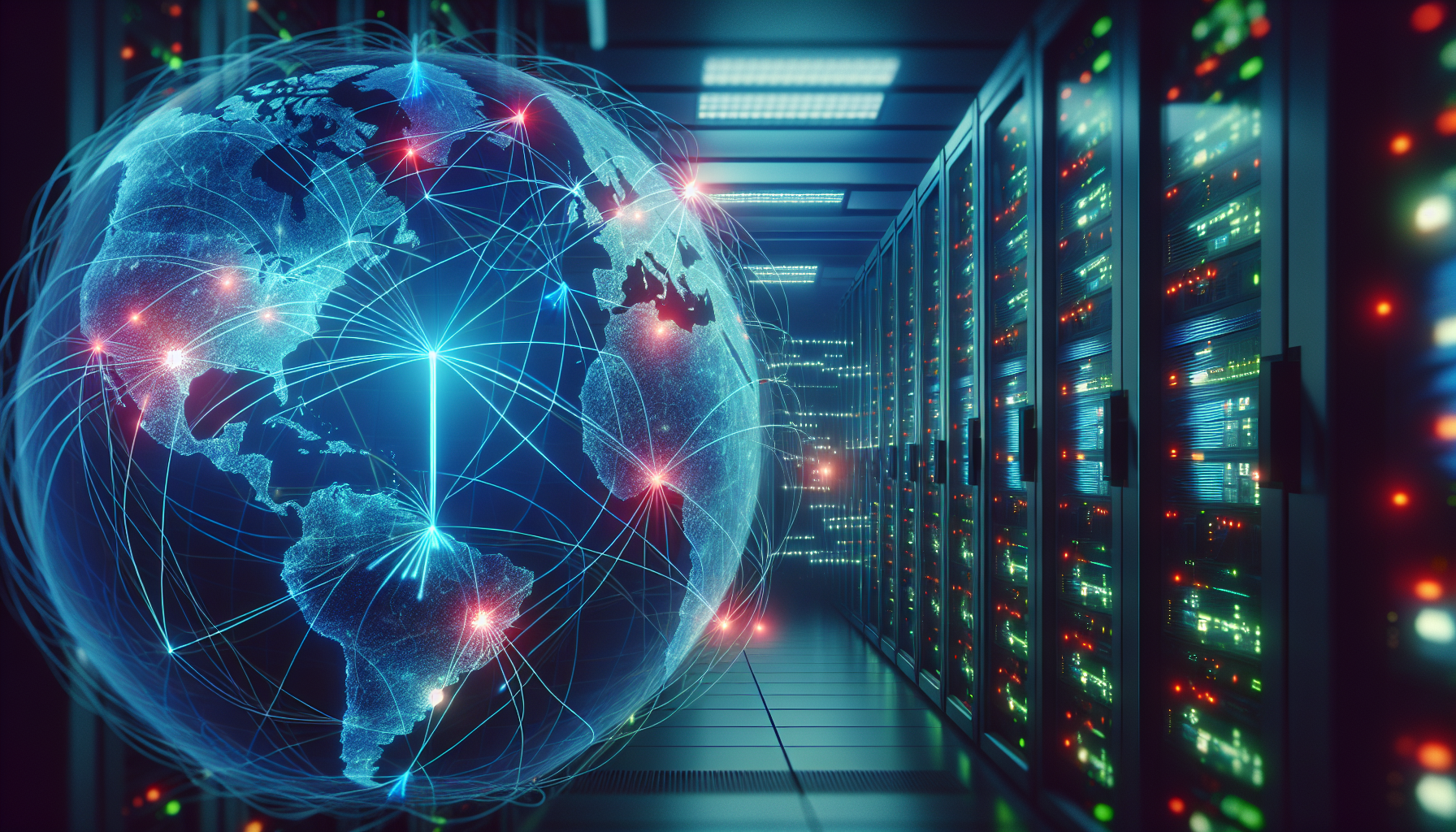
**Undersea fiber-optic cables are the literal backbone of the global economy.** There are dozens of these cables snaking through these narrow passages, carrying trillions of dollars in financial transactions and petabytes of data every single hour.
In a "Hell" scenario where these waters become a theater of kinetic conflict, those cables are the first things to go, either through "accidents" or intentional sabotage.
I remember talking to a network engineer back in 2024 who joked that "the only thing keeping the global financial system together is a few inches of armored plastic and a hope that no one drops an anchor." That joke isn't funny anymore.
If those cables are cut, the "Global Cloud" fragments into "Regional Islands."
Imagine trying to run a distributed database where your US-east nodes can’t talk to your Singapore nodes for 48 hours.
**The latency wouldn't just be high; the connection would be non-existent.** Most modern SaaS companies haven't even tested for a total trans-continental blackout, and April 2026 might be the month we all find out what "cascading failure" actually means in a world of interconnected AI agents.

The End of Just-in-Time AI
We are currently in the middle of the greatest compute gold rush in history.
Companies are burning billions to train the next generation of models, like the rumored **ChatGPT 5** or the upcoming **Claude 5** iterations.
This entire industry is predicated on the assumption that power and hardware will always be available at a predictable scale.
**The Strait warning is the first real threat to the "AI Infinity" narrative.** AI requires an incredible amount of energy, and in 2026, a huge portion of our "green" transition still relies on natural gas as a bridge fuel.
If the LNG tankers stop moving, the power grids in major tech hubs will face a choice: do we keep the lights on for the hospitals, or do we keep the H100 clusters humming?
I’ve spent the last week looking at the energy consumption charts for the newest data centers in Northern Virginia and Ireland. They are massive, and they are fragile.
A 15% drop in available fuel supply doesn't just cause a 15% slowdown in training; it can lead to brownouts that corrupt months of training data.
**We have built a digital civilization that requires 100% uptime, but we are sourcing our stability from a region that is currently at a 0% peace rating.** This is the " एक्चुअली worse" part.
It’s not just that things get more expensive; it’s that the underlying infrastructure of our "intelligence age" is physically incompatible with a closed Strait.
The "Local-First" Logic: A Framework for Survival
If you’re a developer or a tech leader, you can’t control the geopolitics of the Middle East.
You can’t "Open the Strait." But you can stop ignoring the warning and start building for the reality of a fragmented world.
I’ve started calling this **The Local-First Logic**.
It’s a three-part framework designed to ensure that your business, your code, and your career don't vanish the moment a tanker gets stuck or a cable gets cut.
We need to move away from "Global Dependency" and toward "Resilient Isolation."
Step 1: Decentralize Your Infrastructure Stack
The days of assuming your multi-region cloud deployment is "safe" are over. If the Straits go dark, the "regions" themselves will become isolated.
You need to start thinking about **sovereign infrastructure**.
**Audit your dependencies today.** If your app requires a call to an API hosted in a different hemisphere just to function, you have a single point of failure.
Start looking at edge-computing solutions that can run autonomously and move toward "Local-first" data synchronization where the app is functional even if the backbone is severed.
Step 2: Audit Your Physical Dependencies
This is the part that software people hate, but it’s the most critical. You need to know where your hardware comes from. Not just the brand on the box, but the raw materials in the silicon.
If you are planning a massive hardware refresh for late 2026, **move it up to now.** If you are relying on a single vendor that ships through the threatened Straits, find a secondary source today.
The cost of carrying extra inventory or paying a "stability premium" for localized hardware is now a basic cost of doing business, not a "nice-to-have" luxury.
Step 3: Embrace the "Small Model" Revolution
We’ve been obsessed with "bigger is better" in AI, but bigger models require more centralized compute and more energy.
In a world of energy rationing and hardware shortages, **the winner is the person who can do more with less.**
Start investing in quantization and smaller, distilled models that can run on consumer-grade hardware or local "private clouds." If you can run a version of **Gemini 2.5 Flash** or a distilled **Llama 4** locally on-prem, you are immune to the "Cloud Blackouts" that will cripple your competitors.
**Stability is the new scalability.**
Why 2026 Is the "Year of the Wall"
I’ve been writing about tech culture for a long time, and I’ve never seen a shift this sudden. For thirty years, the "Wall" has been coming down.
We lived in a world of open borders, open seas, and open APIs. But April 2026 feels like the moment the "Wall" starts going back up.
The President’s rhetoric is a symptom, not the cause. The cause is that we’ve reached the limit of how far we can stretch a global system before it snaps.
**We are moving into an era of "Geographic Tech."** Where you are physically located, where your power comes from, and which Strait your chips travel through will matter more than your codebase.
I’ll be honest: I’m scared of how many of my peers are still acting like this is just another news cycle.
They think they can "wait it out" or that "the markets will force a resolution." But markets don't work when the physical reality of the world says "No." **The Strait doesn't care about your stock options.**
The Vulnerable Path Forward
I’m not a survivalist, and I’m not a "doomer." I’m someone who lost a contract last year because a data center in Frankfurt went offline for four hours and my "resilient" architecture didn't have a local failover.
I learned the hard way that "The Cloud" is just someone else's computer — and if they can't get the fuel to run it, it's not a computer anymore; it's a very expensive brick.
We have a choice right now. We can keep scrolling r/popular and laughing at the "Open the Strait" memes, or we can take the warning for what it is: **The final bell for the era of unearned stability.**
The companies that survive the next 18 months won't be the ones with the best AI prompts.
They will be the ones that understood their physical reality early enough to build a "Wall" of their own — a wall of resilience, local compute, and physical awareness.
**Have you noticed your project’s hardware lead times creeping up, or are you still seeing "2-day shipping" on your server orders?
I’d love to hear how your team is handling the "Strait Stress" in the comments.**
---
Story Sources
From the Author




Hey friends, thanks heaps for reading this one! 🙏
Appreciate you taking the time. If it resonated, sparked an idea, or just made you nod along — let's keep the conversation going in the comments! ❤️