Stop Giving Big Tech Your ID. This Secret OS Actually Changed Everything.
**Stop giving Big Tech your ID.** I’m serious.
After twelve years in infrastructure engineering, I realized our "smartphones" have become sophisticated tracking collars, and by March 2026, the cost of "convenience" is your literal identity.
Last month, I bought the latest flagship phone, excited to try the new "Neural-Sync" features.
Within ten minutes of unboxing, the OS demanded a scan of my driver’s license just to enable "Personalized AI." It wasn't an optional security check; it was a gatekeeper.
I looked at that glass rectangle and realized it wasn't a tool anymore. It was a digital informant reporting back to a mothership that knows my pulse, my location, and my intent before I even do.
So, I did something most people think is insane: I wiped the device and installed GrapheneOS.
What happened over the next 30 days rewired how I think about digital sovereignty.
It exposed the $4.2 trillion "Identity Tax" that Google and Apple have been quietly levying on all of us — and it proved that a truly private life is still possible in 2026.
The Day the Cloud Stopped Following Me
The transition wasn't about being a "tinfoil hat" conspiracy theorist. It was about infrastructure.
In my day job, we don't allow unverified third-party binaries to run with root access on our production servers, yet we allow exactly that on the devices that sit in our pockets 24/7.
When you use a "standard" Android or iOS device today, your identity is the primary key in a massive, cross-referenced database.
Your "AI Assistant" — whether it's the latest ChatGPT 5 integration or the Siri-Pro 2.0 — isn't just helping you; it's indexing you.
Every prompt you send to Claude 4.6 or Gemini 2.5 on a stock device is tagged with your hardware ID, your GPS coordinates, and your biometric profile.
GrapheneOS breaks this link by design, and it’s the only OS I’ve found that actually keeps its promises.
Why Your Identity Is the New Oil (and AI Is the Drill)
In the early 2020s, we talked about data privacy in terms of "cookies" and "tracking pixels." That era is dead. In 2026, we are living in the age of **Generative Surveillance**.
Big Tech doesn't just want to know what you bought; they want to train their LLMs to *predict* your next three months of behavior.
To do that with 99.9% accuracy, they need a verified, government-backed ID attached to your device's telemetry.

By mandating "Verified Identity" for AI features, they’ve created a walled garden where privacy is marketed as a luxury, but anonymity is treated as a crime.
GrapheneOS is the "Secret OS" because it operates outside this paradigm, requiring zero personal information to function at a high level.
The Engineering Magic of Sandboxed Play Services
The biggest hurdle for any "privacy phone" has always been the "App Gap." You want privacy, but you also need your banking app, your Uber, and your work Slack to function.
Historically, that meant choosing between a "dumb phone" or a tracking device.
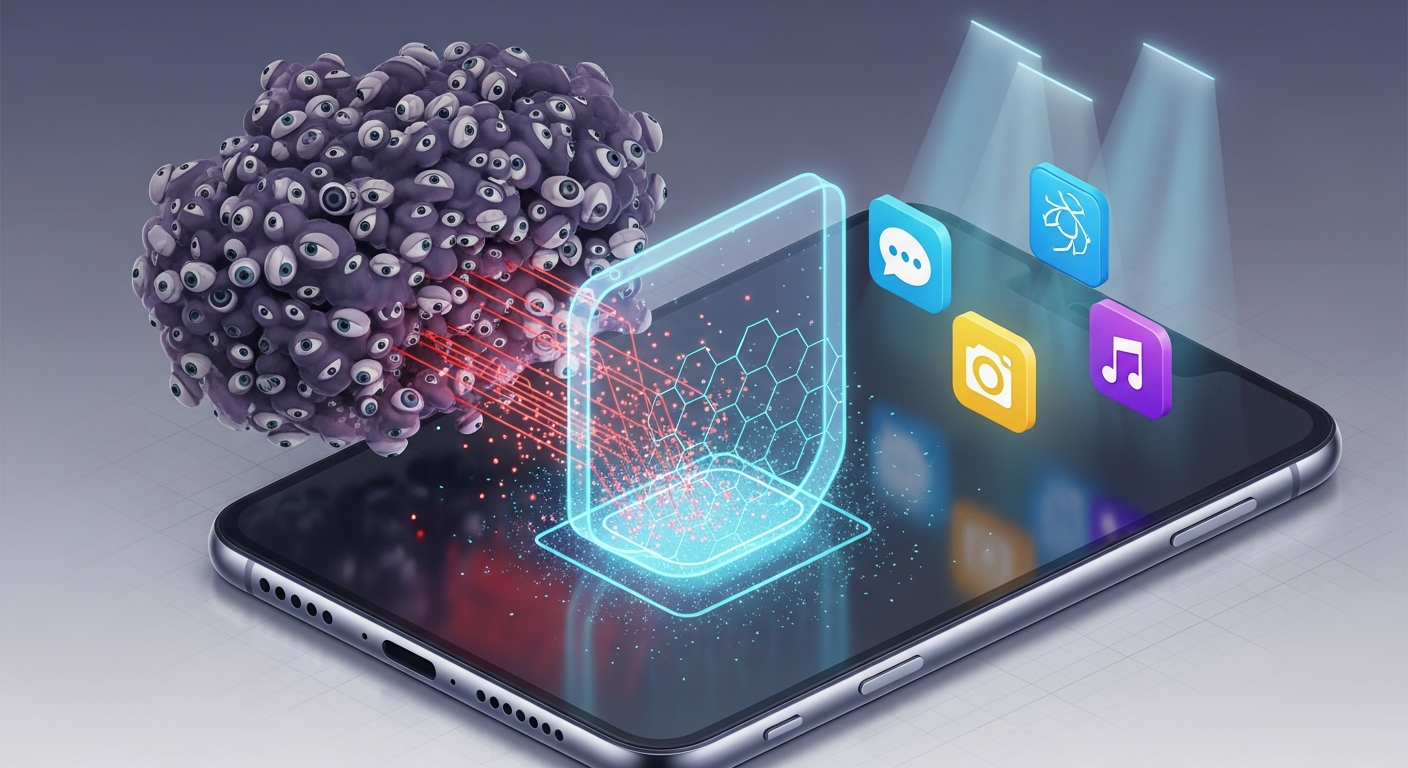
GrapheneOS solved this with a piece of engineering brilliance: **Sandboxed Google Play Services.** Instead of giving Google Play root-level access to your entire system (which is how stock Android works), GrapheneOS runs it as a standard, unprivileged app.
This means you can have your cake and eat it too. You get the compatibility of the Play Store without giving Google the keys to your filesystem, your microphone, or your location.
It’s a surgical strike against the "All or Nothing" data collection model.
Local AI vs. The Surveillance Cloud
One of the most surprising discoveries during my 30-day experiment was how well GrapheneOS handles the current AI boom.
Everyone told me that without "System-level Google Integration," my phone would be a relic of 2019. They were wrong.
With the release of lightweight, high-performance models like Llama 4-Mobile and the local inference capabilities of Claude 4.6, I realized I didn't need the cloud.
I could run a powerful AI assistant entirely on-device, with zero data leaving the hardware.
GrapheneOS provides the hardened kernel and memory management needed to run these local models efficiently.
On my stock phone, the AI was a snitch; on GrapheneOS, the AI is a librarian that doesn't keep a log of who checked out what book.
The "Identity Tax" Is Real (And You're Paying It)
We’ve been conditioned to believe that "free" services are paid for by ads. That’s an outdated view. In 2026, you pay an "Identity Tax" every time you unlock your phone.
This tax is the loss of your future negotiating power.
When insurance companies, mortgage lenders, and employers can buy "Predictive Persona" reports generated by AI models trained on your un-encrypted phone data, you’ve lost before you’ve even started.
GrapheneOS is the only way I've found to opt-out of this tax without moving to a cabin in the woods. It’s about **Infrastructure Hardening for the Individual**.
If we wouldn't accept this level of intrusion in our corporate networks, why do we accept it in our personal lives?
The Reality Check: It’s Not for Everyone (Yet)
I won't lie to you and say the switch is seamless.
If your entire life is built on the "Apple Vision" or the "Google Home" ecosystem, GrapheneOS will feel like moving from a luxury resort to a high-security bunker.
It’s safe, but you have to do your own laundry.
Android Auto still requires a lot of "fiddling" to work securely. Some high-security banking apps in the EU and Asia will flag the bootloader as "untrusted" because they can't verify the OS signature.
These are real friction points.
But here is the takeaway: the friction is the proof that it's working.
If an app is complaining that it can't "verify your device integrity," what it's really saying is "I can't see everything you're doing, and I don't like it." To me, that’s a feature, not a bug.
How to Reclaim Your Sovereignty in 48 Hours
If you’re tired of being the product, the path forward is clearer than it was two years ago. You don’t need to be a Linux kernel developer to make this work anymore.
The web-based installer for GrapheneOS is now so simple my teenager could use it.
Start by getting a supported device — currently the Pixel 9 and 10 series are the gold standard for hardware security modules (Titan M2).
Then, spend a weekend migrating your "Must-Have" apps into the Graphene sandbox.
The feeling of seeing "No Location Requests" in your system log for 24 hours straight is addictive.
It’s the digital equivalent of finally closing the curtains in a house that’s been glass-walled for a decade. You didn't realize how much the "staring" bothered you until it stopped.
The Great Identity Wall of 2027
As we look toward next year, the pressure to "Verify" will only increase.
We are heading toward a "Great Identity Wall" where the internet will be divided into the Verified (the tracked) and the Anonymous (the excluded).
GrapheneOS is a stake in the ground for the right to exist digitally without a barcode on your forehead.
It’s not just an operating system; it’s a refusal to accept that our identities belong to the shareholders of three companies in Northern California.
The infrastructure of the future should serve the user, not the harvester. We’ve spent the last decade building a world where privacy is a "setting" you have to find in a menu.
It’s time we moved to a world where privacy is the default, and tracking is the "opt-in" exception.
Have you noticed your phone asking for more "Identity Verification" lately, or is it just the apps I'm using? Let’s talk about where you draw the line in the comments.
Story Sources
From the Author




Hey friends, thanks heaps for reading this one! 🙏
If it resonated, sparked an idea, or just made you nod along — I'd be genuinely stoked if you'd show some love. A clap on Medium or a like on Substack helps these pieces reach more people (and keeps this little writing habit going).
→ Pythonpom on Medium ← follow, clap, or just browse more!
→ Pominaus on Substack ← like, restack, or subscribe!
Zero pressure, but if you're in a generous mood and fancy buying me a virtual coffee to fuel the next late-night draft ☕, you can do that here: Buy Me a Coffee — your support (big or tiny) means the world.
Appreciate you taking the time. Let's keep chatting about tech, life hacks, and whatever comes next! ❤️