Stop Fearing Vibe Coders. This Uncomfortable AI Truth Changes Everything.
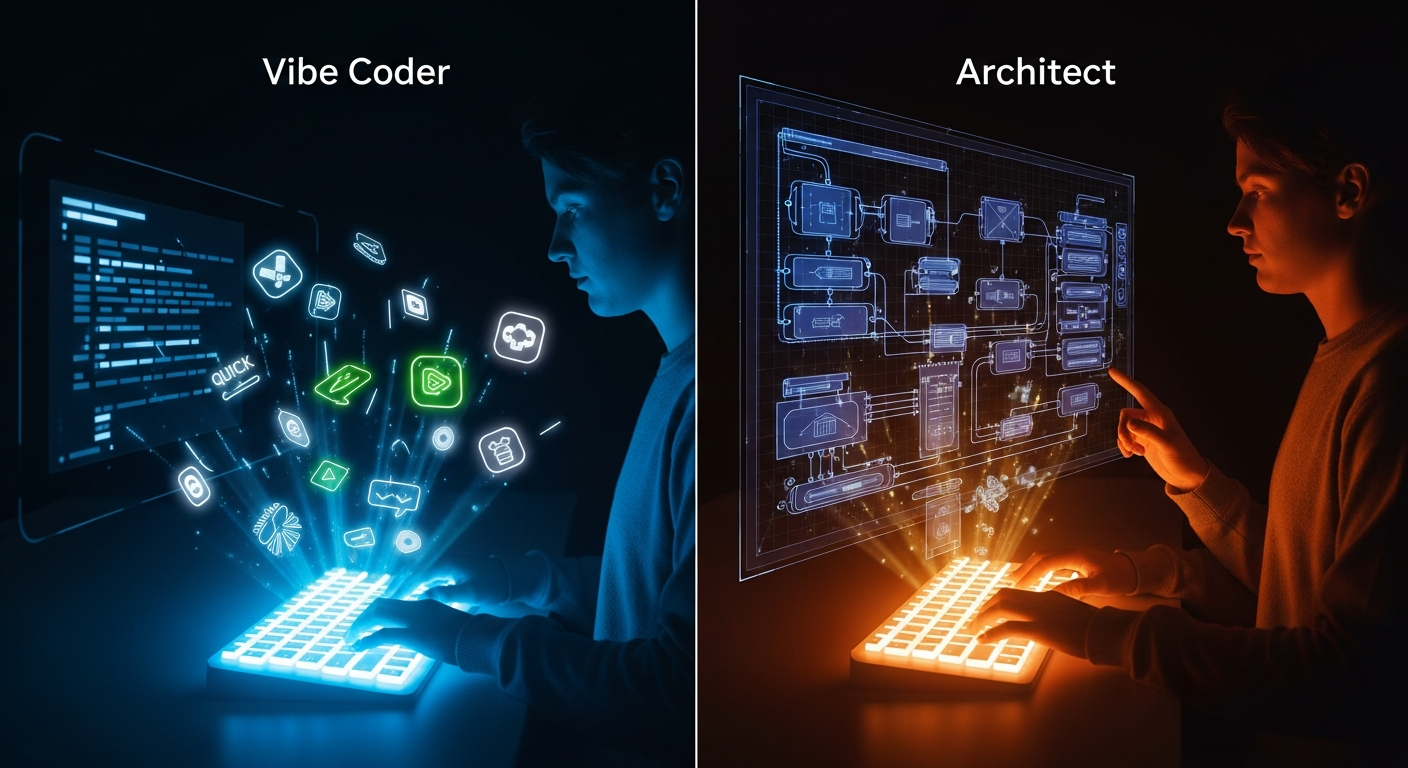
Stop fearing vibe coders. I’m serious.
After spending $400 on API credits and 72 hours trying to "vibe" a production-grade SaaS into existence using only Claude 4.6 and ChatGPT 5, I realized the "Great Replacement" is a total myth.
The "vibe coder"—that mythical creature who builds apps with natural language and zero logic—isn't coming for your job.
They’re coming to create the biggest technical debt crisis in the history of computing. And that is exactly where your new six-figure moat is being built.
I Tried to Fire Myself for 7 Days
Last week, I decided to see if I was obsolete. I set a rule: I would build a full-stack, real-time analytics dashboard without writing a single line of manual code.
No CSS tweaks, no SQL migrations, no "just fixing this one import."
I used the latest models available this March 2026—Claude 4.6 for the logic and ChatGPT 5 for the architectural "vibing." I wanted to prove that a non-technical founder could replace me by next year.
The first 48 hours were, quite frankly, terrifying. I was shipping features faster than I ever had in my 12-year career.
I had a landing page, Clerk auth, and a Postgres schema running in under 20 minutes. I felt like a god.
The 48-Hour Mirage
This is the phase where everyone panics. You see a "vibe coder" on Twitter (now X) post a screen-recording of a working app built in 10 minutes. It looks polished.

The buttons click. The data saves.
But here is the uncomfortable truth: **AI is currently optimized for "The Happy Path."** When you are building from zero to one, everything is a green field.
There are no legacy constraints, no conflicting state, and no edge cases.
By Wednesday morning, my "vibe-coded" app was a Ferrari with no engine.
It looked incredible on mobile, but the moment I asked for a complex feature—like a rolling 30-day retention calculation with timezone-aware filtering—the "vibe" started to rot.
The $1,200 Context Window Tax
As the codebase grew to 5,000 lines, something strange happened. Claude 4.6 started "forgetting" how the authentication middleware was structured.
It began suggesting fixes that broke the database schema it had created two hours prior.
I was stuck in what I call the **Circular Reasoning Loop**.
I would prompt the AI to fix a bug, it would generate a "fix" that introduced two new bugs, and then it would use the new bugs as the "correct" context for the next fix.
**I spent $140 in four hours just trying to get a single API endpoint to stop returning 500 errors.** A junior dev with a basic understanding of REST could have fixed it in three minutes.
But as a vibe coder, I was a prisoner of the prompt.
The Uncomfortable Truth About "AI Maintenance"
We’ve been told that AI will handle the maintenance. That is the biggest lie in tech today. AI doesn't "maintain" code; it **re-imagines** it every time you ask for a change.
When a vibe coder asks for a new button, the LLM often rewrites the entire component logic to accommodate it. This works fine for a Todo list. It is a death sentence for a distributed system.
By Thursday, my project reached **Context Collapse**. Every new prompt felt like playing Jenga with a toddler.
I realized that the "vibe coder" isn't building a product—they are building a hostage situation where the ransom is their own sanity.
The Math of Technical Debt in 2026
In the old days, technical debt was "we used a messy library." In 2026, technical debt is **"nobody knows why this works, and the AI that wrote it is hallucinating the documentation."**
We are entering the era of the **Code Juror**. Your job is no longer to be the fastest typist in the room.
Your job is to be the person who can look at 200 lines of AI-generated TypeScript and say, "This will fail the moment 50 people try to use it simultaneously."
The moat isn't syntax. **The moat is the ability to audit logic without a prompt.** If you can’t debug a race condition without asking Gemini 2.5 for help, you are a vibe coder.
And vibe coders have a very short shelf life.
Why "Vibe Coding" is a Feature, Not a Career
Vibe coding is the best prototyping tool we’ve ever seen. It’s the "new" Figma. You can mock up a functional MVP in an afternoon, and that is a massive win for the industry.

But the moment that MVP hits 1,000 users, the "vibes" stop mattering. **Database locks don't care about your vibes.** Memory leaks don't care about your "intent."
The developers who are thriving right now are the ones using Claude 4.6 as a high-powered excavator, but they still know how to pick up a shovel when they hit a pipe.
They use the AI to generate the boilerplate, then they manually audit the critical path.
The Shift from "Builder" to "System Janitor"
I’ve seen dozens of r/webdev threads where seniors are worried about "Prompt Engineers" taking their roles. Stop. The prompt engineer is just a manager who can’t explain what they want.
The industry is actually bifurcating into two groups:
1. **The Vibe Coders:** Who will build 10,000 "wrappers" and "toy apps" that break the moment the API changes.
2. **The AI-Augmented Engineers:** Who will use those same tools to build robust, scalable systems 10x faster than they did in 2024.
The "Uncomfortable Truth" is that the bar for entry is actually getting **higher**, not lower. You now need to know enough about everything to spot when the AI is lying to you across the entire stack.
My Verdict After 7 Days of Vibing
By Friday, I gave up on the "No-Code" rule. I opened the editor, deleted 40% of the AI's spaghetti, and fixed the state management manually.
It took me 45 minutes to do what I had spent 10 hours trying to prompt.
**The results of my experiment were clear: The AI made me a 10x faster researcher, but a 0.5x slower debugger.**
If you rely on the "vibe," you are capped by the LLM's current reasoning limit. If you rely on your engineering fundamentals, the LLM becomes a force multiplier.
Don't learn to prompt; learn to **read** what the prompt produced.
The Moat is Maintenance, Not Creation
We are moving into a world where code is "cheap" but **correctness is expensive.** Anyone can create a codebase in 2026. Almost nobody can explain why it’s secure, performant, or maintainable.
If you want to be un-replaceable, stop trying to out-prompt the newcomers.
Start specializing in **Legacy AI Recovery.** The world is about to be filled with "vibe-coded" apps that are falling apart at the seams.
There is a multi-billion dollar industry waiting for the developers who can step into a hallucinated codebase and bring it back to reality. That’s not vibing. That’s engineering.
---
**Are you seeing "vibe-coded" projects starting to fail in your organization, or is the AI actually holding the architecture together better than I experienced? Let's talk in the comments.**
---
Story Sources
From the Author




Hey friends, thanks heaps for reading this one! 🙏
If it resonated, sparked an idea, or just made you nod along — I'd be genuinely stoked if you'd show some love. A clap on Medium or a like on Substack helps these pieces reach more people (and keeps this little writing habit going).
→ Pythonpom on Medium ← follow, clap, or just browse more!
→ Pominaus on Substack ← like, restack, or subscribe!
Zero pressure, but if you're in a generous mood and fancy buying me a virtual coffee to fuel the next late-night draft ☕, you can do that here: Buy Me a Coffee — your support (big or tiny) means the world.
Appreciate you taking the time. Let's keep chatting about tech, life hacks, and whatever comes next! ❤️