Stop Calling Yourself Lazy. You’re Quietly Depressed. It’s Not What You Think.
**Stop calling yourself lazy. I’m serious.
After twelve years in clinical practice, I’ve realized that 90% of what we call "laziness" is actually a nervous system in survival mode—and your $45 "atomic" productivity journal is actually making it worse.**
I spent $2,400 on productivity coaches, sunrise alarm clocks, and "deep work" retreats back in 2024 before I finally admitted the truth.
I wasn't undisciplined, and I didn't need a better habit tracker.
I was navigating a high-functioning, "quiet" depression that wore the mask of procrastination, and every time I failed to "just do it," I was driving another nail into the coffin of my self-esteem.
By the time you finish this article, I want you to delete that "productivity" app that sends you shame-inducing notifications at 2 PM.
We’re going to look at the clinical reality of why you’re stuck, why your brain feels like lead, and how to actually move again without the toxic weight of "discipline" holding you down.
The Moral Trap of the "Lazy" Label
In our current 2026 landscape of hyper-efficiency, "lazy" has become the ultimate moral failing.
We treat it like a character flaw, a sign that we simply don’t care enough or aren't "hungry" enough for success.
If you’re a developer or a tech professional, this is doubly true; you’re surrounded by peers who seem to ship code in their sleep and "grind" through 80-hour weeks with a smile.
But as a former therapist, I can tell you that **laziness is a myth.** In the clinical world, we don’t see lazy people; we see people with internal barriers that are currently higher than their internal resources.
When you can’t get off the couch to start that Jira ticket, it’s not because you’re a "slacker"—it’s because your brain has evaluated the task and decided the cost of starting is higher than the perceived reward.
**We need to stop viewing productivity as a test of character and start viewing it as a state of the nervous system.** If you are constantly "failing" at your goals, you aren't lacking willpower.
You are likely experiencing "functional freeze," a state where your body is so overwhelmed by micro-stressors that it shuts down to protect itself.
High-Functioning Depression: The Thief in the Night
What I call "Quiet Depression" is technically known in the DSM-5 as Persistent Depressive Disorder (PDD), or dysthymia.
It’s not the kind of depression that keeps you in bed sobbing for weeks—that’s easy to identify.
**Quiet depression is much more insidious because it allows you to function, but it strips the "color" out of your life.**
You still go to meetings. You still answer Slack messages. You might even go to the gym.
But everything feels like you’re moving through waist-deep water. You’re not "sad" in the traditional sense; you’re just... muted.
You find yourself doomscrolling for four hours not because the content is good, but because the "start-up cost" of doing anything else feels physically impossible.
**This isn't a lack of discipline; it’s anhedonia—the loss of the ability to feel pleasure or motivation.** When your dopamine receptors are fried from 2026-level digital saturation and chronic "always-on" work cultures, your brain enters a state of low-power mode.
You call it laziness. I call it a clinical emergency that requires compassion, not a new Pomodoro timer.
Why Your Brain is Saying "No" (Even When You Want to Say "Yes")
If you’ve ever sat at your desk, staring at a blank IDE, feeling a physical ache in your chest because you *can’t* just type the first line of code, you’ve met the "Great Wall of Awful." This is a concept often used in ADHD circles, but it applies perfectly to quiet depression.
Every past failure, every bit of shame, and every "you’re so lazy" comment from your past builds a brick in that wall.
**Your brain isn't refusing to work; it's trying to protect you from the pain of failing again.** In 2026, the stakes feel higher than ever.
With AI-driven performance metrics and the constant threat of "optimization" in the workplace, the pressure to be perfect is paralyzing.
When you’re depressed, your brain’s "threat detection" center—the amygdala—is on high alert.
The act of starting a task becomes a threat. What if it’s bad? What if I’m too slow?
**The "freeze" response is your body’s way of saying, "If we don't start, we can’t fail."** You aren't avoiding the work; you’re avoiding the emotional fallout you’ve associated with the work.
Shaming yourself for this is like screaming at a car with no gasoline to "just try harder" to start.
The V.A.S.T. Framework: How to Thaw the Freeze
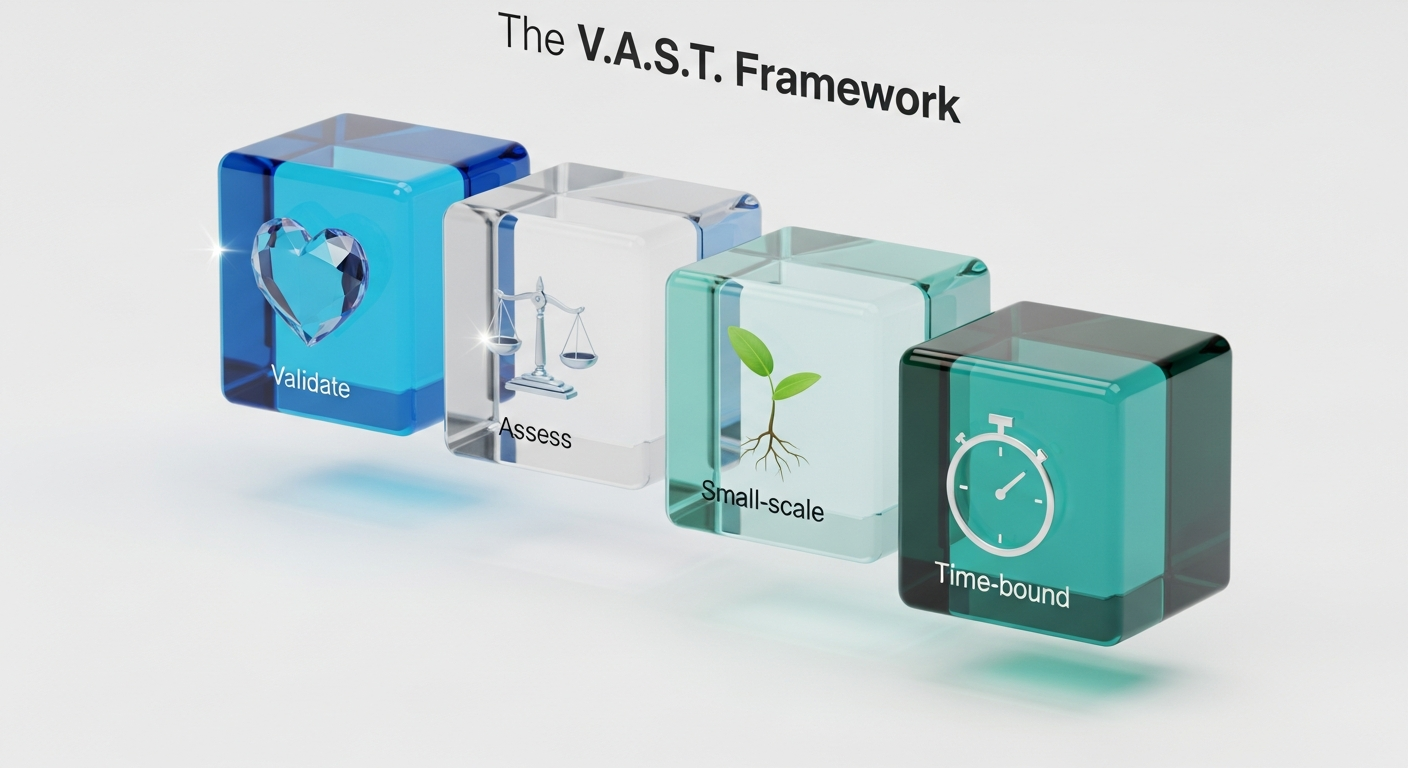
If we want to move again, we have to stop using the tools of the "highly disciplined" and start using the tools of the "healing." I developed the **V.A.S.T.
Framework** during my years in private practice to help high-achievers navigate periods of functional freeze.
V.A.S.T.
stands for **Validate, Assess, Small-scale, and Time-bound.** It’s not about doing more; it’s about lowering the barrier to entry until it’s so low that your "threat detection" system doesn't even notice you’ve started.
1. Validate the Freeze
The first step is the hardest: **You must stop the "shame spiral" immediately.** When you find yourself stuck, say it out loud: "I am not lazy.
I am currently experiencing a functional freeze." By naming it, you move the problem from your "identity" to your "physiology." You can fix physiology. You can't fix "who you are."
2. Assess the "Lead Factor"
On a scale of 1 to 10, how much does your body feel like lead?
If you’re at an 8 or 9, **you cannot "discipline" your way out.** At this level, your goal isn't to "get things done"; it’s to regulate your nervous system.
Take a cold shower, go for a 5-minute walk without your phone, or do 4-7-8 breathing. You have to "thaw" the body before you can use the mind.
3. Small-Scale Slicing
We’ve all heard of "breaking tasks down," but when you’re quietly depressed, even "write the intro" is too big. You need to slice it until it’s ridiculous.
**Don't "write code." Open the file.** That’s it.
Don't "go to the gym." Put on one sock. If you can’t do the one sock, just look at the sock. We are looking for the absolute minimum viable movement.
4. Time-Bound Transitions
The "transition" is where most people with quiet depression get stuck. The move from "scrolling" to "working" feels like jumping across a canyon.
**Use the "5-Minute Rule," but with a twist: promise your brain you will stop after five minutes.** Set a timer.
When it goes off, you have full clinical permission to stop. Usually, the "thaw" happens in those five minutes, but the permission to stop is what makes the start possible.
2026: The Year of the Great Burnout
We have to acknowledge the context we’re living in. As of March 2026, we are navigating a world where the lines between "human" and "machine" productivity have blurred.
We are being benchmarked against LLMs that don't need sleep, don't have childhood trauma, and don't experience the heavy weight of a Tuesday afternoon in a lonely apartment.
**The "laziness" you feel is often a silent protest against a world that demands you be a machine.** We were never meant to be "on" 24/7.
We were never meant to have our worth tied to a "green square" on a GitHub contribution graph.
If you feel "lazy," it might just be your soul's way of telling you that the life you're leading is unsustainable.
As a therapist, I saw the most "disciplined" people break the hardest. The ones who "pushed through" for years eventually hit a wall that no amount of caffeine or "hustle" could overcome.
**Rest is not a reward for good behavior; it is a biological requirement.** If you don't pick a day to rest, your body will eventually pick a month for you.
Moving Toward "Active Recovery"
So, what do we do when the V.A.S.T. framework feels like too much? We move into active recovery.
This isn't "rotting" in front of a screen—which is actually very draining for the brain—it’s doing things that provide "micro-nourishment."
- **Digital Minimalism:** By mid-2026, we know that social media algorithms are specifically designed to exploit the "freeze" state. If you’re stuck, put the phone in another room.
- **Biophilia:** It sounds like a cliché, but human beings need sunlight and dirt.
If you haven't touched a plant or seen the sun in 48 hours, your brain is going to struggle to produce the chemicals required for "discipline."
- **Professional Help:** If your "laziness" has lasted longer than two weeks and is affecting your ability to eat, sleep, or maintain relationships, **it is time to see a professional.** There is no shame in medication or therapy.
Sometimes, you just need a chemical "floor" so you can start building your own foundation again.

The Reframe: From "Lazy" to "Protected"
I want you to try a radical experiment for the next 24 hours. Every time you think the word "lazy," replace it with "protected."
"I'm feeling **protected** right now. My brain thinks I'm under threat, so it’s keeping me here on the couch where it’s safe."
How does that feel? Usually, it feels like a release of tension.
And ironically, **when we stop fighting ourselves, we often find the energy to move.** You cannot hate yourself into a version of yourself that you love.
You cannot shame yourself into being productive.
You are a human being living through a complex, often exhausting era. You are doing your best with the nervous system you have. Give yourself the grace you would give a friend.
**The work will still be there tomorrow, but your mental clarity is a finite resource. Guard it fiercely.**
Have you been calling yourself "lazy" lately, or have you recognized that "heavy" feeling of quiet depression? I’ve been there, and I know how lonely it feels.
Let’s talk about it in the comments—what’s the one task that’s been feeling like a "Great Wall of Awful" for you this week?
---
Story Sources
From the Author




Hey friends, thanks heaps for reading this one! 🙏
If it resonated, sparked an idea, or just made you nod along — I'd be genuinely stoked if you'd show some love. A clap on Medium or a like on Substack helps these pieces reach more people (and keeps this little writing habit going).
→ Pythonpom on Medium ← follow, clap, or just browse more!
→ Pominaus on Substack ← like, restack, or subscribe!
Zero pressure, but if you're in a generous mood and fancy buying me a virtual coffee to fuel the next late-night draft ☕, you can do that here: Buy Me a Coffee — your support (big or tiny) means the world.
Appreciate you taking the time. Let's keep chatting about tech, life hacks, and whatever comes next! ❤️