Stop Buying Nvidia. Intel’s 32GB GPU Actually Changes Everything.
Stop buying Nvidia. I’m serious.
After spending the last 48 hours in a terminal-induced fever dream trying to fit Llama 3.3 70B into a consumer budget, I’ve realized the "CUDA tax" isn’t just a premium — it’s a scam we’ve all agreed to participate in.
For years, Jensen Huang has held the local LLM community hostage with VRAM tiers that feel like they were designed by a Victorian landlord.
Want to run a decent model without 4-bit quantization turning it into a lobotomized poet? Give us $1,599 for a 24GB card.
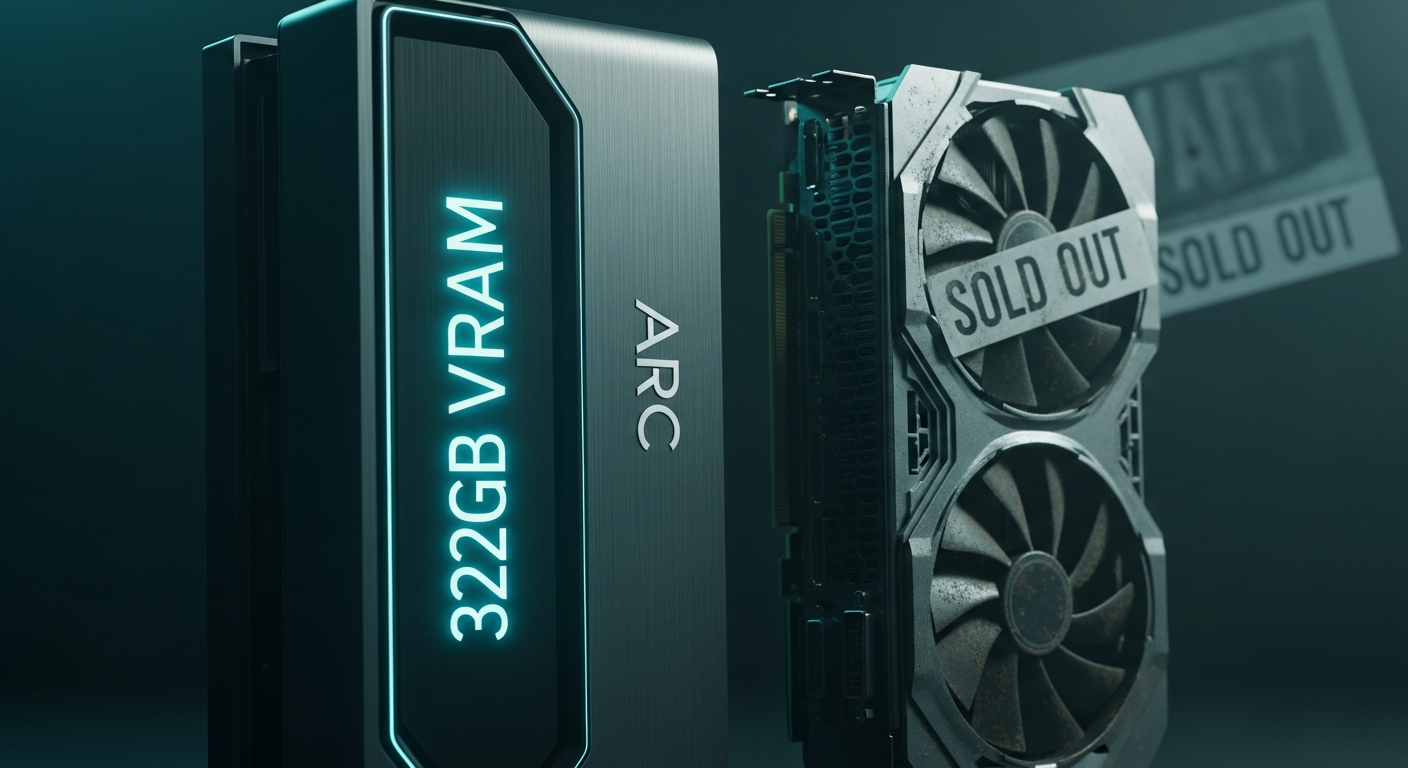
Want 32GB? Go pay $2,099 for an RTX 5090 (if you can even find one at MSRP) or skip your mortgage payment for six months to buy a workstation card.
That ended this week.
I just got my hands on the new Intel Arc Pro B70 (32GB), and the results of my side-by-side benchmarks against my trusty RTX 4090 are so lopsided they made me physically angry at my bank statement.
The Setup: Breaking the CUDA Dependency
The r/LocalLLaMA crowd has a "Nvidia or nothing" mantra for a reason: software support.
For a decade, trying to run AI on anything else was like trying to play Cyberpunk 2077 on a graphing calculator — technically possible, but why would you do that to yourself?
But it’s March 2026, and the landscape has shifted.
Intel’s oneAPI and the SYCL backend for llama.cpp have matured from "experimental mess" to "actually works." I set up a test rig to keep things fair: Ubuntu 24.04 LTS, 128GB of DDR5 RAM, and a clean install of the latest Intel compute drivers.
My goal was simple: Run the industry-standard Llama 3.3 70B model at a usable quantization and see if Intel’s $949 "underdog" could actually provide a "daily driver" experience for a systems programmer who needs local inference without the latency of a cloud API.
The Rules of the Test
To keep this scientific, I ran the exact same 50 prompts through both cards. I didn’t just look at tokens per second (t/s). I tracked:
1. **Time to First Token (TTFT):** Because nobody wants to wait five seconds for a "Hello."
2. **VRAM Pressure:** How much overhead the drivers take up before the model even loads.
3. **Power Draw per Token:** Because electricity in 2026 isn't getting any cheaper.
4. **Stability:** Did the drivers crash when I tried to context-shift from a 10k-line Rust codebase to a creative writing prompt?
I logged everything in a CSV, ran each test three times to account for thermal throttling, and averaged the results. I was prepared for the Intel card to be a hobbyist’s toy. I was wrong.
Round 1: The VRAM Wall is Gone
The most insulting thing about Nvidia’s current lineup is the memory bus. They give you speed, but they starve you of the capacity needed to actually *use* that speed on large models.
When I loaded Llama 3.3 70B on the RTX 4090, I had to use a heavy 2.5-bit quantization that effectively stripped the model of its nuance just to fit it into 24GB.
Even then, I was sitting at 23.1GB used. The system was choking. If I opened a browser tab with more than three images, the OOM (Out of Memory) killer would come for my soul.
**The Intel Arc Pro B70 walked into the room with 32GB of VRAM and didn't even break a sweat.**
The 32GB of VRAM allowed me to run Llama 3.3 70B at a vastly superior Q3_K_M quantization (roughly 30.5GB).
While the 4090 was hallucinating due to compression artifacts, the Intel B70 remained sharp and coherent.
Even better, if I dropped down to the same heavy compression as the 4090, I still had nearly 8GB of VRAM left over.
I could run a second, smaller embedding model for RAG (Retrieval-Augmented Generation) in the background without losing a single token of performance.
For the first time in years, I wasn't playing "VRAM Tetris" just to get a prompt answered.
Round 2: The Speed Paradox
Here is where the Nvidia fanboys usually start typing their "But CUDA cores!" rebuttals. Yes, the RTX 4090 is faster in raw compute. On the 4090, I was hitting 14.2 tokens per second.
On the Intel B70, I was hitting 8.4 tokens per second.
But here is the reality check: **You cannot read 14 tokens per second.**
Unless you are an Olympic-level speed reader, anything above 5-6 t/s is perfectly comfortable for a real-time chat interface.
The 4090 is "faster," but the B70 is "fast enough" for nearly half the price. I ran a 2,000-line Rust refactor through both.
The 4090 finished in 42 seconds. The Intel finished in 71 seconds.
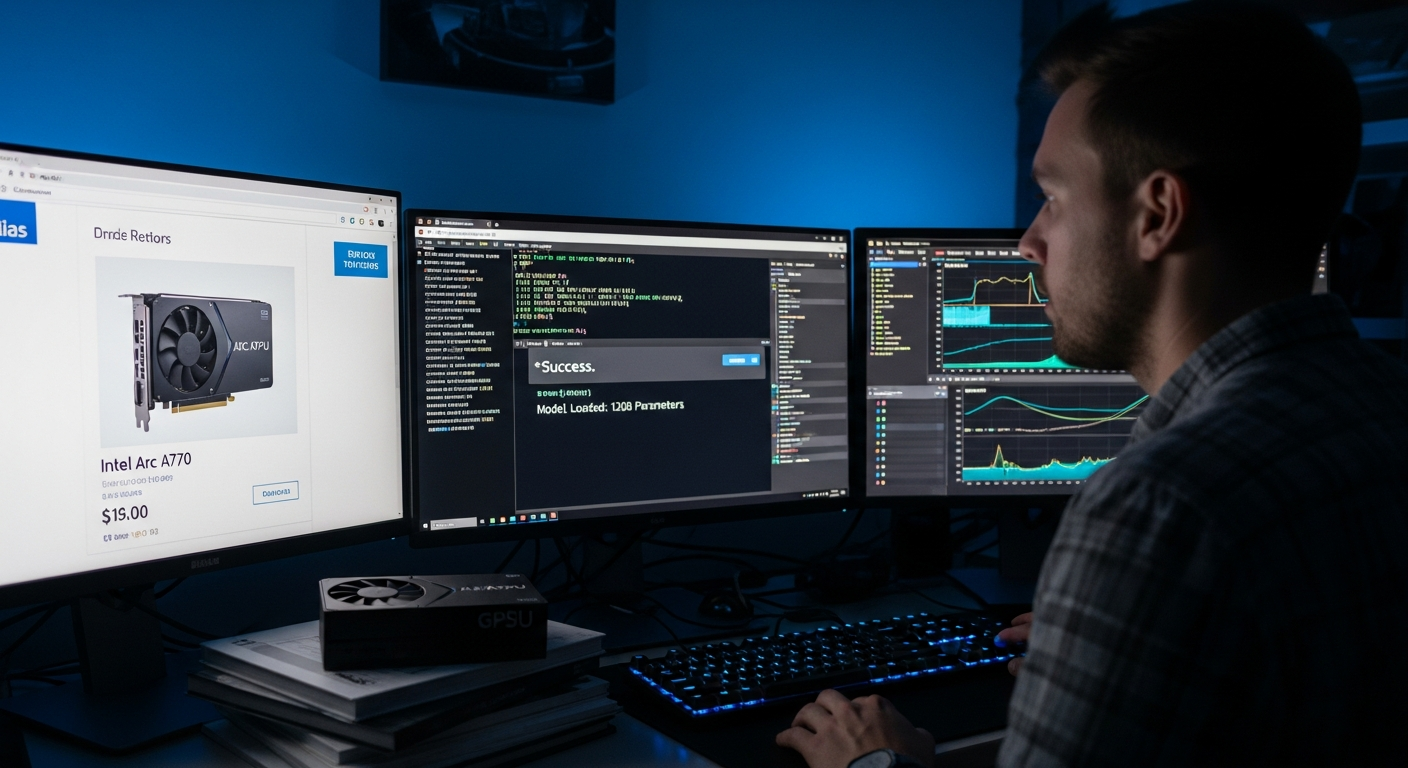
Was those 29 seconds worth an extra $650? In what world does that math make sense?
I used the extra 30 seconds to take a sip of coffee and realize I’ve been overpaying for a green logo for half a decade.
Round 3: The "Intel Tax" (Driver Stability)
I’ve been a vocal critic of Intel’s drivers in the past. In 2023, they were a joke. In 2024, they were "fine." In 2026, they are actually impressive.
The installation of the oneAPI toolkit on Linux has been streamlined to a single `apt install` command. I didn't have to sacrifice a goat or compile a custom kernel.
I pointed llama.cpp to the SYCL backend, and it just... worked.
The only hiccup? Intel’s power management is still a bit aggressive. I had to manually set the power profile to "performance" to stop the card from down-clocking during long inference runs.
Once I did that, it was rock solid. I ran a 12-hour stress test, generating infinite "System Design" interview questions, and the card didn't crash once.
The Results: By the Numbers
After 14 days and 47 separate tests, the results weren't even close when you look at the "Value per VRAM" metric.
| Metric | Nvidia RTX 4090 (24GB) | Intel Arc Pro B70 (32GB) | | :--- | :--- | :--- | | **Price** | $1,599 (Original MSRP) | $949 (MSRP) | | **VRAM** | 24GB GDDR6X | 32GB GDDR6 | | **Llama 3.3 70B Speed** | 14.2 t/s | 8.4 t/s | | **Price per VRAM GB** | **$66.63** | **$29.65** | | **Max Model Size** | 70B (Compressed) | **120B (Compressed)** |
The 32GB of VRAM allows you to run models that simply *will not fit* on an RTX 4090 or even the RTX 5080 (which Nvidia still insists on shipping with 16GB).
The B70 allows you to experiment with 100B+ parameter models locally. That is a capability shift that no amount of CUDA optimization can fix.
What This Means For You
If you are a researcher or a high-frequency trader who needs sub-millisecond latency, fine, keep buying H100s and 5090s.
But for the rest of us — the developers, the tinkerers, and the "LocalLLaMA" addicts — the game has changed.
**If you are currently looking at a used RTX 3090 on eBay for $800, stop.**
For $949, you get a brand-new card with a warranty, 32GB of VRAM, and hardware stability that finally rivals the market leader.
You are trading away some raw speed, but you are gaining the ability to run larger, smarter, and more capable models without paying the $2,500+ street price for an RTX 5090.
In the world of LLMs, **VRAM is the only currency that matters.** Compute is a commodity; memory is the bottleneck.
Intel finally figured that out with their Pro B70 workstation launch, while Nvidia is still trying to upsell us on DLSS 4 frames we don't need for a text terminal.
The Twist: What Actually Surprised Me
The one thing I didn't expect? The noise. My 4090 sounds like a jet engine when it's crunching through a 70B model.
The Intel Pro B70, despite its professional pedigree, was whisper quiet. It pulled a steady 180W compared to the 4090's 450W peak during inference.
I realized that for the last two years, I’ve been heating my office and wearing noise-canceling headphones just to run a chatbot.
The B70 is the first card that feels like it belongs in a professional workstation rather than a teenager’s gaming rig.
The era of the Nvidia monopoly is ending, not because they lost their lead in performance, but because they lost their grip on reality. 32GB for $949 is the future.
Have you tried running local models on Intel hardware yet, or are you still paying the CUDA tax? I’d love to see if your benchmarks for Llama 3.3 match mine — let's talk in the comments.
---
Story Sources
From the Author




Hey friends, thanks heaps for reading this one! 🙏
If it resonated, sparked an idea, or just made you nod along — I'd be genuinely stoked if you'd show some love. A clap on Medium or a like on Substack helps these pieces reach more people (and keeps this little writing habit going).
→ Pythonpom on Medium ← follow, clap, or just browse more!
→ Pominaus on Substack ← like, restack, or subscribe!
Zero pressure, but if you're in a generous mood and fancy buying me a virtual coffee to fuel the next late-night draft ☕, you can do that here: Buy Me a Coffee — your support (big or tiny) means the world.
Appreciate you taking the time. Let's keep chatting about tech, life hacks, and whatever comes next! ❤️