Stop Aesthetic Studying. 10 Minutes of "Looking Stupid" Changes Everything.
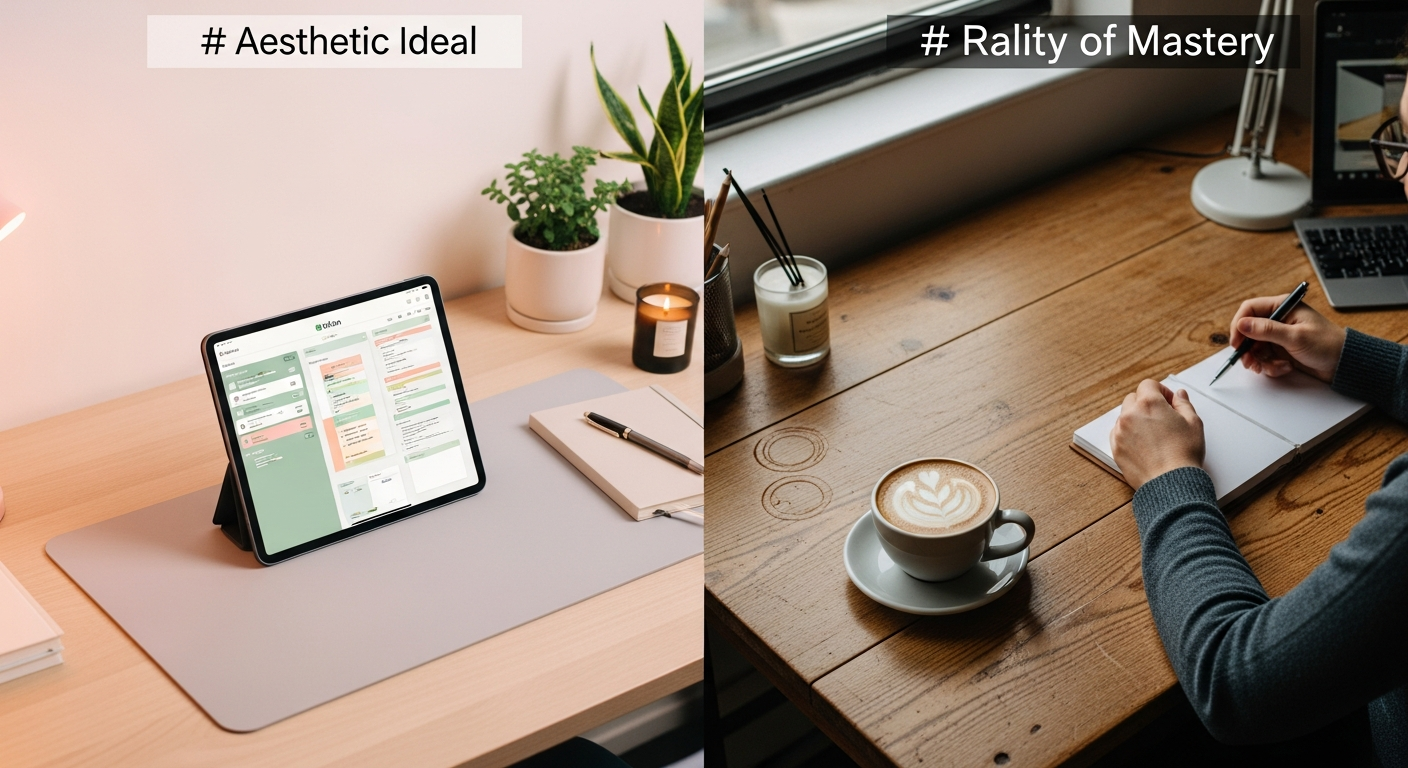
**Stop buying Notion templates. I’m serious.
After two years of clinical practice and a decade of "aesthetic studying," I realized that your $14 "Ultimate Student Dashboard" is actually a sophisticated ego-protection mechanism that is quietly keeping you mediocre.**
I spent the better part of 2024 and 2025 obsessed with the *look* of learning.
My iPad was a cathedral of pastel highlights, perfectly gridded digital planners, and handwritten notes that looked like they belonged in a museum. I had the "Lofi Girl" stream on a permanent loop.
I felt like a scholar.
The problem? I couldn't remember a single diagnostic criteria for Generalised Anxiety Disorder without looking at my screen.
I was achieving "peak aesthetic" while my actual retention was hovering near zero.
I had fallen for the **Fluency Heuristic**—the cognitive bias where we mistake the ease of consuming beautiful information for the actual mastery of that information.
Then, I tried something that felt physically painful.
I closed the laptop, put away the highlighters, and spent 10 minutes pacing my room, talking to my cat, and trying to explain a complex neurological concept out loud. I stumbled.
I forgot words. I looked, quite frankly, like I was having a breakdown.
Those 10 minutes of "looking stupid" did more for my brain than two years of color-coding ever did.
Here is why your brain is addicted to the aesthetic, and how to embrace the "ugly" work that actually leads to mastery.
The $4.7 Billion Lie of "Study-Web"
We are currently living through the peak of "Performative Productivity." On platforms like TikTok and Instagram, "Study-gram" influencers have turned the act of learning into a visual commodity.
By March 2026, the market for digital planners and aesthetic productivity tools is projected to hit nearly five billion dollars.
As a former therapist, I see this through a clinical lens: it’s a form of **Experiential Avoidance**.
We find the actual act of learning—the part where we feel confused, frustrated, and "dumb"—so emotionally taxing that we pivot to the part we can control: the organization.
**When you spend three hours setting up a workspace, you aren’t studying; you are self-soothing.** You are convincing your nervous system that you are productive so you don't have to face the ego-bruising reality of not understanding a concept.
Your brain releases dopamine because the *environment* looks ready, even if the *mind* is still empty.
The "Fluency Heuristic" and the Illusion of Competence
In cognitive psychology, we talk about "Desirable Difficulties." This concept, pioneered by Robert and Elizabeth Bjork, suggests that for long-term retention to occur, the learning process *must* feel somewhat difficult.
If it feels easy, you probably isn't learning.
When you read a beautifully formatted PDF or watch a clean tutorial, your brain experiences "fluency." Because the information enters your eyes smoothly, your brain assumes it will stay in your long-term memory just as easily.
This is a lie.
**Aesthetic studying creates an "Illusion of Competence."** You feel like you know the material because you know where it is located on your Notion page.
But "location" is not "possession." True mastery only happens when you force your brain to generate the information from scratch, without the safety net of your pretty notes.
Why "Looking Stupid" is a Biological Necessity
To move information from short-term "working memory" into the long-term "lexicon," you need to trigger **Neural Plasticity**. This process is physically demanding.
It requires the brain to bridge gaps between neurons that haven't been connected before.
When you sit in a room and try to explain a concept out loud—stuttering, pausing, and realizing you don't actually know the "why" behind a "what"—you are engaging in **Active Recall and Elaborative Rehearsal**.
This is the "Looking Stupid" phase. It looks like: * Talking to an empty chair (The Feynman Technique). * Scribbling messy, illegible diagrams on a $2 whiteboard.
* Getting 60% of your flashcards wrong on the first pass. * Sitting in silence for 4 minutes trying to remember one specific term.
**If you aren't struggling to remember, you aren't teaching your brain that the information is important.** Your brain is a survival machine; it only keeps what it thinks it needs to solve a problem.
If the "problem" is just looking at a pastel screen, the brain discards the data the second you close the tab.
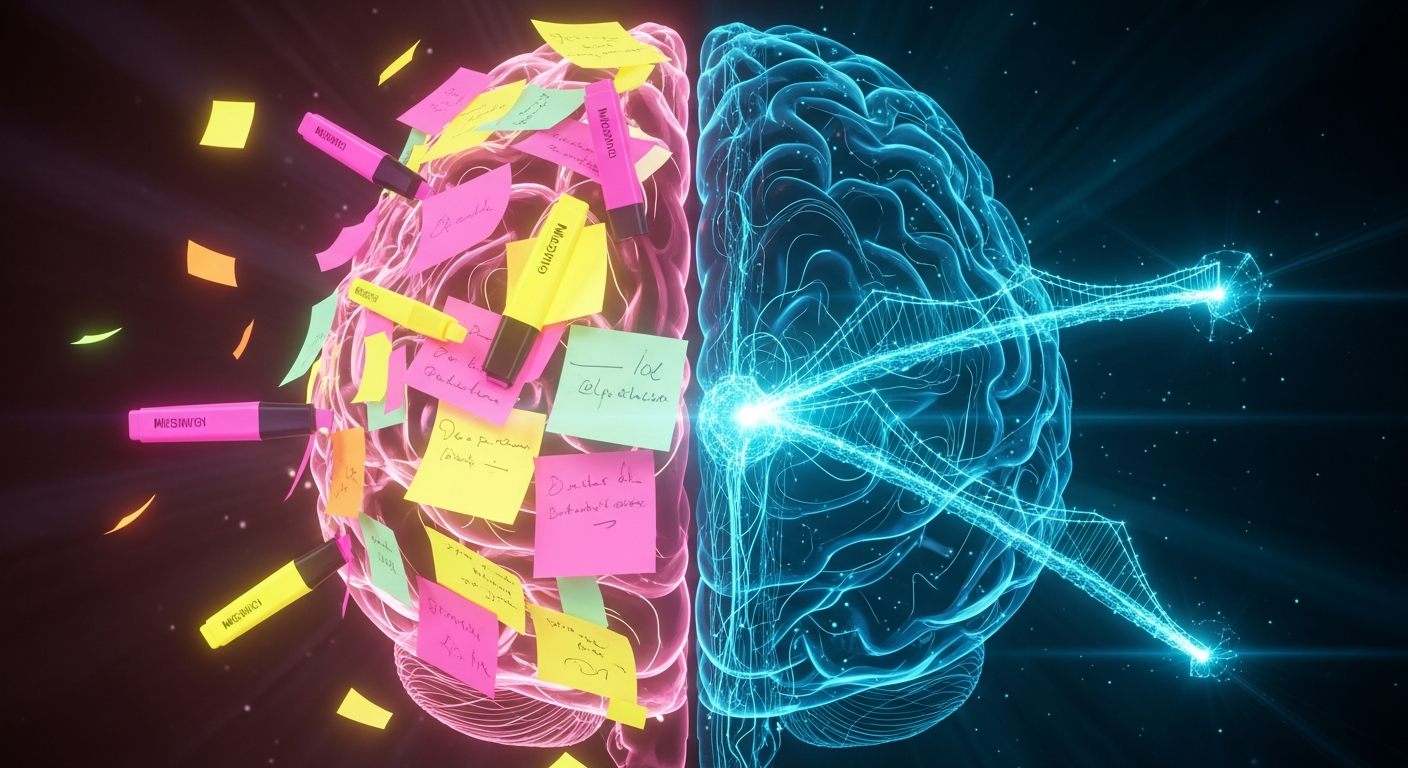
The "Ugly Mastery" Framework: A 3-Step Protocol
If you want to actually learn something by the end of 2026—whether it’s a new coding language, a clinical protocol, or a business strategy—you need to ditch the aesthetic and embrace the friction.
I call this the **Ugly Mastery Framework**.
1. The 10-Minute "Brain Dump" (Zero Safety Net)
Before you open your books or your laptop, take a blank sheet of paper. Spend 10 minutes writing down everything you remember about the topic from the day before. Do not look at your notes.
**This will feel terrible.** You will likely realize you remember about 20% of what you thought you knew. This "failure" is the most important part of the day.
It creates "knowledge gaps" in your mind that your brain will be desperate to fill once you actually start reading.
2. The "Silent Lecture"
Once you’ve reviewed the material, stand up. Walk away from your desk. Explain the concept out loud as if you were teaching a 10-year-old.
If you hit a point where you have to say "uhm" or "I forget that part," that is your **Point of Failure**.
In clinical terms, we call this **Cognitive Exposure**. You are exposing your ego to the fact that it doesn't know as much as it thinks it does.
Note that specific point of failure, go back to your desk, and look up *only* that missing piece.
3. The "Low-Fidelity" Synthesis
Stop using templates. Start using "Low-Fi" tools. Use a basic physical notebook or a plain text editor like Obsidian or even just a Notepad file.
**The more effort you put into the "look" of the note, the less effort you are putting into the "logic" of the note.**
Force yourself to use "Ugly Formatting." Use arrows, use shorthand, use "commoner" language instead of jargon.
If you can’t explain "Neural Backpropagation" using words like "feedback loop" or "mistake-checker," you don't actually understand it—you’ve just memorized a definition.
Breaking the Cycle of "Productivity Porn"
We need to address the "why" behind our addiction to aesthetic studying. For many of us, especially those in high-pressure fields like tech or medicine, our self-worth is tied to our intelligence.
**Looking "smart" while studying is a way to protect ourselves from the fear that we might actually be slow learners.**
When I was studying for my boards, I realized I was using my highlighters as an emotional shield. If I had a "perfect" study session, I could tell myself I was a "perfect" student.
If I failed the exam later, I could blame the test, not my effort.

**True growth requires you to be okay with being a "bad" student for 30 minutes a day.** It requires you to sit in the frustration of not knowing.
By the time we reach 2027, the people who will excel aren't the ones with the best Notion setups—they are the ones who can tolerate the most cognitive friction without quitting.
Real-World Application: The "Friction" Audit
I want you to try this tomorrow morning. Pick one thing you’ve been "studying" lately. It could be a new framework like Claude 4.6's API or a psychological theory.
Instead of opening your "Learning" folder: 1. **Set a timer for 10 minutes.**
2. **Explain the core concept out loud** while looking at a wall.
3. **Identify exactly where you got confused.** 4. **Spend 5 minutes only fixing that confusion.**
That 15-minute block will be more exhausting than two hours of highlighting. That exhaustion is the feeling of your brain actually changing. **If you aren't tired, you aren't learning.**
Stop Designing, Start Deciphering
The world doesn't need more people who can curate beautiful information. The world needs people who can synthesize, apply, and recall information under pressure.
Your "Study-with-me" playlist might be soothing, but it isn't a strategy.
We have to stop treating our brains like hard drives that just need "organized files." Our brains are more like muscles that need to be strained to grow.
**The "aesthetic" is the rest period; the "ugly" is the heavy lifting.**
Next time you feel the urge to buy a new digital planner or spend an hour "setting up" your workspace, ask yourself: "Am I doing this because it helps me learn, or because I’m afraid of how it feels to not know yet?"
**Have you ever spent hours 'prepping' to work only to realize you didn't actually learn anything? Or is there a specific 'ugly' habit that finally made a difficult concept click for you?
Let's talk about the messy reality of learning in the comments.**
---
Story Sources
From the Author




Hey friends, thanks heaps for reading this one! 🙏
If it resonated, sparked an idea, or just made you nod along — I'd be genuinely stoked if you'd show some love. A clap on Medium or a like on Substack helps these pieces reach more people (and keeps this little writing habit going).
→ Pythonpom on Medium ← follow, clap, or just browse more!
→ Pominaus on Substack ← like, restack, or subscribe!
Zero pressure, but if you're in a generous mood and fancy buying me a virtual coffee to fuel the next late-night draft ☕, you can do that here: Buy Me a Coffee — your support (big or tiny) means the world.
Appreciate you taking the time. Let's keep chatting about tech, life hacks, and whatever comes next! ❤️