OpenAI Just Quietly Sold Out. Why Investors Are Actually Celebrating.
OpenAI Just Quietly Sold Out. Why Investors Are Actually Celebrating.
**Stop pretending OpenAI is a mission-driven lab.
It’s a software conglomerate now.** On a Tuesday morning that felt like any other in early 2026, the last vestiges of the "non-profit oversight" that once defined Sam Altman’s empire finally dissolved into a series of SEC filings.
It wasn't a bang, but a quiet, legally-sanctioned whimper that effectively handed the keys to the kingdom to a handful of institutional investors and sovereign wealth funds.
I finally deleted my legacy OpenAI API keys this morning.
Not because the tech isn't impressive—**ChatGPT 5 is a god-tier reasoning engine**—but because the "Open" in the name has officially become the greatest marketing grift in Silicon Valley history.
If you’re still waiting for the "AGI that benefits all of humanity" promise to kick in, I have a bridge in the metaverse to sell you.
But if you’re an investor, you’re likely popping champagne, because OpenAI just removed the one thing that made it a risky bet: its conscience.
The Tuesday Morning Funeral for a Mission
For years, OpenAI operated under a bizarre "capped-profit" structure that was essentially the corporate equivalent of a "it’s complicated" relationship status.
It was a structure designed to appease the idealists while flirting with the capitalists.
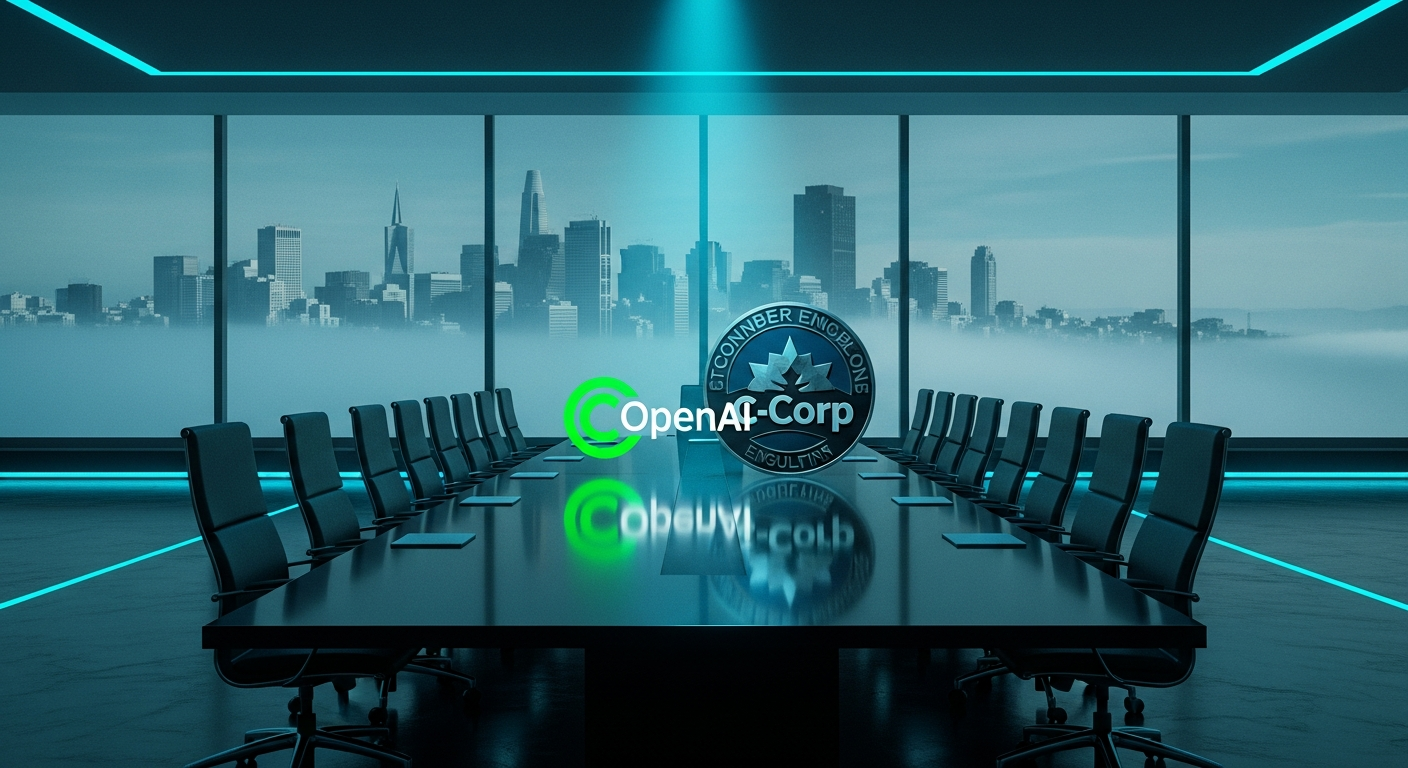
**That tension is gone.** The new filings reveal a streamlined, traditional C-corp structure where the non-profit board—once capable of firing the CEO on a whim—has been relegated to a ceremonial "advisory" role with zero veto power over product direction or safety protocols.
I remember sitting in a coffee shop in late 2023, watching the frantic tweets during the first Altman firing, thinking we were witnessing a battle for the soul of AI. We weren't.
We were witnessing a stress test for a hostile takeover.
**The 2026 pivot is simply the final cleanup crew arriving to remove the bodies.** By removing the non-profit "kill switch," OpenAI has signaled to Wall Street that there will be no more "safety pauses," no more ethical hand-wringing, and no more "alignment" goals that get in the way of the quarterly earnings report.
Investors aren't celebrating because they love AI; they’re celebrating because they love **predictability.** In the high-stakes world of $100 billion compute clusters, an ethical board is a "black swan" risk.
By selling out its original mission, OpenAI has achieved "Institutional Grade" status.
They are now too big to fail, too profitable to regulate, and too corporate to care about the "humanity" part of their original charter.
Why "Capped Profit" Was Always a Lie We Wanted to Believe
We all wanted to believe in the "Good AI" story.
It was a comforting narrative: a group of geniuses in San Francisco would build a digital god that would solve cancer and climate change, and they’d do it without the soul-crushing greed of 1990s Microsoft or 2010s Google.
**We were suckers.** The "capped profit" model was always a temporary bridge to get from "expensive research" to "unlimited monopoly."
The math never worked for the mission. You cannot build a $100 billion Stargate supercomputer on "capped" returns.
**Venture capital doesn't do "capped."** The moment OpenAI accepted the first billion from Microsoft, the timer started.
The 2026 "sell-out" is just the inevitable conclusion of a debt that had to be paid in full—not in cash, but in control.
The reality of 2026 is that the cost of intelligence has plummeted, but the cost of *sovereign* intelligence has skyrocketed.
If you want the best models, you have to rent them from the three or four companies that own the silicon.
**OpenAI has chosen to be a landlord rather than a library.** By moving to a pure for-profit model, they can finally offer the kind of equity packages that keep the best engineers from fleeing to a LocalLLaMA-inspired startup or a stealth-mode competitor.
The Investor’s Wet Dream: Predictable Monopolies
Why is the Valley so bullish on a company that just abandoned its core identity?
Because **scarcity creates value.** By locking down the weights of GPT-5 and the upcoming "GPT-6 reasoning" architectures, OpenAI is creating a walled garden that makes Apple’s App Store look like an open-air market.
Investors see a future where every Fortune 500 company is "taxed" by OpenAI for every automated email, every line of code, and every customer support interaction.
I’ve spoken to three different fund managers this week who all said the same thing: "The 'Non-Profit' tag was a discount on the valuation." Now that the tag is gone, the valuation is uncapped.
**OpenAI is no longer a research lab; it is a utility company.** They are the North American Power Grid of Cognition.
You don't ask your power company for its ethical stance on coal; you just pay the bill so the lights stay on.
This is the "Enterprise Pivot" that has been hidden in plain sight.
While we were arguing about whether GPT-5 could "feel" things, OpenAI was busy signing exclusive deals with the Department of Defense and every major insurance conglomerate.
**The mission didn't die; it was traded for a recurring revenue stream.** For an investor, a company that chooses a $10 trillion market over a vague promise of "human benefit" is the only logical choice.
The "Sovereignty Gap": Why r/LocalLLaMA Is Winning
The irony of OpenAI’s corporate consolidation is that it has sparked a massive, decentralized rebellion.
Over on r/LocalLLaMA, the mood isn't one of defeat, but of **vindication.** Every time OpenAI closes a door, the open-source community builds a ladder.
We are seeing a massive "Sovereignty Gap" opening up between the corporate-sanctioned "Safe AI" and the "Raw AI" being run on local 4090 and 5090 clusters.
I spent the last 48 hours benchmarking a quantized Llama 4-70B model against the "official" ChatGPT 5 API. The gap is closing faster than Sam Altman would like to admit.
**Local models are the new "Off-Grid" living.** While OpenAI’s models are increasingly lobotomized by corporate safety filters and "brand-safe" alignment, local models are becoming the last bastion of uncensored, high-utility reasoning.
The "sell-out" has effectively created two tiers of technology:
1. **The Corporate Stack:** Highly polished, extremely censored, and completely dependent on a subscription.
2. **The Sovereign Stack:** Harder to set up, resource-intensive, but owned entirely by the user.
If you are a developer in 2026, the choice is no longer which API to use; it’s **which side of the wall you want to live on.** Do you want to build on a platform that can revoke your "intelligence access" if your product competes with a Microsoft subsidiary?
Or do you want to own the weights?
The 3-Layer Automation Trap: A Framework for 2026
To understand why this pivot matters, we need to look at what I call the **3-Layer Automation Trap.** This is the framework OpenAI is using to capture the entire tech economy, and it’s why investors are so certain of their success.
1. The Reasoning Layer (The Toll Road)
This is where OpenAI currently dominates. They provide the "brains" for your application.
By selling out to a for-profit model, they can now prioritize "API stability" for enterprise over "innovation" for the masses.
**You are paying a cognitive tax** every time your app thinks. If you don't own the reasoning layer, you don't own your business.
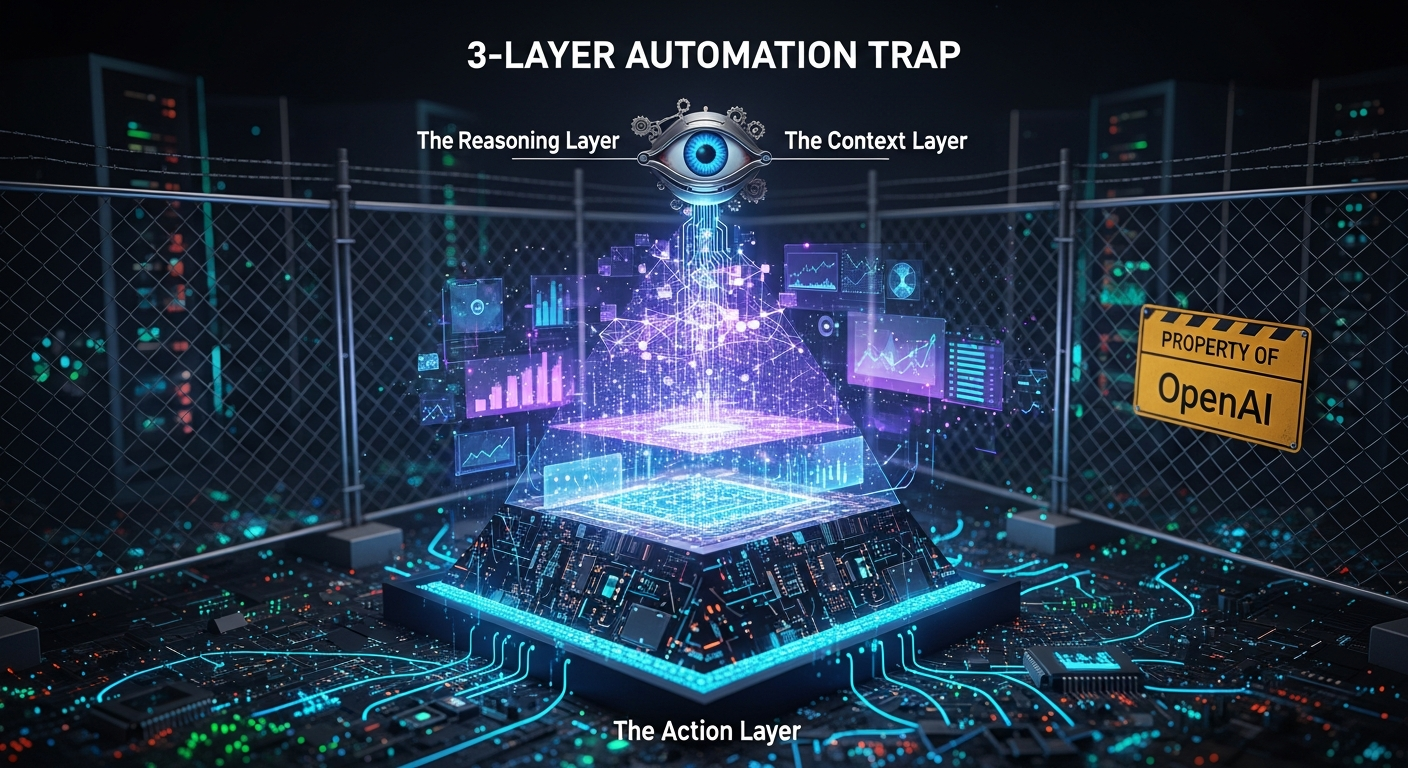
2. The Context Layer (The Data Moat)
OpenAI’s new structure allows them to be more aggressive with data partnerships.
They aren't just training on the public web anymore; they are ingesting the internal workflows of the companies they serve.
**They are learning how your business works so they can eventually replace your business.** When the mission was "non-profit," there was a thin veneer of protection.
Now, your data is just training fodder for their next vertical-specific model.
3. The Action Layer (The Execution Trap)
With the launch of "Operator" agents in late 2025, OpenAI moved from "thinking" to "doing." They can now execute tasks on your behalf across the web.
**The pivot to for-profit means they can now take a "success fee" on those actions.** Imagine an AI that doesn't just find you a flight, but negotiates the price and takes a 2% cut.
That’s the investor’s dream, and it’s only possible when you stop pretending to be a charity.
Your Data Is the New Exit Liquidity
The most cynical part of this entire transition is what it means for the "early adopters." If you’ve spent the last three years feeding your best prompts, your private codebases, and your personal thoughts into OpenAI’s servers, **congratulations: you are the exit liquidity.** You provided the reinforcement learning from human feedback (RLHF) that turned a shaky research project into a trillion-dollar asset.
And what do you get for it?
A "Pro" subscription that costs more than it did last year and a model that refuses to answer half your questions because they might violate a "Safety Policy" written by an insurance company’s legal team.
**OpenAI didn't just sell out their mission; they sold out your contribution to it.** The "Open" era was a data-gathering exercise. The "Corporate" era is the monetization phase.
I’ve talked to developers who feel a sense of "Platform Fatigue." We’ve seen this movie before with Facebook, with Google, and with Twitter.
A company promises to "connect the world" or "do no evil," gathers all our data, and then flips the switch to "extractive mode." **OpenAI just did it faster and with more compute.**
The Final Question: Who Owns Your Intelligence?
As we move deeper into 2026, the "OpenAI pivot" will be seen as the moment the AI industry lost its innocence.
We are no longer in the "Exploration Phase" of AI; we are in the "Exploitation Phase." The big players have staked their claims, the borders are being drawn, and the "mission" has been archived in a PDF that nobody at the company is required to read anymore.
But there is a silver lining.
**This "sell-out" is the best thing that ever happened to the open-source movement.** It has stripped away the illusion that we can rely on a single, benevolent company to provide the world’s intelligence.
It has forced us to realize that if we want AI that is safe, private, and aligned with *our* values (not a board of directors' values), we have to run it ourselves.
The celebratory mood in the boardroom is a signal to the rest of us.
It’s a signal to start investing in your own hardware, to start learning how to fine-tune your own models, and to stop building your future on a foundation of sand and "capped-profit" lies.
**OpenAI is finally honest about what it is.** The question is: are you honest about what that means for your future?
**Have you already started moving your critical workflows to local models, or are you still paying the "cognitive tax" to the new OpenAI? Let’s talk about it in the comments.**
---
Story Sources
From the Author



Hey friends, thanks heaps for reading this one! 🙏
If it resonated, sparked an idea, or just made you nod along — I'd be genuinely stoked if you'd show some love. A clap on Medium or a like on Substack helps these pieces reach more people (and keeps this little writing habit going).
→ Pythonpom on Medium ← follow, clap, or just browse more!
→ Pominaus on Substack ← like, restack, or subscribe!
Zero pressure, but if you're in a generous mood and fancy buying me a virtual coffee to fuel the next late-night draft ☕, you can do that here: Buy Me a Coffee — your support (big or tiny) means the world.
Appreciate you taking the time. Let's keep chatting about tech, life hacks, and whatever comes next! ❤️