OpenAI Just Changed Everything. Why This $730B Valuation Is Actually Terrifying.
OpenAI Just Changed Everything. Why This $730B Valuation Is Actually Terrifying.
I woke up this morning to a notification that felt like a glitch in the simulation. OpenAI just closed a $110 billion funding round at a **$730 billion pre-money valuation**.
That isn't just a "big raise" or a successful Series G.
It is a tectonic shift that effectively ends the "startup" era of artificial intelligence and ushers in something much more industrial—and, if I’m being honest, much more predatory.
For those of us who have been in the trenches since the GPT-2 days, this number represents more than just capital.
It represents the moment the "API for Intelligence" became a sovereign-level utility, and the implications for independent developers are, frankly, chilling.
The Morning Hacker News Melted Down
I was scrolling Hacker News around 6:00 AM when the thread hit. The engagement level was already at 461/100, which is basically the digital equivalent of a five-alarm fire.
The consensus among the gray-beards and the kernels-devs was immediate: **This is the Dutch East India Company of the 21st century.** We aren't looking at a software company anymore; we are looking at a private entity that is attempting to monopolize the very concept of reasoning.
I spent the last three hours running my production stack through ChatGPT 5 and comparing the output to the latest Claude 4.6 builds.
The delta is shrinking, but OpenAI’s war chest just grew so large that they no longer need to have the "best" model to win—they just need to own the most power.
Why $730 Billion Should Keep You Up at Night
To put $730 billion in perspective, that is more than the market cap of JPMorgan Chase or nearly triple Meta’s valuation during its late-2022 trough.
It’s a valuation that demands a "Winner Takes All" outcome to ever make sense to investors.
If you’re a developer building on top of OpenAI’s API today, you aren't a "partner." You are a tenant in a skyscraper that is currently being built around you, and **the rent is about to become an "Intelligence Tax" on every line of code you ship.**
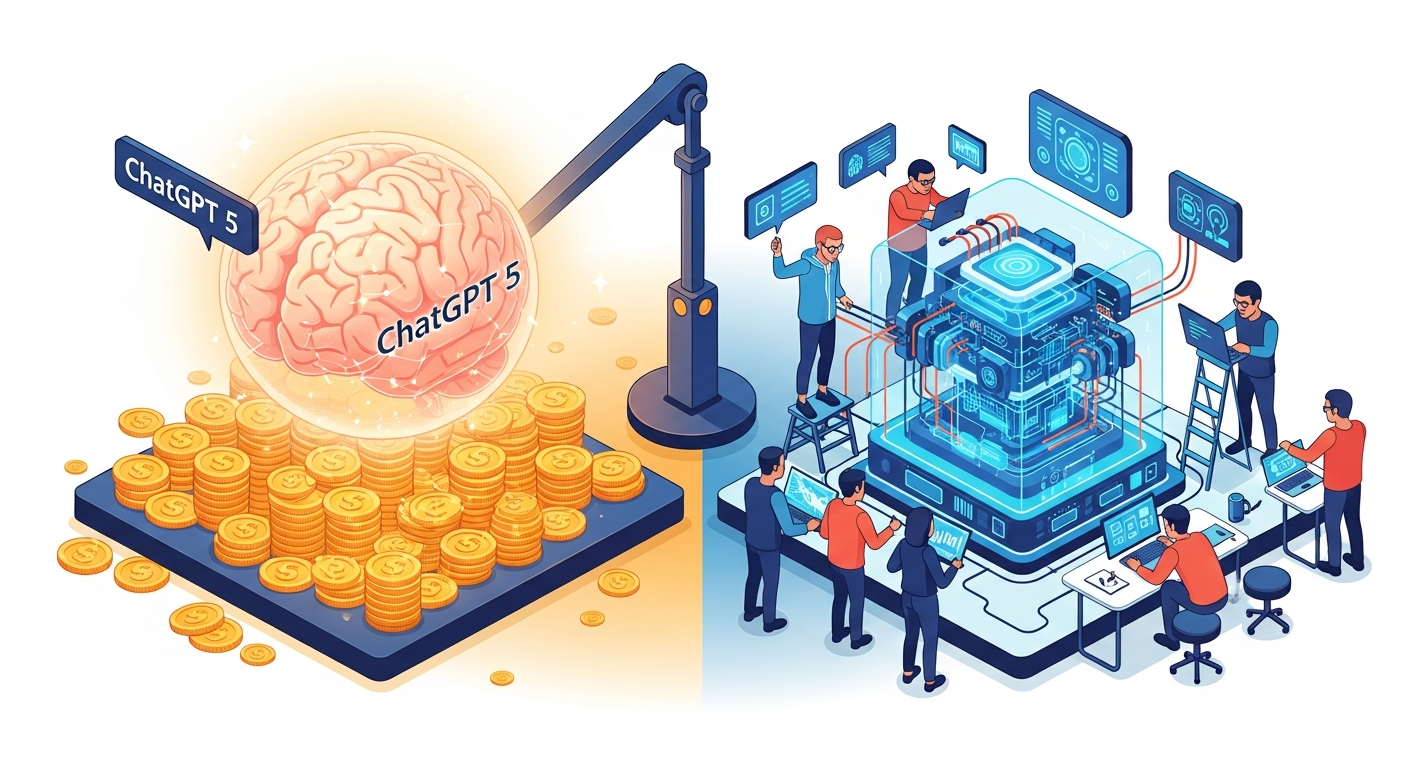
When a company raises $110 billion in cash, they aren't buying better GPUs or hiring more researchers.
They are buying the infrastructure of the physical world—power plants, data centers, and specialized silicon—to ensure that no one else can even afford to compete.
The End of the "Scaling Laws" Romanticism
For the last eighteen months, we’ve been told that scaling laws are the ultimate truth: more compute equals more intelligence.
We’ve seen ChatGPT 5 push the boundaries of agentic reasoning, but we’re also seeing the first signs of diminishing returns.
I’ve noticed it in my own workflow. While ChatGPT 5 is incredible at high-level systems architecture, it’s not 10x better than the models we had six months ago.
It’s perhaps 20% more reliable, but it requires 500% more energy to produce that result.
**The $730B valuation assumes that OpenAI can break through the "data wall" by sheer brute force.** They are betting $110 billion that they can manufacture synthetic data high-quality enough to keep the scaling laws alive until 2027 and beyond.
The "Stargate" Reality
Rumors of the "Stargate" supercomputer have been circulating for a while, but this funding confirms it. OpenAI is no longer a software lab; they are a heavy-industry conglomerate.
They are building a machine that consumes as much electricity as a small country.
As a developer, this terrifies me because it centralizes the "Brain" of the internet into a single geographic and corporate location.
If the future of software is just "calling the most expensive model," then the era of the "garage startup" is officially over.
**You cannot compete with $110 billion of specialized compute unless you have $110 billion of your own.**
What Happens to the Open Source Resistance?
I spent most of last week experimenting with Llama 4 and some of the smaller Mistral models. They are punchy, fast, and surprisingly capable for local dev work.
But let’s be real: they are fighting a guerrilla war against a nuclear power.

OpenAI’s valuation is a signal to the market that "Intelligence" is going to be a centralized utility, much like AWS or the power grid.
They want to make it so cheap and so ubiquitous that you’d be "stupid" to run your own model.
**This is the classic "Dumping" strategy.** Use $110 billion to subsidize the cost of intelligence until every open-source competitor is starved of talent and interest.
Once the competition is gone, the "Intelligence Tax" goes from 1 cent per million tokens to whatever Sam Altman decides it needs to be to justify that $730B price tag.
The Claude 4.6 Factor
Interestingly, Anthropic has taken a different path. Using Claude 4.6 in Cursor lately has felt... more human?
There’s a nuance to the code refactoring that ChatGPT 5 sometimes misses in its quest for "perfect" logic.
But Anthropic doesn't have $110 billion in the bank. This raise puts OpenAI in a position where they can simply out-spend Anthropic, Google, and Meta combined in the race for energy and chips.
The Reality Check: Is AGI Actually Worth $730 Billion?
We have to ask the hard question: Is the "Intelligence" we are getting actually worth this much capital?
I look at the products being built today—the wrappers, the "AI-powered" spreadsheets, the slightly better chatbots—and I don't see $730 billion of value.
I see a massive bubble of expectations.
We are currently in the "installation phase" of AI, where everyone is buying the tools but no one has quite figured out the "killer app" that justifies this level of investment.
**We are building a $730 billion engine for a car that hasn't been designed yet.**
If OpenAI doesn't deliver a "God-in-a-box" by the end of 2026, this funding round will be remembered as the peak of the greatest speculative mania in human history.
The stakes aren't just high; they are existential for the tech economy.
The "Compute-Poor" vs. The "Compute-Rich"
We are entering a two-tier society in tech. There will be the "Compute-Rich" (OpenAI, Microsoft, Google) and the "Compute-Poor" (everyone else).
If you are a senior engineer at a mid-sized firm, your job is about to change.
You won't be "writing code" in the traditional sense; you will be "orchestrating intelligence" that you don't own, don't understand, and can't audit.
**The loss of agency is the most terrifying part of this valuation.** When a single entity controls the "standard" for reasoning, they control the standard for truth, logic, and efficiency.
Practical Takeaways: How to Survive the $730B Era
If you're a developer or a founder looking at this news and feeling a pit in your stomach, you're not alone. The landscape has shifted, and the old rules of "just build a better tool" are gone.
Here is how I’m pivoting my own strategy for the rest of 2026:
1. Stop Building Wrappers, Start Building Pipelines
If your product is just a clever prompt and a UI, you are already dead. OpenAI will incorporate your "feature" into the next ChatGPT 5.5 update before your next sprint ends.
Instead, focus on the **proprietary data pipeline**. The only thing $110 billion can't buy (easily) is the specific, messy, real-world data that lives inside a company's walls.
Become the expert at moving that data into the model and back out into a meaningful action.
2. Diversify Your Model Dependencies (Now)
I’ve spent the last month rewriting my internal agents to be model-agnostic.
I use an abstraction layer that lets me swap between ChatGPT 5, Claude 4.6, and Gemini 2.5 with a single environment variable change.
**Do not give OpenAI the power to "vendor-lock" your intelligence.** If they decide to hike prices or change their safety guidelines in a way that breaks your app, you need to be able to leave within an hour.
3. Focus on "Small AI" and Local Inference
There is a growing movement of developers moving *away* from the giant cloud models toward highly specialized, local models.
If you can deliver 90% of the value of ChatGPT 5 using a model that runs on a user’s MacBook for $0 in API costs, you have a massive competitive advantage.
**Privacy and cost-predictability are the only things OpenAI cannot offer right now.**
4. Invest in "Human-in-the-Loop" Systems
The $730B valuation assumes AI will replace the human. I believe the real value is in AI that *augments* the human.
Build systems that make experts 10x faster, rather than systems that try to replace the expert. The "Human-AI Hybrid" is much more resilient to model changes and platform shifts than a "Pure AI" play.
The Intelligence Grid is Here
By this time next year, in early 2027, we will likely look back at February 28, 2026, as the day the "Intelligence Grid" became a reality.
We are moving toward a world where "thinking" is a service you subscribe to, much like water or internet.
It is a world of incredible potential, but also one of extreme centralization. **The $110 billion OpenAI just raised is a bet that they can be the only ones holding the switch.**
As developers, we have a choice.
We can either be the people who simply "use the grid" and pay the tax, or we can be the ones building the decentralized, open, and private alternatives that keep the "Intelligence Monarchy" in check.
I’m choosing the latter.
It’s a harder path, and I don't have $110 billion in my bank account, but it’s the only way to ensure that the future of software remains in the hands of the people who actually write it.
**How do you feel about the "Intelligence Tax"? Are you doubling down on OpenAI, or are you looking for the exit?
Let’s talk in the comments—I’m genuinely curious if anyone else finds this valuation as haunting as I do.**
Story Sources
From the Author



Hey friends, thanks heaps for reading this one! 🙏
If it resonated, sparked an idea, or just made you nod along — I'd be genuinely stoked if you'd show some love. A clap on Medium or a like on Substack helps these pieces reach more people (and keeps this little writing habit going).
→ Pythonpom on Medium ← follow, clap, or just browse more!
→ Pominaus on Substack ← like, restack, or subscribe!
Zero pressure, but if you're in a generous mood and fancy buying me a virtual coffee to fuel the next late-night draft ☕, you can do that here: Buy Me a Coffee — your support (big or tiny) means the world.
Appreciate you taking the time. Let's keep chatting about tech, life hacks, and whatever comes next! ❤️