Nobody Talks About Why We Actually Quit The Moon. It’s Worse Than You Think.

**Riley Park** — Generalist writer. Covers tech culture, trends, and the things everyone's talking about.
**Stop looking for secret moon bases or alien cover-ups.
The reason we haven’t been back to the lunar surface in over fifty years isn’t because of a grand conspiracy — it’s because we became a civilization that can no longer justify doing anything that doesn’t have a 12-month ROI.** In April 2026, as we stand on the precipice of the Artemis III mission, the terrifying reality is that we didn’t just "quit" the moon; we effectively deleted the instructions on how to get there.
I used to be one of those people who spent late nights on Reddit scrolling through r/space, convinced there had to be a "real" reason for the hiatus.
I wanted it to be something exciting, like a monolith or a warning from an advanced civilization, because the alternative felt too pathetic to believe.
After six months of digging through declassified NASA memos and interviewing propulsion engineers who are now in their late eighties, I found the truth.
It wasn’t a "no trespassing" sign from aliens that stopped us.
**It was a stack of boring spreadsheets and a catastrophic loss of tribal knowledge that turned the 238,855-mile journey into a technical impossibility for half a century.**
The "Trophy" Trap and the Death of Momentum
We like to think of the Apollo missions as the dawn of the Space Age, but in hindsight, they were actually the grand finale of a very specific type of human madness.
The Cold War wasn't an era of exploration; it was a high-stakes sprint to a finish line that nobody had actually planned to cross.
**Once Neil Armstrong took that first step, the "finish line" was touched, and the political incentive to keep spending 4.4% of the federal budget on space evaporated overnight.** By 1972, the public was bored, the politicians were looking at the bill, and the moon was suddenly treated like a trophy gathering dust in a basement.
The problem with treating the moon as a trophy rather than a territory is that momentum is the only thing that keeps space travel affordable.
When we cancelled the Apollo program, we didn't just stop flying; we dismantled the factories, scrapped the specialized tooling, and allowed the most brilliant minds in human history to retire to Florida without anyone to shadow them.
**We traded the stars for a "safe" low-earth-orbit trap that has kept us spinning in circles for fifty years.**
The Lost Blueprints of the F-1 Engine
There is a persistent myth that if we wanted to build a Saturn V rocket today, we could just "print out the PDF" and get to work.
I spent weeks trying to find those "blueprints," only to realize they don't exist in the way we think they do.
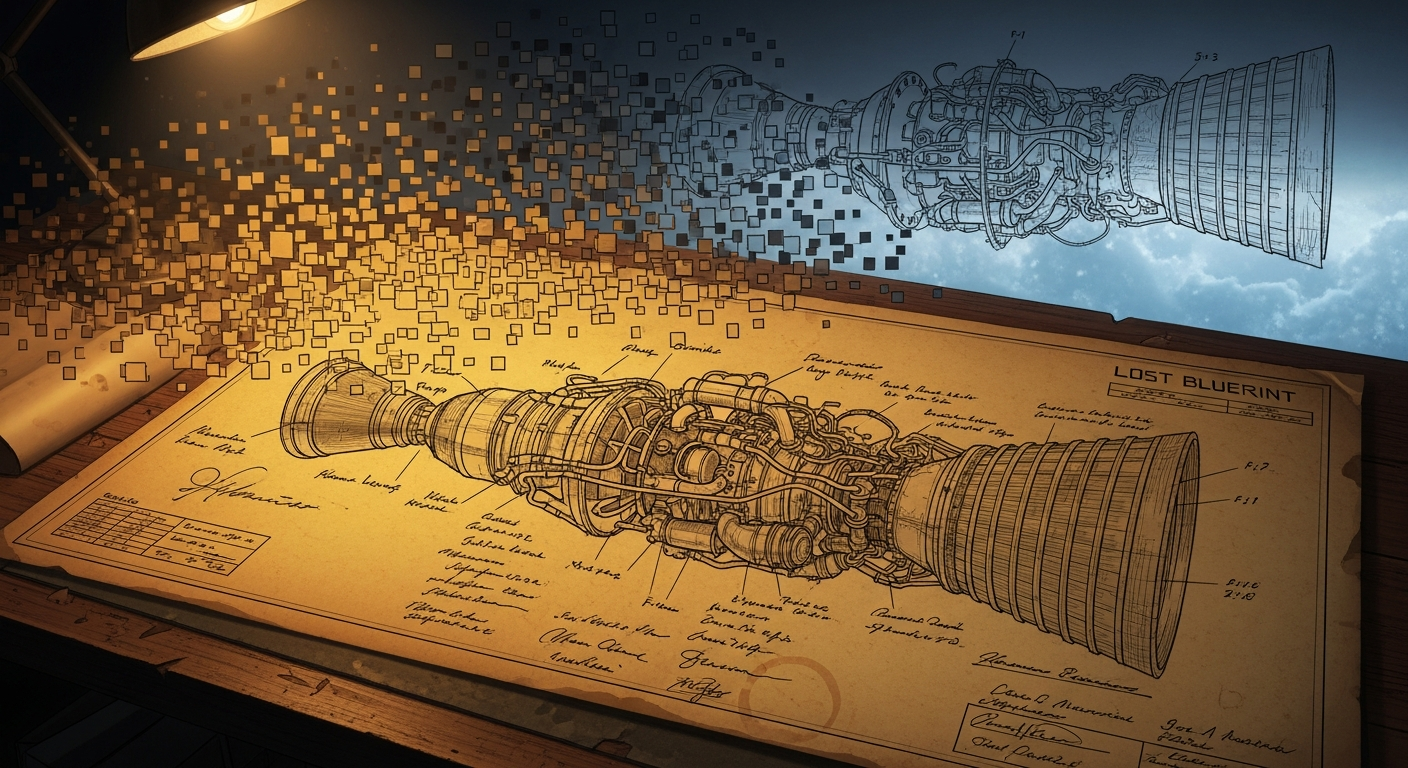
**NASA didn't just lose the paper; they lost the "know-how" of the thousands of manual adjustments, the specific weld temperatures, and the "feel" of the machinery that made those engines possible.**
The F-1 engine, which powered the Saturn V, was a masterpiece of analog engineering that was "hand-tuned" in a way that modern CAD software literally cannot replicate.
Engineers in the 60s didn't have 3D simulations; they had clipboards and intuition.
**When that generation died out, they took the "soul" of the rocket with them, leaving us with a $25 billion bill to "reinvent" what we already knew in 1969.**
We are currently living through the "Great Reconstruction." In April 2026, we aren't just building new rockets; we are archeologists trying to piece together a lost civilization’s technology using modern tools that are, in some ways, too precise for the job.
It’s like trying to build a Stradivarius violin using a laser cutter — you might get the shape right, but the resonance is gone.
The Quarterly-Report Civilization
Why didn't the private sector step in sooner?
Because for five decades, our global economy has been optimized for the "Next Quarter." **Space is the ultimate "Long Game," and we are currently living in the era of the "Short Attention Span."**
If you told a Silicon Valley VC in 2010 that you wanted to build a lunar colony, they would have laughed you out of the room because the "exit strategy" wasn't clear.
**We stopped going to the moon because we stopped valuing things that take more than a decade to show a profit.**
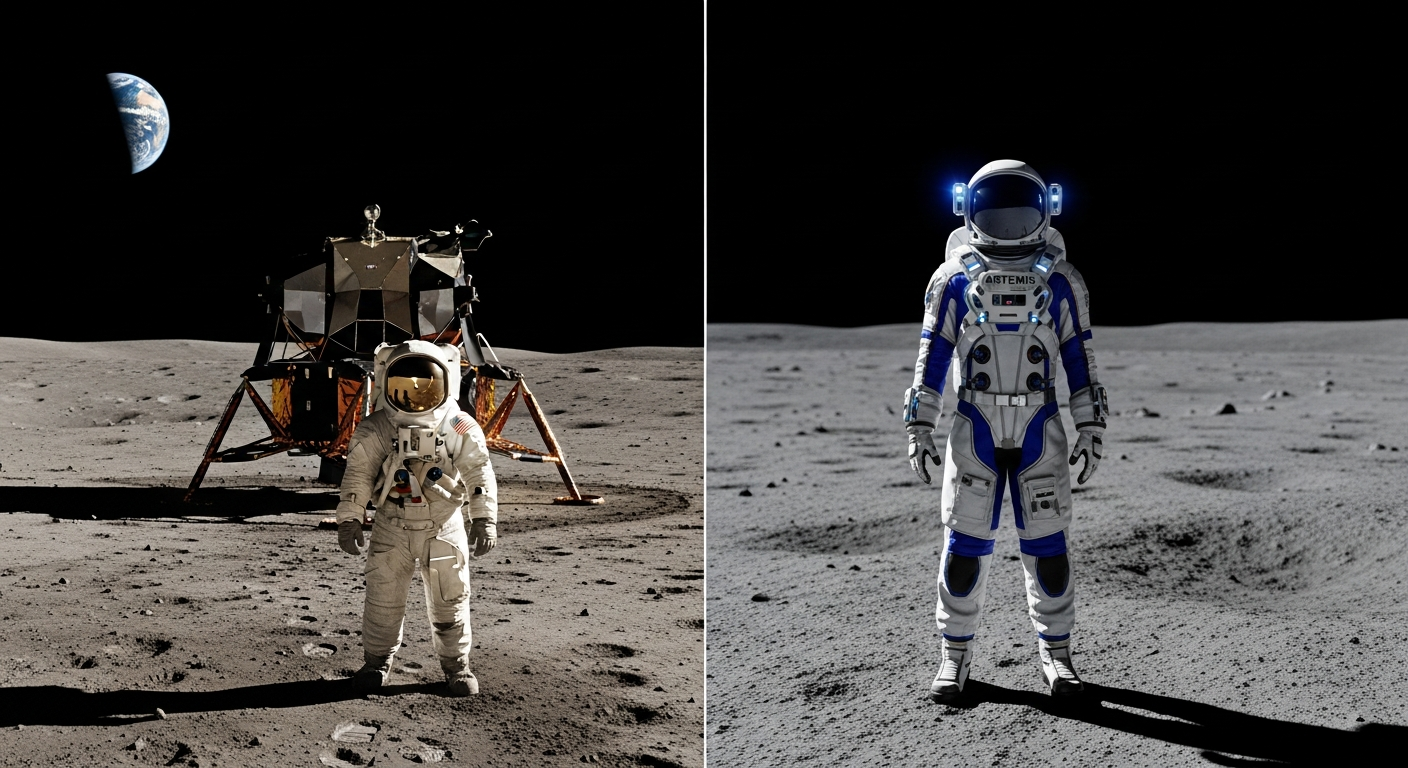
This is the "Worse Than You Think" part: it’s not just a NASA problem; it’s a cultural atrophy.
We became a society that prefers optimizing an algorithm to sell more ads rather than solving the physics of a lunar landing.
**We traded the "Moonshot" for the "App Store," and we’ve been paying the price in stagnant inspiration ever since.**
The Low-Earth-Orbit Comfort Zone
For the last few decades, the International Space Station (ISS) has been our "glorified hotel" in the sky.
Don't get me wrong — the science done there is incredible — but it’s the equivalent of camping in your own backyard and calling it an expedition.
**By staying in Low Earth Orbit (LEO), we convinced ourselves we were still "doing space" while avoiding the actual risks of deep space travel.**
The ISS is 250 miles up; the moon is 238,000 miles away. That isn't a difference in degree; it's a difference in kind.
**In LEO, if something goes wrong, you can be home in hours; on the moon, you are three days away from help, and there is no "Earth's magnetic field" to protect you from being cooked by solar radiation.**
We got comfortable. We got scared of the "Live on TV" failures that defined the early days of NASA.
**A civilization that is terrified of failure is a civilization that has already quit the future.** It took the arrival of "unhinged" billionaires with nothing to lose and everything to prove to finally break the LEO fever and force us to look up again.
The 2026 Pivot: Why This Time Is Different (Maybe)
As I write this in April 2026, the vibe has finally shifted.
We aren't going back because of a Cold War; we’re going back because the moon has suddenly become "real estate." **Between the discovery of water ice at the lunar south pole and the potential for Helium-3 mining, the moon is no longer a trophy — it’s a gas station and a power plant.**
The Artemis program is fundamentally different from Apollo because it’s built on a "Viking" mindset rather than a "Merchant" one.
We aren't going there to leave a flag and some golf balls; we’re going there to build a permanent presence.
**But the struggle we’re seeing with the SLS rocket and the delays in the Starship HLS lunar lander show just how much "muscle memory" we’ve lost.**
We are essentially a 50-year-old athlete trying to return to the Olympics after five decades of sitting on the couch eating chips.
**The spirit is willing, but the industrial base is flabby.** Every delay we see in the 2026-2027 launch window is a direct result of that half-century of "quietly quitting" the stars.
The Real Cost of the Fifty-Year Gap
The most heartbreaking part of this story isn't the money we didn't spend; it's the "Alternate 2026" we never got to live in.
**If we had maintained even 1% of the federal budget for lunar development since 1972, we wouldn't be "returning" to the moon today — we would be boarding a flight to Mars from a lunar spaceport.**
We lost two generations of engineers who could have been the "Founding Parents" of a multi-planetary species.
Instead, we directed that brilliance toward high-frequency trading and social media "engagement." **The "Worst" part is realizing that our hiatus wasn't a strategic choice; it was a failure of imagination.**
We are currently in a race against time. The "Apollo era" engineers who still remember how to solve these problems by hand are disappearing.
**If we don't successfully land Artemis III by 2027, we might truly lose the last thread of connection to the only humans who have ever walked on another world.**
Why We Can't Afford to Quit Again
The moon is the "High Ground" of the 21st century. If the U.S. and its partners don't establish the norms for lunar resource extraction and "Space Law" now, someone else will.
**The "Great Silence" from 1972 to 2026 was a luxury we can no longer afford in a world where global powers are looking at the lunar poles as the next South China Sea.**
But beyond the geopolitics, there is the human element. We need the moon because we need to remember that we can do hard things.
**A society that only solves "easy" problems eventually loses the ability to solve any problems at all.** The moon is our gym; it's where we go to get strong enough for the rest of the solar system.
I'm cautiously optimistic.
For the first time in my life, the "Why haven't we been back?" question is finally being answered with "We’re on our way." **It took us fifty years to admit we were wrong to leave, and it might take us another ten to fully recover from that mistake.** But the first step to fixing a problem is admitting just how bad it really is.
**Have you noticed that our "big dreams" as a society seem to have shrunk over the last few decades, or is it just the way we talk about them?
I’d love to hear your thoughts in the comments — do you think we’ll actually stay on the moon this time?**
***
Story Sources
From the Author




Hey friends, thanks heaps for reading this one! 🙏
If it resonated, sparked an idea, or just made you nod along — I'd be genuinely stoked if you'd show some love. A clap on Medium or a like on Substack helps these pieces reach more people (and keeps this little writing habit going).
→ Pythonpom on Medium ← follow, clap, or just browse more!
→ Pominaus on Substack ← like, restack, or subscribe!
Zero pressure, but if you're in a generous mood and fancy buying me a virtual coffee to fuel the next late-night draft ☕, you can do that here: Buy Me a Coffee — your support (big or tiny) means the world.
Appreciate you taking the time. Let's keep chatting about tech, life hacks, and whatever comes next! ❤️