Nobody Talks About This Uncomfortable Japan Secret. It’s Worse Than You Think.
I spent three years building "sovereign" systems in Minato City, Tokyo. I thought we were partners. I was wrong.
I believed that by sitting in the heart of Japan’s tech district, I was part of a global, collaborative engine where information flowed both ways and "allies" meant exactly that.
Then, last Tuesday, everything changed. That viral clip of Trump dismissively explaining why he didn’t notify Japan or any other U.S.
allies before carrying out **Operation Epic Fury** on February 28th didn’t just break the news cycle—it broke the illusion of digital safety for every engineer in East Asia.
If you haven't seen the clip yet, it’s chilling in its simplicity: a reporter asks about the lack of communication, and the response is a shrug that says, "We didn't need to."
**The "Japan Secret" isn't about hidden military bases or old scrolls.
It’s about the fact that Japan has quietly become a digital vassal state.** We talk about Japan as the land of Sony, Nintendo, and high-tech innovation, but underneath the neon lights of Akihabara, there is a rot that nobody wants to acknowledge.
It’s worse than you think because it’s not just about politics; it’s about the very servers your code is running on.
The Digital Black Ships of 2026
In 1853, Commodore Matthew Perry arrived in Edo Bay with "Black Ships," forcing Japan to open its doors to the world.
We are currently living through the **Second Black Ship era**, but this time, the ships are invisible.
They are the fiber optic cables and the satellite arrays owned by four giants in Seattle, Mountain View, and Austin.
Japan’s "Galapagos Effect"—the tendency for its tech to evolve in isolation—was once a source of pride. Now, it is a cage.
Because Japan spent decades perfecting hardware while ignoring the software-defined world, it has been **digitally colonized**.
Every major Japanese bank, every government ministry, and even the Shinkansen ticketing systems now run on U.S. cloud infrastructure.
While Sakura Internet is fighting a lonely battle as the sole domestic challenger to be certified for the "Government Cloud," it remains an underdog against the hyperscaler tide.
When the U.S. carries out a unilateral "operation" like Epic Fury without notifying its allies, it isn’t just a diplomatic snub. It is a **demonstration of ownership**.
If the U.S. can move without telling Japan, it can also "turn off" the lights without telling Japan. As a developer on the ground, I saw the panic in the eyes of CTOs last week.
They realized that their "national" infrastructure is essentially a rented apartment, and the landlord just changed the locks without a phone call.
Why 96% of Japanese Tech is a Facade
We’ve been lied to about Japan’s technical prowess for a long time. While we were all enamored with their robotics and automotive engineering, the **underlying digital backbone was hollowed out**.
If you look at the "Japan Secret" through a technical lens, you see a terrifying level of dependency.
**Over 90% of Japan’s mission-critical cloud-hosted data is stored on non-Japanese servers.** Think about that for a second.
The birth records, tax filings, and healthcare data of 123.6 million people are sitting in data centers managed by foreign entities under complex jurisdictional conflicts.
This is the "uncomfortable secret" that Japanese politicians have been trying to hide with "Digital Transformation" (DX) buzzwords.
The Trump clip acted as a catalyst because it proved that the "partnership" is entirely one-sided. In the world of 2026, **sovereignty is synonymous with compute**.
If you don’t own the silicon and the hypervisor, you don’t own your country.
Japan is currently a high-tech nation with a third-world digital sovereignty profile. It is a vulnerability that is ready to be exploited.
The "Kill Switch" Nobody Is Prepared For
Let’s talk about the technical reality of Operation Epic Fury. Whether it was a cyber-strike, a kinetic movement, or a data-seizure operation, the message was clear: **The U.S.
acts, and the world reacts.** For a developer, this means your "High Availability" setup is a joke if the route to the US-EAST-1 region is severed by a policy change.
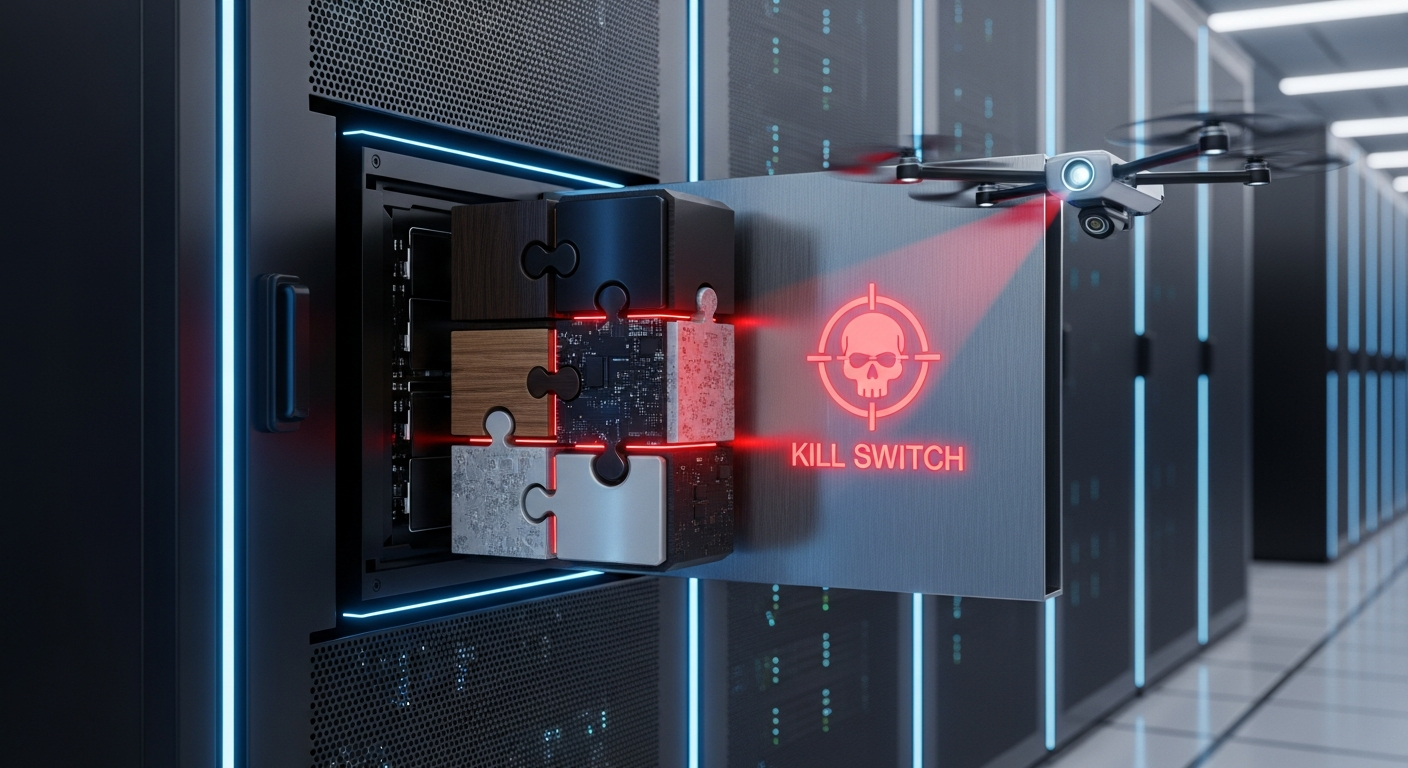
I call this the "Digital Kill Switch." It’s not a physical button, but a series of **API revocations**.
Imagine waking up tomorrow and finding that every AWS IAM role associated with Japanese government accounts has been "temporarily suspended" due to a security mandate from Washington.
Japan’s economy would stop. Not in days, but in seconds.
The reason this is worse than you think is that there is **no viable Plan B for immediate scale**.
While domestic providers like Sakura are scaling up, they currently lack the capacity to absorb the nation's entire digital workload.
Japan has effectively traded its resilience for convenience, hoping the landlord remains "friendly" forever. But as we saw last week, "friendly" is a very flexible term in 2026.
The 4-Layer Sovereign Audit: A Framework for Survival
Layer 1: The Compute Layer (The Silicon Test)
Where was your hardware born? If your entire stack runs on ARM or x86 architecture controlled by a single country’s export laws, you are at a **Level 1 Dependency**.
In 2026, we are seeing the rise of RISC-V precisely because of the fear generated by events like Operation Epic Fury. If you can’t fab it, you don’t own it.
Layer 2: The Data Layer (The Jurisdiction Test)
Where does the bit rest? If your data is encrypted but the "keys to the kingdom" (the KMS) are managed by a provider in Northern Virginia, your encryption is a **legal fiction**.
You must audit where your metadata lives. Metadata is often more valuable than the data itself, and it’s the first thing "allies" scrape during unilateral operations.
Layer 3: The Protocol Layer (The Gateway Test)
How do you talk to the world? Most of us rely on DNS and BGP protocols that are heavily influenced by U.S.-based entities.
If your country’s top-level domain can be "poofed" out of the global routing table, you are at a **Level 3 Dependency**.
We saw this with smaller nations in the 2020s; by late 2027, we might see it happen to a G7 nation.
Layer 4: The Intelligence Layer (The Model Test)
Who trained your AI? In 2026, every "smart" system in Japan is built on top of LLMs trained in San Francisco.
If the weights and biases of your decision-making systems are **culturally and politically biased** toward a foreign power, you have lost the ability to think as a nation.
This is the most dangerous layer of the "Japan Secret."
Real-World Consequences: The "Blackout" of 2027
Based on the trajectory of Operation Epic Fury, we can predict what "18 months from now" (late 2027) looks like for Japan. The "Secret" is out now, and the reaction is going to be messy.
We are likely to see a **forced decoupling** that Japan is not ready for.
Think about the "1989 Computer" experiment I wrote about last month. Back then, Japan was a hardware king. If you wanted to send an email, you used a machine built in Tokyo with a BIOS written in Tokyo.
Today, if you want to send an email in Tokyo, your data travels to a server in Oregon and back. **We have traded resilience for convenience**, and the bill is finally coming due.
The "Blackout" of 2027 won't be a power failure. It will be a **service failure**. It will be the day a mid-level bureaucrat in the U.S.
Treasury signs an order that accidentally (or intentionally) flags a major Japanese logistics hub as a "security risk," and the AI-driven supply chain automatically re-routes everything away from the island.
And nobody will notify Japan. Because, as we’ve learned, nobody has to.
Why You Should Care (Even If You Aren't in Japan)
You might be reading this from a coffee shop in Berlin, London, or Sydney thinking, "This is a Japan problem." You are wrong. This is a **Global Dependency Problem**.
Japan is just the "canary in the coal mine" because of its unique history of being a tech leader that gave up its throne.
If the U.S. can carry out Operation Epic Fury without telling an ally as critical as Japan, what makes you think they’ll tell *your* government before they pivot their tech policy?
We are moving into an era of **Digital Realpolitik**. The "Japan Secret" is simply the first time the curtain has been pulled back so violently.
As developers, we have a responsibility to build **Anti-Fragile Systems**.
This means moving away from "The Cloud" as a singular, god-like entity and moving toward **Distributed, Local-First, and Sovereign** architectures.
It’s harder, it’s more expensive, and it’s less "sexy" than a one-click AWS deployment. But it’s the only way to ensure that your code—and your country—doesn’t have a "Kill Switch."
The Uncomfortable Truth
The most painful part of the "Japan Secret" isn't the U.S. dominance. It’s the **Japanese complicity**. For years, Japanese tech leaders took the easy path.
They outsourced their future for short-term stock gains. They traded their digital sovereignty for a "Seamless Integration" badge.
I’ve sat in those meetings. I’ve heard the excuses. "It’s too expensive to build our own." "The U.S. is our protector." "They would never turn it off." Last week, those excuses died.
The "uncomfortable secret" is that **Japan chose this path**, and now they are stuck on it with no clear exit.
The Trump clip wasn't a gaffe. It was a **status report**. It told the world exactly where we stand in the hierarchy of the 2026 digital empire.
You are either the architect of the platform, or you are a tenant. And tenants don't get notified when the building is being demolished.
Is There a Way Out?
I spent my final month in Tokyo helping a small team of engineers build a "Dark Stack"—a completely isolated, hardware-to-software suite designed to run without a single packet leaving the building.
It was slow. It was "clunky." It looked like something from 2005.
But when the news of Operation Epic Fury broke, that was the only team in the entire ward that wasn't panic-checking their AWS dashboards. They had **True Autonomy**.
They weren't part of the "Japan Secret" because they had stopped pretending that the "partnership" was real.
We need more of that energy. We need a global movement of **Sovereign Developers** who prioritize resilience over "five nines" of rented uptime.
The "Japan Secret" is a warning to all of us: if you aren't at the table, you're on the menu. And in the world of 2026, the menu is digital.
**Do you think your country has a "Digital Kill Switch," or are you confident in your local infrastructure?
I’ve been seeing some wild takes on the "Sovereign Stack"—let’s talk about it in the comments. Is total digital independence even possible anymore?**
---
Story Sources
From the Author




Hey friends, thanks heaps for reading this one! 🙏
If it resonated, sparked an idea, or just made you nod along — I'd be genuinely stoked if you'd show some love. A clap on Medium or a like on Substack helps these pieces reach more people (and keeps this little writing habit going).
→ Pythonpom on Medium ← follow, clap, or just browse more!
→ Pominaus on Substack ← like, restack, or subscribe!
Zero pressure, but if you're in a generous mood and fancy buying me a virtual coffee to fuel the next late-night draft ☕, you can do that here: Buy Me a Coffee — your support (big or tiny) means the world.
Appreciate you taking the time. Let's keep chatting about tech, life hacks, and whatever comes next! ❤️