Nobody Talks About the Uganda Chimp War. It’s Actually Worse Than You Think.

**Nobody Talks About the Uganda Chimp War. It’s Actually Worse Than You Think.**
**Nature is not a Disney movie.
I spent the last seventy-two hours descending into a rabbit hole that rewired how I view "teamwork," and frankly, it’s a lot bloodier than anything we’ve seen in a corporate boardroom.** While we’ve been obsessing over AI benchmarks and the 2026 election cycle, a literal "Game of Thrones" has been playing out in the Kibale National Park of Uganda, and the stakes are nothing less than total extinction.
I used to think "monkeying around" was a cute metaphor for play or lighthearted chaos.
After deep-diving into the Ngogo Chimp War—a decade-long conflict that has recently exploded back into the cultural zeitgeist on Reddit—I realized it’s actually a blueprint for how every empire eventually eats itself.
**If you think human politics is cutthroat, you haven’t seen what happens when an alpha loses his "leadership debt."**
The reason everyone is suddenly asking "what is going on with the chimps" is that we are finally seeing the long-term data from one of the most brutal civil wars in non-human history.
It’s a story of a "super-group" that grew too big to fail, only to realize that **the bigger the tribe, the more violent the divorce.**
The Golden Age of the Ngogo Empire
To understand the war, you have to understand the peace that preceded it. For decades, the Ngogo community was the largest known group of chimpanzees in the world, numbering over 200 individuals.
**In the wild, this was an anomaly—a biological "super-state" that defied the laws of ecology.**
Most chimp groups top out at 50 or 60 members before they naturally fragment due to food competition.
But the Ngogo chimps were different; they lived in a lush, "resource-rich" part of Uganda that allowed them to sustain a massive population.
**They weren't just a tribe; they were a monopoly.** Because of their sheer numbers, they were able to expand their territory with terrifying efficiency, essentially "merger-and-acquisitioning" neighboring groups by killing the males and absorbing the land.
This period was the Ngogo Golden Age, led by legendary alphas like Hare and later, the formidable Jackson. They moved with a level of coordination that would put a SWAT team to shame.
**The problem with winning too much, however, is that you eventually run out of external enemies.** When there were no more neighbors to conquer, the Ngogo chimps did what every over-extended empire does: they started looking at each other.
The Schism: Why Empires Break
By the mid-2010s, the "leadership debt" at Ngogo had become unsustainable.
In any large organization—whether it’s a tech startup or a primate troop—leadership relies on a delicate balance of "pro-social" grooming and "coercive" dominance.
**Jackson, the reigning alpha, was a beast of a leader, but even he couldn't groom 200 different individuals to keep them loyal.**

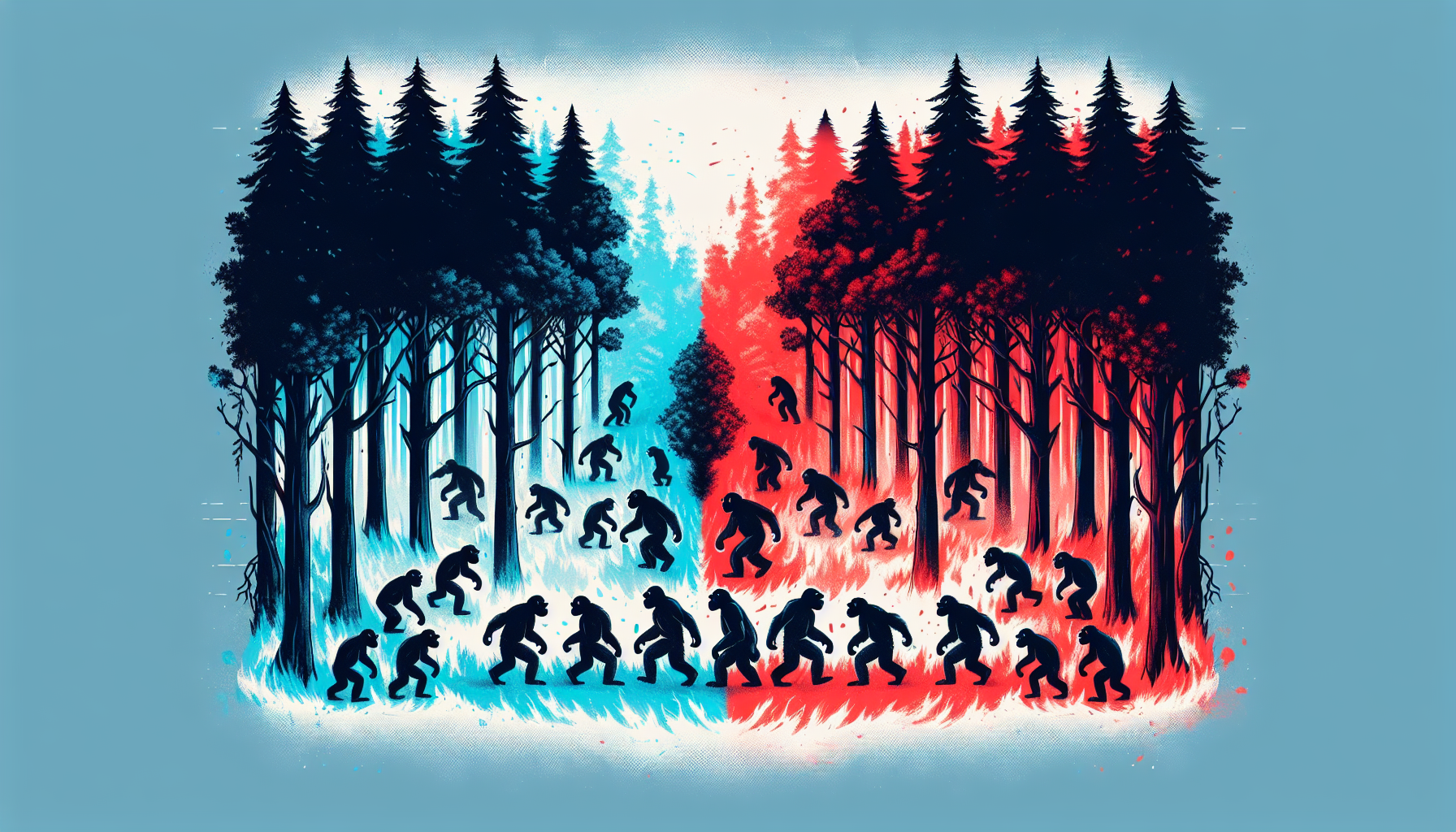
Slowly, the group began to drift into two factions: the Central and the Western.
It started with subtle "geographical shifts"—certain males would only forage in certain areas, and the grooming networks (the chimp version of Slack channels) began to silo.
**By 2026, looking back at the data, it's clear that the "Big Tech" of the chimp world was experiencing its first major fork in the codebase.**
The split wasn't peaceful. It wasn't a "we’ve decided to go our separate ways" conversation. It was a cold, calculated abandonment.
The Western faction, led by a younger, charismatic rebel named Richmond, essentially "seceded" from the main group.
**They stopped showing up to the "all-hands" meetings and started patrolling their own borders.**
The "Ugly" Side: Targeted Assassinations
This is where the story gets darker than the headlines suggest. Once the split was official, the Ngogo chimps didn't just ignore their former brothers; they went to war.
**This wasn't an accidental skirmish over a piece of fruit—it was a systematic campaign of targeted killings.**
Researchers documented "patrols" where 20 or 30 males would move in eerie, total silence toward the border of the other faction. They weren't looking for food.
They were looking for a "lone outlier"—a former friend who had wandered too far from his new tribe.
**When they found one, the result was a level of coordinated violence that challenges our entire "noble savage" myth of nature.**
They didn't just kill; they humiliated. They would hold the victim down, tear at his limbs, and—in some of the most haunting footage ever captured—celebrate over the body.
**This is the "Uganda Chimp War" that people are talking about on r/OutOfTheLoop: a 10-year saga of betrayal where former allies became the most dangerous enemies.**
The Tech Connection: Why We Are Obsessed
You might be wondering why a generalist writer like me is covering this in 2026. The answer is that the Ngogo War has become a mirror for our own digital tribalism.
**As we move further into the age of "Algorithmic Echo Chambers," the behavior of these chimps feels less like "nature" and more like a "simulation" of our own social media feeds.**
The internet is obsessed with this because it validates our deepest fears about group dynamics.
We like to think that as we become more "civilized" and "technical," we move away from these primal urges.
**The Ngogo chimps prove that the more "successful" a group becomes, the more likely it is to weaponize its intelligence against its own members.**
There’s also a "true crime" element to it.
Documentary projects like *Rise of the Warrior Apes* have given these chimps names, personalities, and "character arcs." We aren't just watching animals; we are watching a tragedy.
**When Jackson finally fell, it wasn't just a biological event; for the millions of us watching the data, it felt like the end of an era.**
The "Factionalism Framework": Lessons for Humans
So, what do we do with this information? I’ve spent a lot of time thinking about how to turn this "chimp horror story" into something actionable for our own lives.
**The reality is that we all live in "tribes"—at work, in our families, and in our online communities.**
I’ve developed what I call **The Ngogo Cycle: The Three Stages of Tribal Decay.** If you can spot these in your own life, you might be able to avoid your own "civil war."
1. The Silo Signal (The "Geographical" Drift)
In the Ngogo war, the first sign of the split was chimps only hanging out in specific parts of the forest.
In your life, this looks like "private groups" or "hidden channels" where people stop talking to the "Main Group." **If you notice your team or friend group is becoming "geographically" or "digitally" siloed, the schism has already begun.**
2. The Grooming Gap (Leadership Debt)
Chimps maintain peace through grooming—physical touch that lowers cortisol.
Humans do it through "checking in," "active listening," and "shared vulnerability." **When the "super-group" gets too big, the leader can no longer "groom" everyone.** This creates a "Grooming Gap" where people feel unseen and undervalued, making them ripe for recruitment by a "Richmond" figure.
3. The Dehumanization Phase (The "Silence" Patrol)
The most terrifying part of the chimp war was the silence of the patrols. They stopped communicating and started calculating.
**When you stop "arguing" with the other side and start "monitoring" them, you have moved from conflict to warfare.** Once you stop seeing the "other faction" as people (or former friends) and start seeing them as "targets," the damage is usually permanent.
Real-World Application: Try This Today
We can't change our DNA, but we can change our "environment." If you feel like your "tribe"—whether it’s your dev team or your neighborhood association—is drifting toward a "Ngogo-style" split, try the **"Cross-Border Grooming"** protocol.
Force yourself to interact with the "other faction" in a non-transactional way.
**Don't talk about the "war" or the "project." Talk about the "fruit."** Spend fifteen minutes talking to someone in the "other department" about something totally unrelated to work.
**Lower the cortisol in the room before the "patrols" start forming.**
It sounds simple, but it’s the one thing the Ngogo chimps couldn't do. They were slaves to their geography and their numbers.
**We have the advantage of "meta-cognition"—the ability to look at our own "monkey brain" and say, "Wait a minute, I’ve seen this movie before."**
Why the "Ugly" Side Matters
It’s tempting to look at the Uganda Chimp War and say, "Well, that’s just animals." But ignoring the "ugly" side of nature is a form of intellectual dishonesty.
**By acknowledging the capacity for coordinated violence in our closest relatives, we can more clearly see the "guardrails" we’ve built into our own society.**
The Ngogo chimps didn't have a "legal system." They didn't have "HR." They didn't have a "Constitution." They only had their instincts and their environment.
**When the environment changed and the instincts failed, the result was a decade of trauma.** It’s a reminder that "peace" isn't the default state of nature; it’s a high-maintenance achievement that requires constant work.
**April 12, 2026, marks another year into this research, and the "Western" and "Central" factions are still at it.** The map of the forest has been permanently redrawn.
Some chimps we grew to "know" through the documentaries are gone. **The "Super-Empire" is dead, and in its place are two smaller, more paranoid groups living in the shadow of what they used to be.**
Community Validation
I’m curious—have you ever seen a "tribe" in your own life (a company, a community, or a group of friends) split like the Ngogo chimps?
**Did you see the "Silo Signal" before it happened, or were you caught in the "Silence Patrol"?**
I’d love to hear your stories of "tribal decay" and how you (hopefully) managed to fix the "Grooming Gap." Let's talk about it in the comments.
**I’ll be here, hopefully avoiding any literal patrols in my own neighborhood.**
---
Story Sources
From the Author




Hey friends, thanks heaps for reading this one! 🙏
Appreciate you taking the time. If it resonated, sparked an idea, or just made you nod along — let's keep the conversation going in the comments! ❤️