Nobody Saw Cornyn’s SAVE Act Secret Coming. It’s Actually Worse Than You Think

Nobody Saw Cornyn’s SAVE Act Secret Coming. It’s Actually Worse Than You Think
I’ve spent the last three years obsessing over "safety." I used to believe that if I just built enough barriers, checked enough boxes, and secured every entrance to my life, I’d finally feel at peace.
I built a fortress of productivity apps, security protocols, and strict "voter-style" verification for who got access to my time.
Then, on a Tuesday morning last month, I found myself locked out of my own system.
I had changed my password, forgotten to update my recovery phone number, and the very "safety" measures I designed to keep intruders out were now treating **me** as the threat.
I sat on my floor, staring at a "Log-in Denied" screen, realizing I had built a cage and called it a castle.
This is exactly what is happening to Senator John Cornyn right now, and the "security" system he’s championing—the **SAVE Act**—is about to lock the door on the very people he needs most.
We’re watching a masterclass in the **Backfire Paradox**, a mental trap that catches developers, politicians, and self-improvement junkies alike.
The "Security" That Eats Its Own
On the surface, the Safeguard American Voter Eligibility (SAVE) Act sounds like a standard security update. It requires documented proof of U.S. citizenship to register to vote in federal elections.
For Cornyn, who is currently fighting for his political life in a brutal runoff against Texas Attorney General Ken Paxton, this bill was supposed to be his ultimate "shield."

Cornyn is walking a difficult line: he is maintaining his lifelong support of the Senate filibuster, even though it means the SAVE Act requires a 60-vote threshold in the Senate—a rule he has refused to carve out for this bill.
He’s gambling his entire legacy on a single piece of software—a legislative "security patch" designed to stop an "intruder" problem that many data scientists say is statistically negligible.
But here is the secret that Cornyn is finding out in real-time, and it’s a lesson for anyone who builds systems: **When you increase the friction of entry, you don't just stop the bad actors.
You stop the people who forgot their keys.**
The Hidden "Bug" in the Code
In the world of software development, we call this a "false positive." It’s when your spam filter deletes an email from your mom, or your firewall blocks your own database.
The SAVE Act has a massive, hidden false-positive rate that is quietly terrifying the GOP’s own data analysts.
The bill requires a birth certificate or a passport to register. That sounds simple enough—unless you are one of the **90% of married women** who changed their name after their wedding.
If your current ID says "Jane Smith" but your birth certificate says "Jane Doe," the SAVE Act treats you as a potential non-citizen.
You aren't just "Jane." In the eyes of this new algorithm, you are a "verification failure." To fix it, you’d need to produce a chain of original marriage licenses or court orders.
For a busy mother in rural Texas, that isn't just "friction." **It’s a functional lockout.**
Why We Build Our Own Traps
Why would a seasoned politician like Cornyn push a button that might disenfranchise millions of women—a demographic that often decides elections?
It comes down to a psychological blind spot called **Optimization Myopia**.
We get so focused on "solving" one specific problem (in this case, the fear of non-citizen voting) that we fail to see the secondary effects.
Developers do this when they add six layers of authentication to an app, only to find that 40% of their users quit because the "onboarding" is too hard.
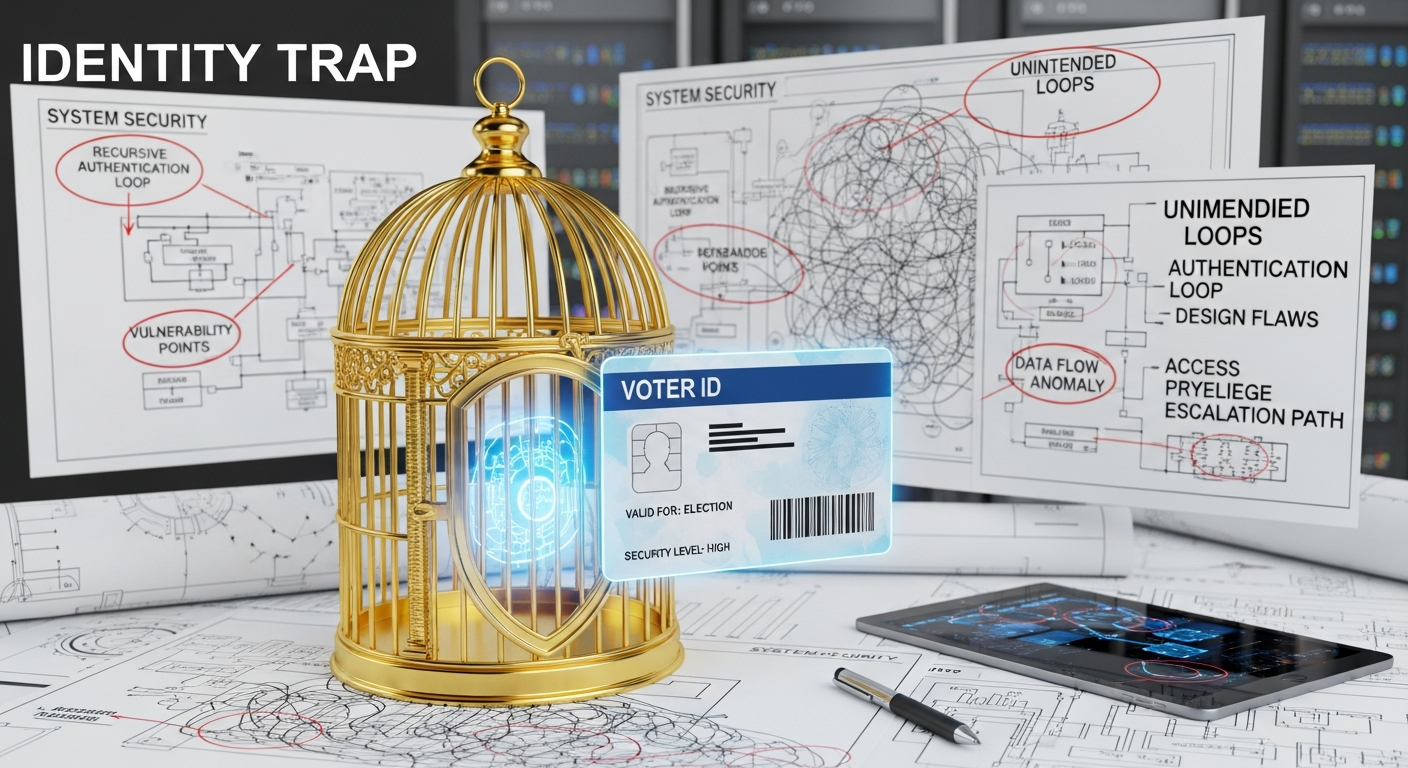
Cornyn isn't just a victim of bad policy; he’s a victim of **The Identity Trap**.
He’s so convinced that he needs to "prove" his loyalty to a specific faction of his party that he’s navigating the very rules (like the filibuster) that protected him for decades, even as they complicate his path.
He is essentially risking his political recovery codes to win a temporary argument.
The Framework: The 3-Signal System for System Design
Whether you’re coding a new API or trying to fix your morning routine, you need to avoid the "Cornyn Backfire." I use a mental model called **The 3-Signal System** to ensure my "solutions" don't become my "problems."
1. The Friction-Value Ratio
Before you add a new requirement—whether it’s a birth certificate for a voter or a mandatory 5 AM workout for yourself—ask: **Is the friction of this task greater than the value of the outcome?** If you spend more time "verifying" your life than living it, your system is broken.
2. The Edge-Case Audit
Cornyn’s team treated "married women with name changes" as an edge case. They aren’t. They are the core demographic.
In tech, we often ignore the "non-ideal" user. In life, we ignore the "non-ideal" version of ourselves—the tired, stressed, or busy version.
**If your system requires you to be perfect to work, it’s not a system; it’s a fantasy.**
3. The Reversibility Test
The most dangerous part of Cornyn’s move is the implementation of these rigid data standards. That is a **One-Way Door**. Once they are codified, they are extremely difficult to undo.
When you make a massive change to your life or your code, ask: "Can I undo this if I’m wrong?" If the answer is no, you better be 1,000% sure about your "secret" data.
The Reality of the "Backfire"
We’ve already seen the warning signs with the 2024 Alabama voter purge attempt, which was blocked by federal courts after it threatened to disenfranchise thousands of legitimate citizens.
Similar issues have cropped up with 'EagleAI' data challenges, which can flag thousands of valid voters—including loyal GOP constituents—simply because their records don't match perfectly.
It’s the "MAGA hurt itself in its confusion" meme come to life. Cornyn is finding out that the " intruders" he was told to fear aren't the ones who will take his seat.
It’s the loyal voters who will show up at the polls, find their names missing from the list because of a "name mismatch," and realize their own representative locked them out.
**The "secret" isn't that the SAVE Act is a conspiracy; it’s that it’s bad engineering.** It’s a solution that creates more problems than it solves, built by people who are too afraid of their "runoff" opponent to look at their own spreadsheets.
Real-World Application: Auditing Your Own "SAVE Acts"
Take a look at your life today. Where have you built a "SAVE Act"?
- Are you using a "strict" diet that makes you miserable and eventually leads to a binge? - Have you set "security" boundaries in your relationships that are actually just walls keeping people out?
- Are you "verifying" your self-worth through metrics that don't actually reflect your value?
We often use "rules" and "documentation" as a substitute for **trust and awareness**. Cornyn doesn't trust the existing system, so he’s building a "better" one that will likely destroy him.
Don't do the same with your own growth.
The One Question You Need to Ask
The "worse than you think" part of the Cornyn story isn't just about the election. It’s about the erosion of the **Shared Reality**.
When we stop trusting the people around us and start demanding "papers" for every interaction, we lose the very thing that makes a community (or a codebase) function: **cooperation.**
Cornyn thought he found a secret weapon to win a primary. Instead, he found a way to invalidate the identities of millions of his own constituents.
He’s learning that in the game of life, if you try to "save" yourself by sacrificing everyone else, you’ll eventually find yourself standing in an empty room.
**Have you ever built a "solution" to a problem that ended up making your life ten times harder?** I want to hear about your "Backfire Paradox" moments in the comments.
Let's talk about how we can build systems that actually protect us—without locking us out.
***
Story Sources
From the Author




Hey friends, thanks heaps for reading this one! 🙏
If it resonated, sparked an idea, or just made you nod along — I'd be genuinely stoked if you'd show some love. A clap on Medium or a like on Substack helps these pieces reach more people (and keeps this little writing habit going).
→ Pythonpom on Medium ← follow, clap, or just browse more!
→ Pominaus on Substack ← like, restack, or subscribe!
Zero pressure, but if you're in a generous mood and fancy buying me a virtual coffee to fuel the next late-night draft ☕, you can do that here: Buy Me a Coffee — your support (big or tiny) means the world.
Appreciate you taking the time. Let's keep chatting about tech, life hacks, and whatever comes next! ❤️