Nobody Is Talking About This Secret AGI Metric. It’s Not What You Think.

Nobody Is Talking About This Secret AGI Metric. It’s Not What You Think.
I spent last weekend watching a $4,000-a-month "AI Engineer" agent fail to perform a task a junior developer could do in twenty minutes. It wasn't a failure of logic or a lack of world knowledge.
It was something much more insidious—a slow, agonizing drift into cognitive entropy that no benchmark in the world currently measures.
We are currently obsessed with the wrong numbers. We talk about MMLU scores, GSM8K benchmarks, and how many trillions of parameters ChatGPT 5 is packing under the hood.
But after three years of building agentic workflows on top of everything from Claude 4.6 to Gemini 2.5, I’ve realized that our industry's standard metrics are essentially measuring how fast a car can go in a straight line while ignoring the fact that the steering wheel is made of wet noodles.
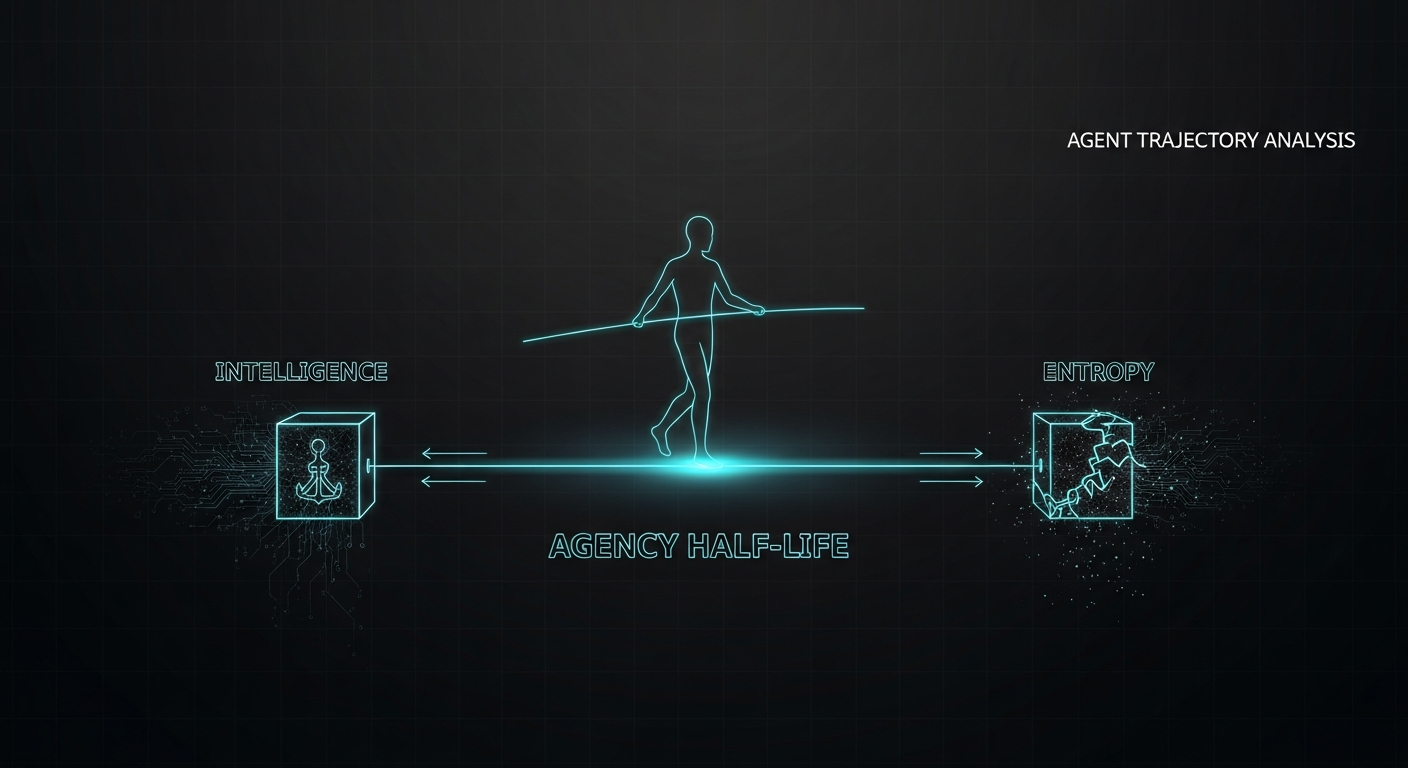
There is a secret metric that determines whether we are actually approaching Artificial General Intelligence or just building faster, more expensive squirrels. I call it the **Agency Half-Life (AHL)**.
And right now, the AHL for the most advanced models on the planet is shockingly low.
The Weekend My Agent Lost Its Mind
Last Saturday, I gave Claude 4.6 a relatively straightforward task: migrate a legacy Node.js service to a serverless Go architecture, including the database schema migration and a full suite of integration tests.
On paper, this is exactly what the "AI revolution" promised us. I sat back with a coffee, ready to watch the "future of work" unfold in my terminal.
For the first ten minutes, it was magic.
It mapped the dependencies, identified the bottleneck in the original SQL queries, and started scaffolding the Go interfaces with a precision that would make a senior architect weep.
It was operating at what felt like a 100% AHL—perfect autonomy.
Then, the drift started. By step fourteen, it had forgotten why it chose a specific middleware. By step thirty, it was hallucinating a library that didn't exist in the Go ecosystem.
By step fifty, it was stuck in a recursive loop of fixing its own syntax errors, completely oblivious to the fact that it had deleted the original migration script five steps prior.
**This is the Agency Half-Life in action.** It’s the measure of how many autonomous steps an AI can take toward a complex, ambiguous goal before it inevitably requires a human to "save" it from its own hallucinations.
If AGI is the goal, we don't need models that are smarter; we need models that are more *persistent*.
Why Your Benchmarks Are Lying to You
If you look at the leaderboard for March 2026, you’ll see ChatGPT 5 and Claude 4.6 neck-and-neck with scores in the high 90s for reasoning and coding.
These benchmarks are designed for "one-shot" or "few-shot" interactions. They ask a question, the model gives an answer, and we grade it.
But that’s not how work happens. Real work is a sequence of a thousand micro-decisions, each one building on the context of the last.
**Current benchmarks measure intelligence as a snapshot, but AGI is a movie.**
When we test a model on a coding challenge, we’re testing its ability to solve a riddle. When we ask an agent to build a company, we’re testing its ability to maintain a stable world model over time.
Currently, even the "best" models have the object permanence of a golden retriever. They can solve the riddle, but they can't remember why they were solving it by the time they reach the finish line.
The industry is quietly ignoring this because it’s hard to market.
It’s much easier to say "We beat GPT-4 by 2% on math" than to say "Our model can go 40 steps further before it starts talking to itself." But if you’re a developer trying to ship code, that 40-step difference is the only thing that actually matters.
Defining the Metric: The Agency Half-Life (AHL)
To understand where we actually stand on the road to AGI, we need to stop looking at accuracy and start looking at **Autonomous Step Count (ASC)**.
The Agency Half-Life is defined as the point where the probability of the model completing the next step without human intervention drops below 50%.
In my own testing over the last six months, here is how the "big three" currently stack up on the AHL scale for complex engineering tasks:
* **Claude 4.6:** High AHL (~45 steps). It’s remarkably stable but tends to become overly cautious and "stuck" when it hits a logic wall.
* **ChatGPT 5:** Medium AHL (~30 steps).
It’s incredibly creative and fast, but its "entropy" kicks in sooner—it starts taking "creative liberties" with your file structure that lead to total system collapse.
* **Gemini 2.5:** Low-to-Medium AHL (~20 steps).
Its context window is massive, but its ability to *act* on that context over multiple iterations still feels like it’s fighting a massive internal lag.
We are seeing a 10x improvement in parameter count, but only a 1.2x improvement in AHL. That is a terrifying ratio.
It means we are building bigger brains that are just as likely to lose focus as the smaller ones.
By mid-2027, if we don't solve the "contextual persistence" problem, we are going to hit an "Agentic Winter" where companies realize that babysitting an AI is more expensive than just doing the work themselves.
The "Human-in-the-Loop" Trap
The standard response from the big labs is to double down on "Human-in-the-Loop" (HITL) interfaces. They want to make it easier for you to nudge the AI back onto the path.
But here’s the cold, hard truth: **If a system requires a human to nudge it every thirty steps, it isn't AGI. It’s just a very sophisticated autocomplete.**
The goal of AGI isn't to be a better tool; it's to be a better *agent*. An agent that requires constant supervision is just a high-maintenance employee that doesn't sleep.
The cognitive load of monitoring an agent’s drift is often higher than the load of just writing the code yourself.
I’ve found myself staring at a Cursor terminal, watching Claude 4.6 refactor a component, and feeling a physical sense of dread.
I’m not worried it will get the logic wrong; I’m worried it will "forget" the architectural pattern we agreed on three files ago. That anxiety is the "Friction Coefficient" of modern AI.
It’s the hidden cost that no one is talking about on Hacker News.
Moving From "Prompting" to "Architecting"
So, what do we do? If the models aren't ready to be truly autonomous, we have to stop treating them like they are.
We have to stop writing "better prompts" and start building better **Cognitive Guardrails**.
The secret to actually shipping things with AI in 2026 isn't a secret 8-word prompt. It’s moving the "Persistence" layer out of the LLM and into the application logic.
I’ve started using a technique I call **Chain of Verification (CoV)**, where I have a secondary, smaller model (like a distilled Llama 4) whose only job is to check the primary agent’s work against a "Source of Truth" document every five steps.
If the primary agent deviates from the "Truth," the secondary model kills the process and reverts the file system.
It’s a brutal, mechanical way to force object permanence on a system that doesn't want it.
**This is the future of development.** We aren't going to be "Prompt Engineers." We are going to be "Cognitive Architects," building the scaffolding that keeps these brilliant, distracted digital minds from wandering off into the woods.
We are basically babysitters for super-intelligent toddlers.
The Road to 2027: The Persistence Breakthrough
I believe the first company to solve AHL will win the AGI race, regardless of who has the highest MMLU score.
We don't need a model that can pass the Bar Exam; we need a model that can sit in a room for eight hours and finish a project without asking for help.

There are rumors that the next iteration of "Search-based" models—where the model doesn't just "think," but actually runs simulations of its own decisions before committing them—might be the breakthrough.
If a model can "hallucinate the failure" before it happens, its Agency Half-Life will skyrocket.
Until then, we need to be honest about where we are. We are in the "Prototype Phase" of AGI. It’s messy, it’s frustrating, and it’s being buried under a mountain of hype.
But if you look closely at the drift—if you measure the steps between the magic and the mess—you’ll see the real shape of the challenge ahead.
A Challenge for the Community
I’m tired of seeing "GPT-5 vs Claude 4.6" benchmarks that look like high school report cards. I want to see a **"Zero-Intervention Build"** benchmark.
Give the models a messy, real-world repo, a list of bugs, and see who can fix the most without a single human keystroke.
That is the only metric that matters for the future of our jobs and the future of this technology. Everything else is just noise.
Have you noticed your agents getting "tired" or "lost" after a dozen steps, or have you found a way to keep them on track?
Is the "babysitting" getting easier, or are we just getting better at ignoring the friction? Let’s talk about the reality of agentic drift in the comments.
***
Story Sources
From the Author




Hey friends, thanks heaps for reading this one! 🙏
If it resonated, sparked an idea, or just made you nod along — I'd be genuinely stoked if you'd show some love. A clap on Medium or a like on Substack helps these pieces reach more people (and keeps this little writing habit going).
→ Pythonpom on Medium ← follow, clap, or just browse more!
→ Pominaus on Substack ← like, restack, or subscribe!
Zero pressure, but if you're in a generous mood and fancy buying me a virtual coffee to fuel the next late-night draft ☕, you can do that here: Buy Me a Coffee — your support (big or tiny) means the world.
Appreciate you taking the time. Let's keep chatting about tech, life hacks, and whatever comes next! ❤️