Nobody Actually Has Energy After Work. It’s Not What You Think
**Lena Morales** — Former therapist turned writer. Covers self-help, habits, and mental clarity.
Nobody Actually Has Energy After Work. It’s Not What You Think
I used to sit in my car for twenty minutes after every therapy session, staring at the steering wheel like it was a complex alien artifact I didn't know how to operate.
I had spent eight hours helping clients navigate deep-seated trauma and career burnout, yet I couldn't muster the cognitive power to decide between kale or spinach at the grocery store.
It wasn’t just "being tired"—it was a total system collapse that left me feeling like a ghost in my own living room.
For years, I told myself I just needed more discipline or a better "evening routine." I bought the expensive journals, tried the 5 PM HIIT classes, and drank enough matcha to turn my blood green.
None of it worked because I was solving for the wrong variable.
**The reason you have zero energy at 6:00 PM isn't because you’re lazy; it’s because your brain is suffering from a "Context Switching Hangover" that modern productivity culture refuses to acknowledge.**
In March 2026, we are living through the most cognitively demanding era in human history.
With ChatGPT 5 and Claude 4.6 handling our menial tasks, we thought we’d have more "brain space," but the opposite happened.
We’ve simply filled that space with higher-order decision-making and 24/7 connectivity, leaving our prefrontal cortexes fried before the sun even sets.
The Myth of the Human Battery
We’ve been sold a lie that energy is like a battery: you charge it at night, and you drain it during the day.
If you’re "out of juice" by 5:00 PM, the logic goes, you simply didn't charge enough or you "wasted" it on the wrong things.
This is a fundamentally flawed clinical perspective that ignores how **neurochemistry actually dictates our motivation.**

As a therapist, I saw hundreds of high-achieving professionals who felt like failures because they couldn't "turn on" for their families or hobbies after work.
They weren't physically exhausted—most of them sat in ergonomic chairs all day. They were experiencing **Decision Fatigue and Attention Residue**, two silent killers of the modern soul.
Every time you check a Slack notification while writing a report, or prompt an AI to "fix" a paragraph while listening to a meeting, you pay a "switch cost." By the end of an eight-hour day, you haven't just worked eight hours; you’ve performed thousands of micro-switches.
**Your brain hasn't run out of energy; it’s run out of the ability to prioritize what matters next.**
Why 2026 Is Different (The AI Fatigue Factor)
It’s easy to blame the "grind," but something shifted over the last 18 months. As we’ve integrated Claude 4.6 into our daily workflows, our output has tripled, but our "processing time" has vanished.
We no longer have the "buffer beats"—those small moments of boredom while waiting for a file to save or a colleague to reply.
Now, the work is instantaneous, which means the cognitive load is continuous.
Research coming out of Stanford this year suggests that **"Prompt Fatigue" is a real neurological phenomenon.** We are constantly in a state of high-level oversight, acting as the "editor-in-chief" of our digital lives rather than just "workers."
This creates a state of **Hyper-Vigilance**, where your nervous system stays in "beta wave" territory all day.
When you finally close your laptop, your brain doesn't just "relax." It stays in that high-frequency state, searching for the next "problem" to solve, which manifests as that familiar, heavy-limbed apathy we call "after-work exhaustion."
The "Transition Protocol": A 3-Part Framework
If you want to have a life after 5:00 PM, you have to stop trying to "power through" and start implementing a **Transition Protocol.** This isn't a "routine"—routines feel like chores.
This is a physiological and psychological "handshake" between your Work Self and your Home Self.
I developed this system after seeing it work for surgeons and air traffic controllers—people who *cannot* afford to carry the stress of their day home.
We call it **The Decompression Delta**, and it relies on three specific signals to tell your nervous system that the "threat" of the workday is over.
Step 1: The Cognitive Offload (The Zeigarnik Reset)
The Zeigarnik Effect is a psychological phenomenon where our brains remember uncompleted tasks better than completed ones.
If you leave work with three half-finished emails, your brain will keep those "tabs" open all night, draining your "background RAM."
**Before you leave your desk, spend exactly five minutes doing a "Brain Dump."** Don't use a fancy app; use a physical piece of paper. Write down every "open loop" in your head.
Tell your brain, "I see these, they are safe on this paper, and we will handle them at 9:00 AM tomorrow." **You are giving your prefrontal cortex permission to stop monitoring these tasks.**
Step 2: The Sensory Bridge
Your brain is highly attuned to environmental cues. If you work from home, the "commute" from your desk to your kitchen is ten feet. There is no sensory signal that work has ended.
You need a **Pattern Interrupt** that involves at least two of your five senses.
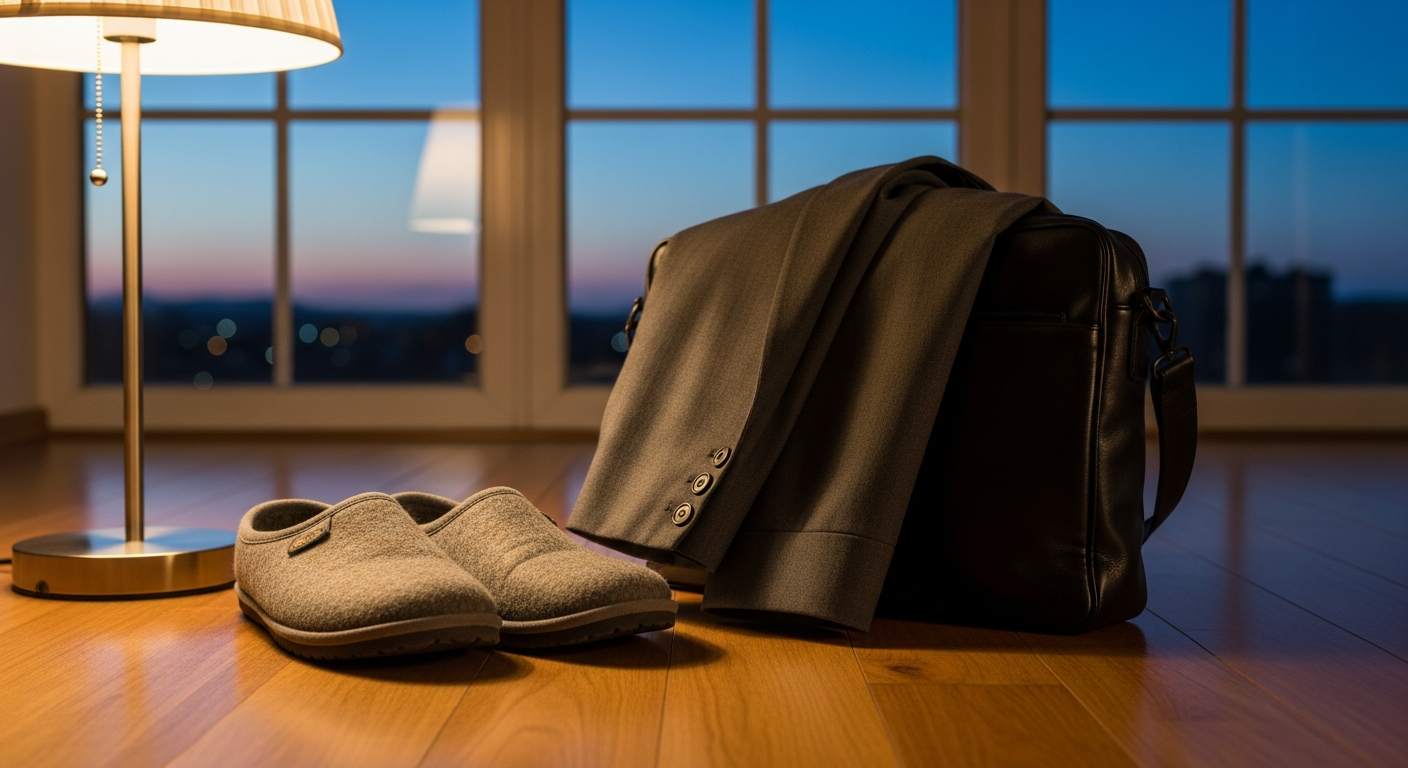
For me, it’s a three-minute cold shower followed by a specific playlist that I *only* listen to after work. For others, it’s changing into "home clothes" (yes, even if you were in sweatpants all day).
**The physical act of changing your clothes or your environment’s scent (light a candle) acts as a neurological firewall.** It tells your brain: "The rules of engagement have changed."
Step 3: The "Zero-Demand" Hour
The biggest mistake we make is trying to be "productive" the moment we stop working.
We think, "I'll go for a run," or "I'll cook a gourmet meal." This is just more "doing," and your brain is already over-done.
**Commit to one hour of "Low-Dopamine, Zero-Demand" time.** This means no scrolling (which is just more information processing), no chores, and no "learning." Sit on the porch.
Walk the dog without a podcast. Play with a Lego set.
**You are allowing your nervous system to downregulate from Beta waves to Alpha waves.** Once you hit that Alpha state, your "real" energy—the energy for creativity and connection—will naturally return.
Stop Optimizing for the Wrong Things
We’ve become obsessed with "optimizing" our time, but we’ve forgotten to optimize for **humanity.** If you’re judging yourself for "wasting" your evening on the couch, you’re adding "shame-exhaustion" to your "work-exhaustion."
Clinical research shows that **shame is one of the most energy-draining emotions we can experience.** When you tell yourself you "should" be doing more, you trigger a cortisol spike.
Your body thinks it’s in trouble, so it stays in "survival mode," which makes you feel even more paralyzed.
Accepting that **nobody actually has "high-vibe" energy at 6:00 PM** is the first step toward freedom.
Most of the people you see on social media "crushing it" in the gym after a 10-hour day are either in a state of manic burnout or they are lying to you.
**True wellness isn't about doing more; it’s about having the clarity to do nothing when nothing is what you need.**
The Power of the "Micro-Wins"
If you still feel like you’re failing at "life" after work, shift your metrics. Instead of trying to "be a person who paints for two hours," try to be a person who "looks at a canvas for two minutes."
**We often mistake the "weight of the task" for the "weight of our fatigue."** When we’re tired, everything looks like a mountain.
By shrinking the task to a "micro-win," you bypass the brain’s "effort-reward" calculation.
Often, once you start that two-minute task, you’ll find that you actually *do* have the energy to continue—you just didn't have the energy to *decide* to do the big version of it.
Your Life Is Not a Project to Be Managed
As we move deeper into 2026, the pressure to "be productive" will only increase.
With AI agents like Gemini 2.5 capable of managing our schedules and Claude 4.6 drafting our thoughts, we are at risk of becoming "managers of our own lives" rather than "livers of our lives."
Your evening is not a "slot" to be filled with "self-improvement." It is the time where you get to be a biological creature again. **You are allowed to be tired.
You are allowed to be "unproductive." You are allowed to just exist.**
The "secret" to having energy after work isn't a hack; it's a boundary. It’s the radical act of saying, "The world has had enough of me today. This time belongs to my soul."
**Have you noticed that your "brain fog" has gotten worse since the latest AI updates, or have you found a way to actually unplug?
I'd love to hear your "Transition Protocol"—drop it in the comments below.**
---
Story Sources
From the Author



Hey friends, thanks heaps for reading this one! 🙏
If it resonated, sparked an idea, or just made you nod along — I'd be genuinely stoked if you'd show some love. A clap on Medium or a like on Substack helps these pieces reach more people (and keeps this little writing habit going).
→ Pythonpom on Medium ← follow, clap, or just browse more!
→ Pominaus on Substack ← like, restack, or subscribe!
Zero pressure, but if you're in a generous mood and fancy buying me a virtual coffee to fuel the next late-night draft ☕, you can do that here: Buy Me a Coffee — your support (big or tiny) means the world.
Appreciate you taking the time. Let's keep chatting about tech, life hacks, and whatever comes next! ❤️