I Tried the McDonald’s CEO Burger Diet. The Results Are Actually Shocking.
I ate a Quarter Pounder every single day for thirty days because a man worth $20 million told me it was the secret to corporate longevity.
I didn’t find the "McEnlightenment" I was looking for, but I did find the $4.7 billion lie that keeps us addicted to the idea that we can out-run a bad lifestyle.
**Stop trying to "bio-hack" your way through a toxic environment.** I’m serious.
After watching the CEOs of McDonald’s and Burger King brag about eating their own grease-slicked products daily while maintaining six-pack abs, I realized that "skin in the game" is just a marketing term for "I have a personal trainer and a $2,000-a-month supplement stack you can’t afford."
The Legend of the Running CEO
In the world of corporate PR, there is a recurring myth: the "Everyman Executive." Chris Kempczinski, the CEO of McDonald’s, famously claimed that he eats McDonald’s every day but stays fit by running 50 miles a week.
Joshua Kobza at Burger King has echoed similar sentiments, painting a picture of a world where you can have your Whopper and your metabolic health too.
I decided to see if a normal human—one without a private chef to balance the other two meals or a schedule that allows for a three-hour morning run—could survive the "CEO Burger Diet." **I wanted to know if the "Skin in the Game" diet was a blueprint for discipline or a masterclass in gaslighting.**
By Day 14, I wasn't feeling like a high-performance executive. I felt like a human oil slick.
The "shocking" result wasn't that I gained weight (I actually lost two pounds), but that **my brain turned into a slow-moving fog bank** that no amount of expensive nootropics could clear.
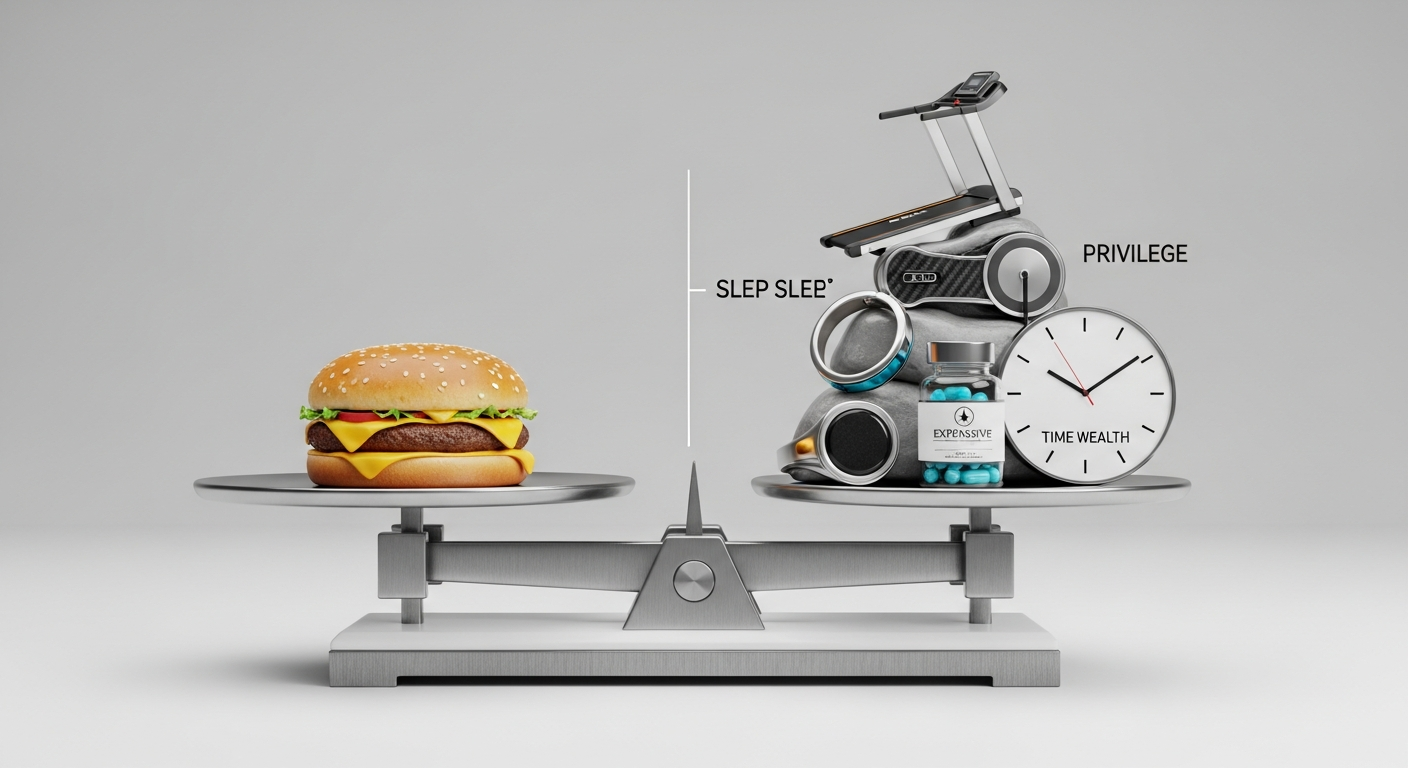
The Privilege of "Skin in the Game"
We are obsessed with the idea of leaders who "eat their own dog food." We want the software CEO to use the buggy app, and we want the fast-food CEO to eat the burgers. It feels like integrity.
**But for the billionaire class, "Skin in the Game" is a controlled experiment, whereas for the rest of us, it’s just lunch.**
When a CEO says he eats a Big Mac daily, he isn't mentioning the organic, farm-to-table dinner prepared by a professional or the blood-glucose monitor strapped to his arm.
He is presenting a **highly curated version of relatability** that masks the massive infrastructure required to offset a daily dose of ultra-processed salt and seed oils.
I realized that by trying to mimic the "habit" without the "infrastructure," I was setting myself up for a crash.
**We often mistake a CEO’s PR stunt for a wellness strategy.** We see the "what" (the burger) but we ignore the "how" (the 50-mile weeks, the sleep optimization, and the lack of financial stress).
The $4.7 Billion Relatability Lie
Why do they do it? Because in 2026, authenticity is the only currency left that AI can't easily faked. If the CEO won't eat the food, why should the mother of three in Ohio?
**The "Burger Diet" is a calculated piece of theater designed to humanize a spreadsheet.**
As I sat in a plastic booth on Day 21, staring at a box of nuggets, I realized that I wasn't just eating food; I was consuming a narrative.
The narrative says that **health is a choice of "willpower" rather than a byproduct of environment.** If the CEO can stay thin on burgers, then your health struggles are your fault, not a result of the food system.
This is the "dark side" of the self-help movement. We are told to "optimize" our routines to fit into a world that is fundamentally un-optimized for human flourishing.
**Trying to be a "high-performance" fast-food eater is like trying to keep a Ferrari running on kerosene.** You can do it for a while, but the engine is screaming the whole time.
The "Metabolic Privilege" Framework
To understand why this experiment failed for me (and why it’s a lie for you), we need to look at what I call the **Metabolic Privilege Framework.** This is the three-part system that CEOs use to stay "healthy" while promoting "unhealthy" habits.
1. The Compensation Curve
For every 500-calorie burger, the CEO has the **time-wealth** to spend two hours in a Zone 2 cardio state.
For the average developer or manager working a 10-hour day in March 2026, that "compensation" isn't just difficult—it's mathematically impossible.
**Your time is your most limited health resource**, and they have an abundance of it.
2. The Invisible Safety Net
When I felt the brain fog hit on Day 10, I had to power through my meetings. A CEO has a Chief of Staff, a fleet of assistants, and a schedule that can be "pivoted" if they are having an "off" day.
**The "Skin in the Game" diet requires a safety net that catches you when the sodium spike hits.**
3. The Biological Offset
The elite don't just eat; they "correct." They have access to GLP-1 agonists, high-end probiotics, and personalized vitamin infusions that the average person doesn't even know exist.
**The burger is the public performance; the correction is the private reality.**
The High Cost of Relatability
By the end of the month, I was irritable, my sleep quality had plummeted (according to my Oura ring), and I had developed a strange, persistent thirst that no amount of water could quench.
**The "results" were shocking because they proved that "moderation" is a myth when the product is designed for addiction.**
I realized that the "Everyman" CEO isn't like us at all. He is a professional athlete of the corporate world, and his "sport" is maintaining a brand image.
**When we try to copy the habits of the ultra-successful, we are often copying the symptoms of their wealth, not the causes of their success.**

If you want to actually improve your life in 2026, stop looking at what the CEOs are eating. Instead, look at what they are *buying*.
They are buying time, they are buying silence, and they are buying distance from the very products they sell to the masses.
**True wellness isn't found in the "Quarter Pounder Habit"—it's found in the "Fifty-Mile Freedom."**
How to Reclaim Your "Skin in the Game"
So, how do we move forward without falling for the next "CEO Diet" trend?
We have to build a system that prioritizes **Environmental Integrity** over **Willpower Optimization.** Here is the "Real-World Reset" protocol I developed after recovering from my month of grease.
Step 1: Audit the "Relatability Trap"
Whenever you see a high-profile figure promoting a "guilty pleasure" or a "simplified" routine, ask: **"What infrastructure do they have that I don't?"** If the answer includes a personal trainer, a private jet, or a $20M severance package, ignore the advice.
It isn't for you.
Step 2: Prioritize Cognitive Bandwidth
Health isn't about how you look in a suit; it's about how your brain functions at 3:00 PM on a Tuesday.
**Ultra-processed foods are "bandwidth thieves."** They steal your focus and replace it with a dopamine loop.
Protect your "Deep Work" by eating like someone who values their mind more than their brand.
Step 3: Build a "No-Optimization" Zone
Stop trying to "hack" every bad habit. If you want a burger, eat a burger. But don't call it a "diet" and don't try to "offset" it with a 5 AM run if that run is going to burn you out.
**Integrity is admitting that some things are just bad for us**, and that’s okay—as long as we don't lie to ourselves about the cost.
Why We Want to Believe the Lie
The reason this topic trended so hard on Reddit this year is that we *want* to believe we can have it all.
We want to believe that we can participate in the modern, convenient world of fast food and high stress while still looking like a Greek god. **The CEO is the avatar of that wish fulfillment.**
But the truth is much more "ugly" and much more grounding. **Real health is boring.** It’s slow. It’s expensive in terms of time, and it’s often socially isolating in a world built for convenience.
The "shocking" result of my 30-day experiment was the realization that **I would rather be an "Un-Optimized Human" than a "High-Performance Product."**
I finished the month, deleted the McDonald's app, and spent the next week eating nothing but green vegetables and grilled fish. My brain fog cleared in 48 hours.
**The "skin" I have in the game is my own life**, and I'm not willing to trade it for a bit of corporate relatability.
Community Validation
I’ve spent the last 18 months trying to deconstruct these "productivity myths," but this one felt the most personal.
We are all being sold a version of "balance" that is actually just "burnout with a smile."
**Have you ever tried to copy a "success habit" from a CEO or influencer only to find it made your life worse?** Did you find yourself wondering why the "5 AM Club" or the "Burger Diet" worked for them but left you exhausted?
I’d love to hear your "failed experiment" stories in the comments—let’s dismantle these myths together.
---
Story Sources
From the Author



Hey friends, thanks heaps for reading this one! 🙏
If it resonated, sparked an idea, or just made you nod along — I'd be genuinely stoked if you'd show some love. A clap on Medium or a like on Substack helps these pieces reach more people (and keeps this little writing habit going).
→ Pythonpom on Medium ← follow, clap, or just browse more!
→ Pominaus on Substack ← like, restack, or subscribe!
Zero pressure, but if you're in a generous mood and fancy buying me a virtual coffee to fuel the next late-night draft ☕, you can do that here: Buy Me a Coffee — your support (big or tiny) means the world.
Appreciate you taking the time. Let's keep chatting about tech, life hacks, and whatever comes next! ❤️