I Tried Michael B. Jordan’s Oscar Routine for 30 Days. I Wasn't Ready For This
Michael B.
Jordan held that gold statue this past Sunday, and all I could think about was the incredible transformation he underwent for Sinners. As the credits rolled on the 98th Academy Awards on March 15, 2026, I looked at my reflection in the darkened TV screen—a tired Senior Dev with "tech-neck," three empty LaCroix cans on the coffee table, and a lumbar support pillow that was clearly losing the war.
I realized that the 30 days I’d just spent living his routine had changed me, too.
I had decided, exactly one month before the ceremony, that I was going to do it. I wasn't going to just watch the "Best Actor" frontrunner; I was going to live like him.
I committed to the 30-day countdown to the Oscars, following the exact routine Jordan used to transform into the Moore twins, Smoke and Stack, the protagonists of Sinners.
I thought I was prepared for the physical toll. I thought I knew what "discipline" meant after a decade of shipping code on tight deadlines.
I was wrong. What started as a quest for a six-pack turned into a brutal lesson in mental architecture that nearly broke my career before it saved my life.
The Routine That Built a "Sinner"
The "Sinners" routine isn't just a workout; it’s a full-system override. Michael B.
Jordan worked with elite trainer Corey Calliet to create a protocol that achieved a shredded, vascular look suited for his supernatural dual role.
For a developer who spends 10 hours a day in a Herman Miller chair, this was the equivalent of trying to run Cyberpunk 2077 on a 2014 MacBook Air.
The baseline was simple, yet terrifying.
A 4:30 AM wake-up call, followed by 90 minutes of high-intensity interval training (HIIT) and metabolic conditioning. Then came the "clean" diet: six to seven meals a day, primarily bison, chicken, and greens, with zero sugar, zero dairy, and—most painfully for a tech lead—zero caffeine after 10:00 AM.
By the third day of my trial, I wasn't feeling like a Best Actor winner. I felt like a legacy codebase with no documentation and a failing build pipeline.
My brain felt foggy, my legs felt like lead, and my Slack messages were becoming increasingly "terse." I realized that Hollywood routines are designed for people whose job is to look good, not for people whose job is to solve complex architectural problems.
Why Your Body Is Not a Graphics Card
As tech professionals, we often treat our bodies like hardware. We think we can just "overclock" our brains with caffeine and "up the RAM" with more monitors.
We assume that if we just push the "Work" button harder, we’ll get more output.
The first ten days of the Jordan routine exposed this fallacy. By forcing my body into a state of extreme physical stress, I expected my mental output to follow suit. Instead, my productivity plummeted.
I spent four hours on a Tuesday staring at a simple React hook because my brain simply didn't have the glucose to process logic.
I had ignored the "Thermal Throttling" of the human spirit. When you push your physical limits to the edge, your brain prioritizes survival over "refactoring the microservices architecture." I was so focused on the output (the definition, the routine) that I completely ignored the input (recovery, neurological capacity).
The "Peak State" Fallacy
We are obsessed with "Peak Performance." We read articles about 5 AM CEOs and 80-hour work weeks. But Michael B.
Jordan didn't win that Oscar because he worked out 18 hours a day; he won because he managed his transitions.
Around Day 15, I stopped trying to "grind" through the routine and started looking at the structure of it.
Jordan’s prep included mandatory 20-minute recovery windows and specific "dark room" meditation sessions to reset between playing the two distinct characters, Elijah and Elias.
He wasn't just training; he was aggressively recovering.
This was the "Aha!" moment.
In tech, we celebrate the "grind," but we rarely celebrate the "reset." We treat "sitting still" as wasted time, when it is actually the period where the "compilation" of our thoughts happens. Once I started treating my recovery as seriously as my gym sessions, the fog began to lift.
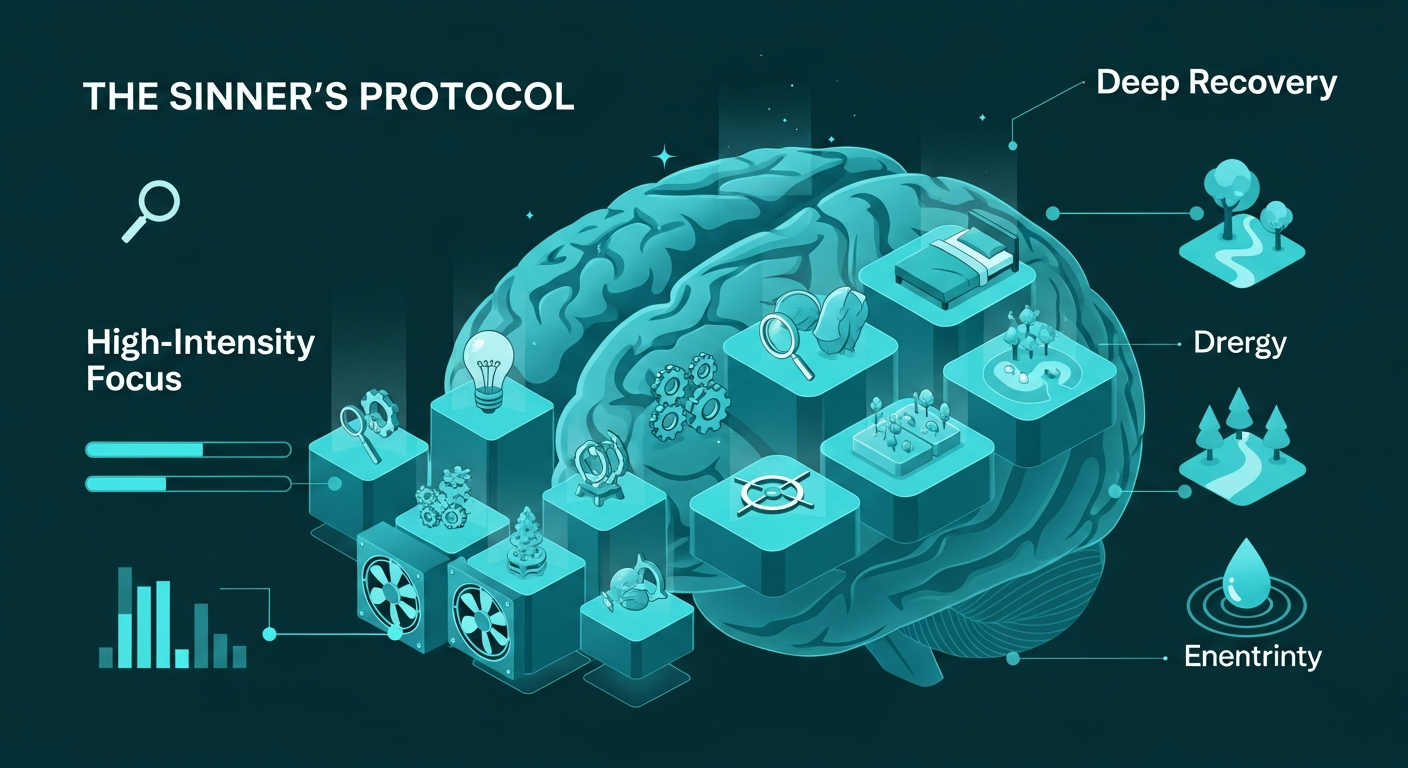
The Protocol: How to Code Like an Oscar Winner
By Day 20, I had modified the "Sinners" routine into something sustainable for someone who actually has to use their brain for a living.
I call it the "Sinners Protocol for High-Output Knowledge Work." It’s not about the bison meat or the boxing—it’s about the neurological rhythm.
Step 1: The High-Intensity Interval Focus (HIIF)
Instead of just "working for 8 hours," I broke my day into 90-minute blocks of "High-Intensity Focus." During these blocks, my phone was in another room, and all notifications were killed.
No Slack, no email, no "just checking Jira."

Just like Jordan’s circuit workouts, these blocks were followed by a 15-minute "Cool Down" where I walked away from the screen entirely.
You cannot stay in a state of high-intensity logic for 8 hours any more than you can sprint for 8 hours. Your brain needs the interval to clear out the metabolic waste of deep thought.
Step 2: The Metabolic Reset (The 2:00 PM Wall)
The "Sinners" routine is strict about meal timing and carb cycling to keep blood sugar stable. For developers, the biggest enemy isn't "bad code"—it's the 2:00 PM insulin crash.
When you eat a heavy carb lunch and then sit for 4 hours, your brain enters "Sleep Mode."
I switched to the MBJ-style "Complex Fueling." A high-protein, high-fat lunch followed by a 10-minute "Zone 2" walk.
This simple change—walking for 10 minutes after eating—cleared my afternoon brain fog better than a third espresso ever did. It kept my blood sugar stable and my logic sharp for the final "push" of the day.
Step 3: Emotional Resonance and the "Final Act"
The most surprising part of Jordan’s prep for Sinners was the "Emotional Journaling" used to differentiate the twins Elijah and Elias.
While we don't need to be haunted to write Go, we do need to be "present."
In tech, we are often "abstracted." We solve problems for users we never see and systems we never touch.
This leads to "Career Burnout," a state where the work feels meaningless. I started spending the last 10 minutes of my day "Closing the Loop"—writing down exactly who my work helped that day.
It provided the emotional fuel to start the routine again the next morning.
The 30-Day Result: I Wasn't Ready For the Clarity
By the end of the 30 days, I didn't look like Michael B. Jordan. I didn't have his deltoids, and I certainly didn't have his paycheck. But I had something much more valuable: I had my agency back.
I realized that I had been living my life in "Default Mode." I was eating when I was bored, working until I was exhausted, and "resting" by scrolling through social media.
The "Sinners" routine, in all its brutality, forced me to be intentional about every single minute of my day.
My code quality improved, my "Mean Time to Resolution" dropped, and for the first time in years, I didn't feel like I was "drowning" in my inbox. The routine didn't give me more hours in the day; it gave me more "power" per hour.
Why You Should "Settle for Less" Than Michael B. Jordan
If you try to do the full Michael B. Jordan Oscar routine tomorrow, you will fail. You will probably pull a hamstring, offend your partner, and get a "Performance Improvement Plan" from your manager.
The goal isn't to be him; the goal is to borrow his "Internal Architecture."
Start with one thing. Don't wake up at 4:30 AM.
Just try the "No caffeine after 10 AM" rule. Or try the "10-minute walk after lunch." These small, metabolic wins aggregate into a "Life Refactor" that is far more sustainable than a 30-day Hollywood blitz.
We are not graphics cards. We are biological systems that require maintenance, cooling, and high-quality input. Michael B.
Jordan won an Oscar because he understood how to push his system to the absolute limit without melting the motherboard.
Have you ever tried an "extreme" routine to boost your productivity, or are you still searching for that habit that actually sticks? Let's talk about the "grind" in the comments.
---
Story Sources
From the Author




Hey friends, thanks heaps for reading this one! 🙏
If it resonated, sparked an idea, or just made you nod along — I'd be genuinely stoked if you'd show some love. A clap on Medium or a like on Substack helps these pieces reach more people (and keeps this little writing habit going).
→ Pythonpom on Medium ← follow, clap, or just browse more!
→ Pominaus on Substack ← like, restack, or subscribe!
Zero pressure, but if you're in a generous mood and fancy buying me a virtual coffee to fuel the next late-night draft ☕, you can do that here: Buy Me a Coffee — your support (big or tiny) means the world.
Appreciate you taking the time. Let's keep chatting about tech, life hacks, and whatever comes next! ❤️