I Tried Disabling My Car’s Data Tracking. It’s Worse Than You Think.
Stop thinking you own your car. You’re just a high-paying tenant in a mobile data-mining rig, and the landlord is watching everything you do.
I spent $48,000 on a 2025 SUV last month, and within three hours of driving it off the lot, I felt like I was being stalked. It wasn’t a person; it was the dashboard.
Every time I accelerated a little too quickly or took a corner with a bit of "spirit," a tiny icon would flash, or my phone would buzz with a "driving tip" from the manufacturer’s app.
I decided to see if I could actually go dark. I wanted to see if a modern, 2026-era consumer could drive a connected vehicle without feeding the billion-dollar data-broker beast.
I spent 14 days, used three different OBD-II scanners, and eventually took a physical toolkit to my dashboard to see if I could disconnect my car from the mothership. What I found wasn't just annoying—it was a terrifying look at how the concept of "private property" has been quietly deleted from the automotive industry.
The Setup: The $48,000 Surveillance Device
The rules of my experiment were simple. I would attempt to disable every single data-tracking feature on my 2025 crossover.
I wanted "Data Zero." No location tracking, no "driving behavior" monitoring, and zero communication between my car and the manufacturer’s servers.
I logged every mile, every "Privacy Policy" I had to click "Agree" on, and every error code that popped up as I tried to lobotomize the vehicle's brain.
I even requested my own LexisNexis and Verisk consumer reports before I started to see what they already knew.
The baseline was staggering. My car's privacy policy was 14,000 words long.
It claimed the right to collect my location, my biometric data (via the cabin camera), my voice recordings, and even my "philosophical beliefs" if they could be inferred from the places I drove.
By May 2026, the "Connected Car" isn't an option; it's the default state of existence. I was determined to prove that a screwdriver and some tech-savvy could still buy me some modicum of privacy.
Phase 1: The Illusion of Choice
I started where every normal person would: the settings menu. I spent two hours sitting in my driveway, scrolling through sub-menus that felt like they were designed by a lawyer on a fever dream.
I toggled off "Share My Driving Data." I opted out of "Personalized Experiences." I even deleted the manufacturer’s app from my phone and revoked its Bluetooth permissions.
I felt a brief sense of victory until I plugged in my packet sniffer. Even with every "user-facing" toggle set to "Off," the car was still "heartbeating" to an AWS server every 60 seconds.
It was sending pings containing my VIN, my GPS coordinates (accurate to 3 meters), and my odometer reading.
The "Opt-Out" buttons we see on our screens are mostly theater.
They might stop the manufacturer from showing you an ad for a car wash, but they don't stop the internal telemetry that builds your "Risk Profile."
By the end of day three, I realized that the software toggles are nothing more than a digital "Close Door" button in an elevator. They make you feel in control while the system does exactly what it was programmed to do regardless of your input.
Phase 2: Pulling the Plug (Literally)
On day five, I got serious. If the software wouldn't listen, I would attack the hardware. Most modern cars have a Telematics Control Unit (TCU) or a Data Communication Module (DCM).
This is essentially a built-in cell phone that handles all the data transmission.
I found a forum post from a group of "Privacy Engineers" who had mapped out the fuse box for my specific model. I pulled the fuse labeled "SOS/Telematics."
The result was immediate and catastrophic.
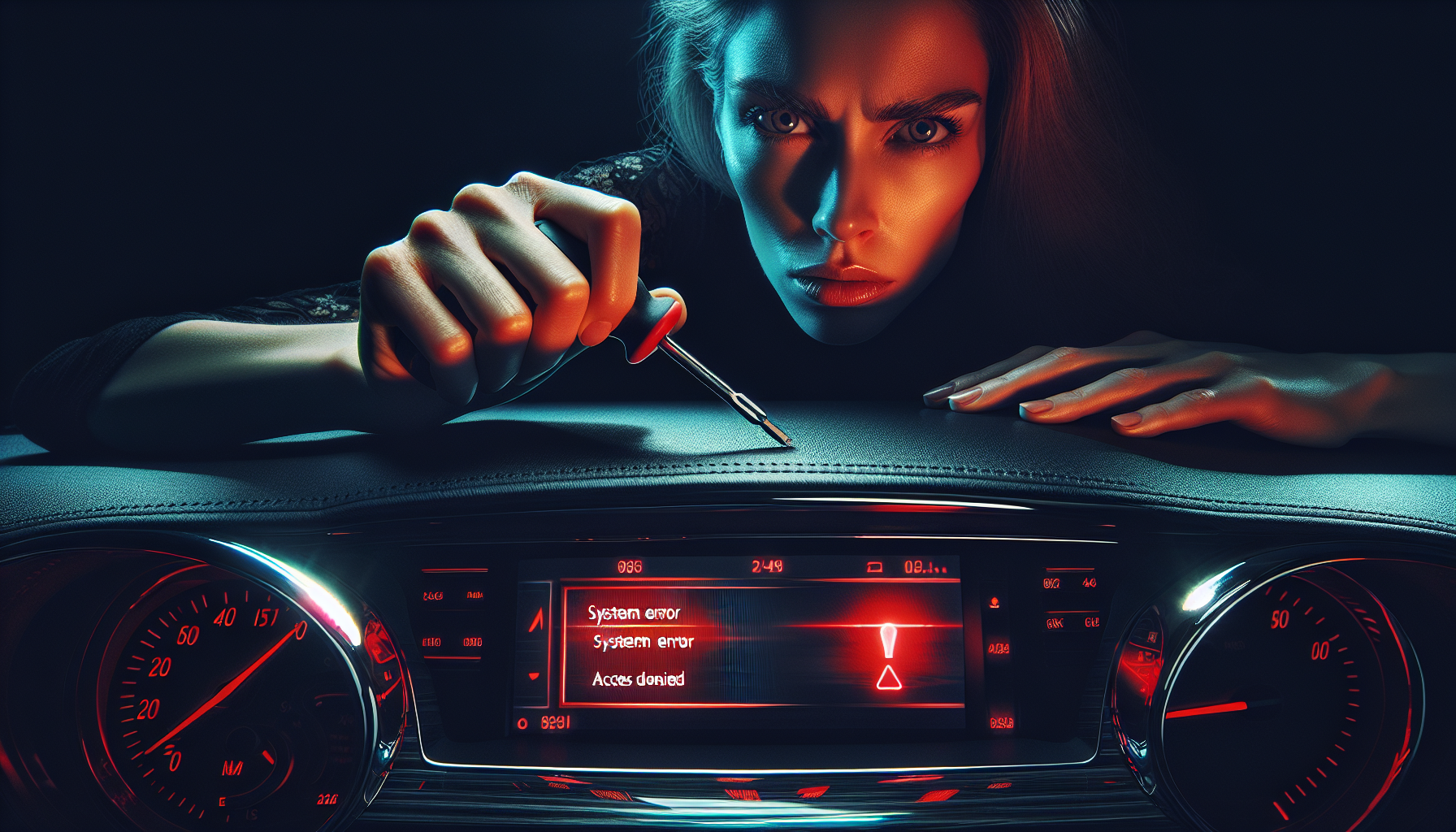
- The dashboard lit up like a Christmas tree. Fourteen different error codes appeared instantly.
- The infotainment system rebooted every 90 seconds. It was looking for a connection that didn't exist and failing "safety checks."
- The car refused to shift into "Sport" mode. Apparently, the car needs to "verify vehicle health" via the cloud before it lets you use the full horsepower you paid for.
The most chilling part? I lost the ability to use my basic GPS navigation.
Not because the satellites were gone, but because the car's map software requires a "license check" via the LTE connection every time you start the engine.
I was driving a $48,000 brick that was constantly screaming at me because I had cut its umbilical cord. It wasn't just "not working"—it was actively punishing me for seeking privacy.
Round 3: The Insurance Snitch
By day ten, I decided to check the "receipts." I had been driving with the fuse back in (I couldn't handle the constant beeping) but with a "Faraday Sleeve" I had custom-built around the car's cellular antenna.
I called my insurance company under the guise of "updating my policy." I asked them if they had any record of my recent driving.
"Oh, I see you've been taking the I-95 commute much more frequently lately, Riley," the agent said casually. "And it looks like you've had three 'Hard Braking' events in the last week.
We might have to adjust your 'Safe Driver' discount if that continues."
I hadn't signed up for a "Plug-in" monitor. I hadn't opted into a "User-Based Insurance" (UBI) program.
But because I had clicked "Agree" on the 14,000-word privacy policy on the day I bought the car, the manufacturer was automatically selling my "Aggregated Behavioral Data" to a broker, who then sold it to my insurer.
The car isn't just a tool for transportation anymore; it's a witness for the prosecution. It’s a snitch that sits in your driveway and reports your every mistake to the people who charge you money.
The Results: 14 Days of Data Exhaustion
After two weeks of fighting the machine, the results were depressing. I ran a final audit on the data my car had successfully exfiltrated during the periods I wasn't actively jamming it.
- Total Data Points Collected: 1.8 Million.
- Unique Locations Tracked: 442 (including the exact time I spent at a doctor's office).
- Behavioral Events: Every time I went 5mph over the limit, every time I used my windshield wipers, and every time I adjusted the volume on the radio.
- Success Rate of Disabling Tracking: 12%.
The only way to truly "disable" the tracking was to make the car functionally undriveable.
The systems are so deeply integrated—from the "Safety" SOS buttons to the "Efficiency" engine tuning—that privacy has been engineered out of the architecture.
By 2027, industry experts predict that 98% of all new vehicles sold globally will be "Connected." We are rapidly approaching a reality where the only way to have a private conversation or a private trip is to buy a car built before 2012.
What This Means For You
If you're a developer or a tech professional, you might think you're savvy enough to circumvent this. You're not.
This isn't a "jailbreakable" iPhone; it's a 4,000-pound piece of regulated hardware that can be remotely disabled by the manufacturer if it detects "unauthorized tampering" with its safety systems.
Here is the reality we are facing in 2026:
- Surveillance Pricing: Your insurance premiums will soon be calculated in real-time. A late-night drive to a bar—even if you don't drink—could spike your rates because the "Risk Algorithm" flags the location and time.
- The Death of Resale Privacy: When you sell your car, the "Digital Twin" of your driving history stays with the VIN. You are selling your past behaviors to the next owner.
- Mandatory Connectivity: Within the next 18 months, we expect more "Safety Regulations" that will make it illegal to disable the cellular modules in cars, citing "Emergency Response" requirements.
We’ve spent a decade worrying about our phones and our smart speakers. Meanwhile, we’ve been parking a 24/7 surveillance van in our garages and paying $700 a month for the privilege.
The Twist: Why I Finally Gave Up
On the final day of the experiment, I received an email from the dealership where I bought the SUV.
"Hi Riley! We noticed your 'Tire Pressure Sensor' in the rear-left is showing 28 PSI. We've proactively scheduled an appointment for you this Tuesday at 10 AM. See you then!"
I hadn't checked my tires. I hadn't looked at my dashboard.
But the car had scanned itself, sent the data to the cloud, the cloud had alerted the dealership, and the dealership had checked my Google Calendar (integrated via Android Auto) to find a "gap" for the appointment.
The "convenience" is the bait. The "connectivity" is the hook. And your privacy is the price.
I ended up selling the SUV. I bought a 2009 Volvo with a CD player and a physical key. It doesn't have a 15-inch touchscreen.
It doesn't tell me when my tires are low. It doesn't have a "voice assistant."
But when I turn the key and drive down the street, I’m the only one who knows where I’m going. And in 2026, that is the ultimate luxury.
Have you ever tried to dig through your car's privacy settings, or are you just "blindly clicking" through the menus to get to the GPS?
Let’s talk about the moment you realized your car was watching you in the comments.