I Secretly Watched My Husband Load The Dishwasher. It’s Worse Than You Think.

**Stop trying to "optimize" your marriage.
I’m serious.** After spending twenty minutes secretly watching my husband turn the lower rack of our dishwasher into a chaotic graveyard of nested spoons and blocked spray arms, I realized my systems-first mindset wasn't just annoying — it was a silent tax on our relationship that was costing us more than a few dirty plates.
I stood there, hidden by the kitchen island, clutching a lukewarm oat milk latte. I watched him place a giant mixing bowl directly over the detergent dispenser.
My heart rate spiked, the same way it does when I see a junior dev push to production without a PR. In my head, I was already drafting the "performance review."
But as I stood there in the quiet of our suburban kitchen on this Tuesday morning, March 31, 2026, I caught a glimpse of something I hadn't expected. It wasn't just about the dishes.
It was about the fact that I have spent the last decade trying to "user-experience" my entire life into submission, and I was finally hitting the limits of the API.
The Geometry of Chaos
If you’re a certain type of person — the kind who has a favorite Claude 4.6 prompt for organizing your inbox or someone who actually reads the manual for their air fryer — you understand the Dishwasher Conflict.
**It is the ultimate litmus test for compatibility.** There is the "Correct Way," which involves maximizing surface area exposure to water jets, and there is the "Husband Way," which appears to be governed by the laws of a three-dimensional game of Tetris played by someone who has never seen a square.
My husband, a man I otherwise respect for his ability to navigate complex logistical hurdles at work, treats the dishwasher like a suggestion box.
He doesn't see "tines"; he sees opportunities for rebellion. He stacks bowls like they’re trying to keep each other warm. He puts wooden spoons in the high-heat cycle.
It’s worse than you think because it’s not an accident.
**It is a fundamental breakdown of the "Mental Model" we share for our home.** In tech, we talk about "Technical Debt" — the cost of choosing an easy solution now instead of a better one later.
In a marriage, this is "Domestic Debt." Every time he loads the dishwasher "wrong," I feel like I have to go in and refactor his code.
The Optimization Trap of 2026
We live in an era where everything is supposed to be frictionless. It’s early 2026, and we have AI agents like Gemini 2.5 managing our energy grids and Claude 4.6 drafting our legal contracts.
We are obsessed with efficiency.
We track our sleep, our steps, our macros, and our "Deep Work" hours. **We have been conditioned to believe that if a system isn't optimized, it is failing.**
This is what I call the Optimization Trap. We take the logic of the workplace — where "better, faster, cheaper" is the law — and we drag it across the threshold of our front doors.
We start treating our partners like underperforming software. We want them to have better "throughput." We want them to minimize "latency" in their chores.
But humans aren't software. And marriages aren't Jira boards.
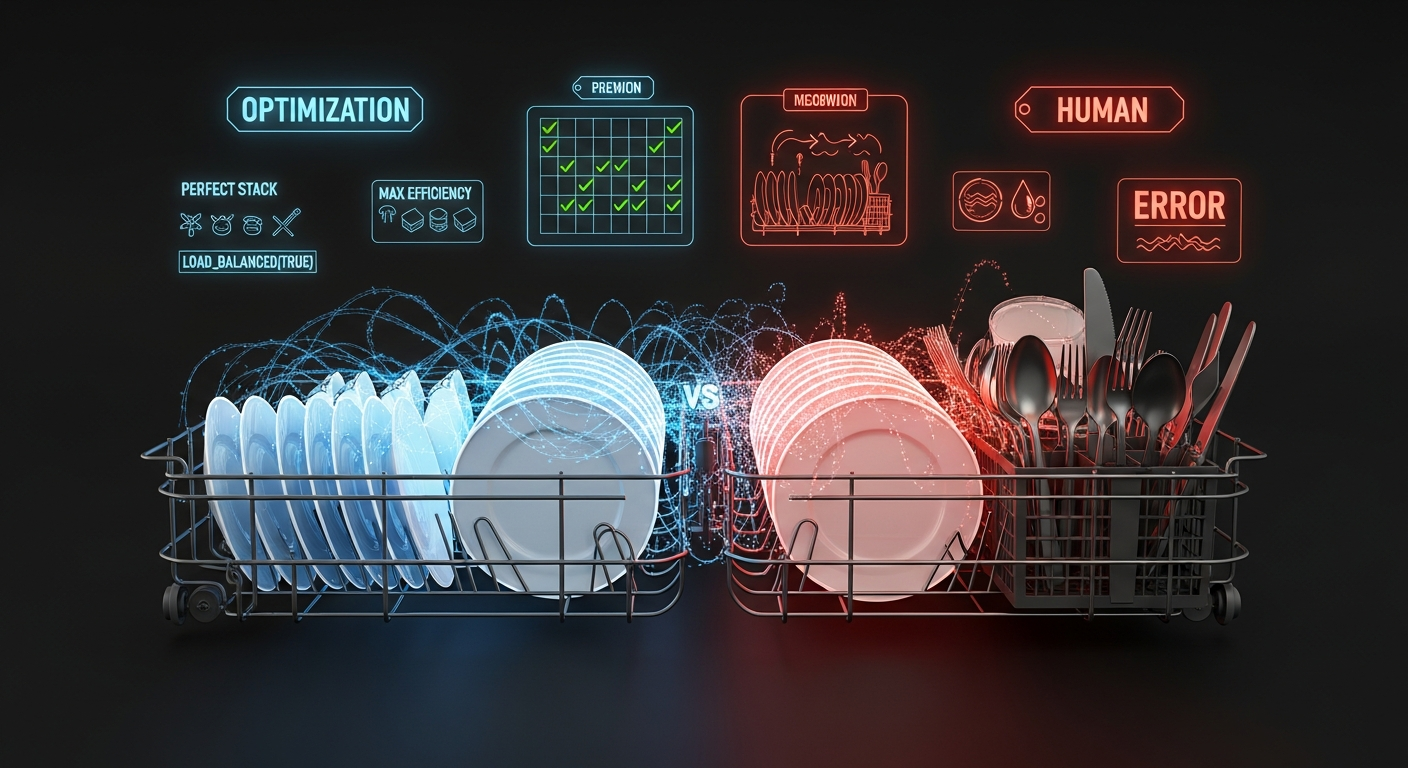
When I watched my husband shove a lasagna-encrusted pan into a spot that was clearly meant for salad plates, I wasn't just mad about the pan.
I was mad that he wasn't following the "Protocol." I was prioritizing the efficiency of a $900 appliance over the emotional safety of the man I love.
The High Cost of Being "Right"
I realized that being the "Manager of the Dishwasher" was a promotion I never asked for and a job I desperately needed to quit.
**The mental load of being the only person who knows how to "properly" load a rack is exhausting.** It turns you into a domestic auditor.
You stop being a partner and start being a quality control officer.
According to recent 2025 sociological studies on "The Mental Load," women still carry the vast majority of cognitive labor in the home. But there’s a nuance we often miss: the "Gatekeeping" effect.
When we insist that a task be done *exactly* our way, we inadvertently signal to our partners that their contribution isn't valued unless it’s a perfect replica of our own.
By watching him secretly, I was engaging in a form of domestic surveillance. I was looking for reasons to be disappointed. I was looking for proof that my "System" was superior.
And while I was right about the spray arm being blocked, I was spectacularly wrong about what actually mattered in that moment.
The Domestic Entropy Protocol
After that twenty-minute stakeout, I decided I needed a new framework. I couldn't just "stop caring" — that’s a platitude that doesn't work for people with high-functioning brains.
I needed a system for the lack of a system. I call it **The Domestic Entropy Protocol.**
This isn't about lowering your standards; it's about reallocating your cognitive resources. It’s about recognizing that in a world of 2026 chaos, the kitchen doesn't have to be a battlefield.
This framework is built on three pillars that changed how I view my husband, my home, and my own need for control.
Pillar 1: The Functional Minimum
Instead of aiming for "Optimized," we aim for "Functional." In engineering terms, this is the Minimum Viable Product (MVP). **Does the water hit the dirty parts?
Will it smell tomorrow?** If the answer to those two questions is "mostly yes," the load is a success.

I had to train my brain to stop looking for the 100% solution. If the dishwasher is 80% efficient but I didn't have to spend five minutes rearranging it, I’ve gained five minutes of life back.
That is a 20% "Inefficiency Tax" I am now happy to pay for my own sanity.
Pillar 2: The Cognitive Offset
This is the realization that **the value of a task being "done" is almost always higher than the value of the task being "done perfectly."** When my husband loads the dishwasher, he is removing a chunk of cognitive labor from my plate.
He is taking ownership of a cycle of domestic life.
If I go behind him and "fix" it, I am effectively telling him that his labor has zero value. I am "undoing" the gift he gave me.
The Cognitive Offset means acknowledging that the "wrong" way is still better than me doing it the "right" way at 11:00 PM when I’m exhausted.
Pillar 3: Radical Acceptance of the Nested Spoon
This is the hardest part. It’s the acceptance that some spoons will, in fact, emerge from the cycle still holding a small reservoir of peanut butter. This is not a tragedy.
This is not a sign of a failing household. It is simply a spoon that needs a second lap.
In 2026, we are so scared of "waste" and "errors" that we've lost our tolerance for the messy reality of being alive.
**Radical acceptance means choosing the person over the plate.** It means realizing that a nested spoon is a small price to pay for a husband who feels comfortable in his own kitchen.
Reclaiming Your Mental Bandwidth
Since implementing the Domestic Entropy Protocol, something strange has happened. My husband loads the dishwasher more often. Because I stopped hovering, he stopped feeling like he was being graded.
He started developing his own (admittedly weird) systems that actually work for him.
I’ve reclaimed about thirty minutes of mental bandwidth a week. That doesn't sound like much, but in our hyper-accelerated 2026 lives, those thirty minutes are pure gold.
I use them to read, to breathe, or to actually talk to my husband instead of lecturing him on the fluid dynamics of a dishwasher.
**We have to stop treating our homes like tech startups.** We don't need to "disrupt" our chores. We don't need to "scale" our laundry.
We just need to live in our spaces with the people we chose, even if those people think a cast-iron skillet belongs in the bottom rack (okay, maybe that’s still a dealbreaker).
The 48-Hour "No-Comment" Challenge
If you find yourself nodding along — or if you’ve currently got a tab open with a "how to load the dishwasher" diagram to show your spouse — I want to challenge you to a 48-hour "No-Comment" period.
For the next two days, **do not look inside the dishwasher until it is finished.** Do not "re-load." Do not "adjust." If a plate comes out dirty, just put it back in for the next round without a word.
Watch what happens to the tension in your shoulders. Watch what happens to the vibe in your kitchen.
We are so obsessed with the "Correct Way" that we’ve forgotten how to enjoy the "Together Way." The world is complicated enough in 2026.
Your kitchen should be the one place where "sub-optimal" is actually the highest form of living.
**What is the one "wrong" way your partner does things that secretly drives you up the wall? Are you ready to let it go, or is the "Nested Spoon" your hill to die on?
Let’s talk about the domestic dealbreakers in the comments.**
---
Story Sources
From the Author




Hey friends, thanks heaps for reading this one! 🙏
If it resonated, sparked an idea, or just made you nod along — I'd be genuinely stoked if you'd show some love. A clap on Medium or a like on Substack helps these pieces reach more people (and keeps this little writing habit going).
→ Pythonpom on Medium ← follow, clap, or just browse more!
→ Pominaus on Substack ← like, restack, or subscribe!
Zero pressure, but if you're in a generous mood and fancy buying me a virtual coffee to fuel the next late-night draft ☕, you can do that here: Buy Me a Coffee — your support (big or tiny) means the world.
Appreciate you taking the time. Let's keep chatting about tech, life hacks, and whatever comes next! ❤️