I Ran a Tesla Brain on My Desk for 7 Days. I Wasn't Ready For This.
**Stop buying "smart" devices.** I’m serious. If you can’t take the "brain" out of the product you bought and run it on your desk with a bucket of coolant and a prayer, you don’t actually own it.
You’re just renting a very expensive brick from a landlord who can evict your features at any moment.
Last week, I spent $450 on a salvaged "Autopilot Computer" from a 2022 Tesla Model 3 that met its end in a Florida ditch.
For seven days, that computer sat on my desk, humming with a life it was never meant to have outside of a chassis.
What I discovered wasn't just a cool hardware hack; it was the terrifying proof that the "software-defined future" is actually a digital feudal system.
We’ve been told that these cars are the pinnacle of consumer freedom and "green" technology.
After a week of staring into the silicon soul of a Tesla, I’m here to tell you that the industry is lying to us.
**The most powerful computer you own is currently locked in your garage, and the manufacturer is doing everything in its power to make sure you never understand how it works.**
The Salvage Yard Supercomputer
Most people look at a crashed Tesla and see a write-off. I looked at it and saw a dual-processor AI powerhouse that makes a top-of-the-line MacBook Pro look like a graphing calculator.
The Tesla "Full Self-Driving" (FSD) computer, specifically the Hardware 3 (HW3) suite, is a masterpiece of engineering.
It features two custom-designed AI chips, each capable of 72 trillion operations per second.
To put that in perspective, while you’re waiting for **Claude 4.6** to process a PDF in the cloud, this board is designed to process 2,300 frames of video per second locally.
It doesn't need a data center. It doesn't need a subscription.
**It just needs power and a way to stay cool, yet Tesla has spent millions ensuring that "regular" people can’t use this hardware for anything else.**
When I finally got the board to boot on my desk, it felt like I was performing an exorcism. I had to bypass "Gateway" security protocols that are more stringent than most bank encryption. Why?
Because if the world realizes that a $400 salvaged car part can run local neural networks faster than a $3,000 workstation, the entire "Cloud AI" business model starts to look like a scam.
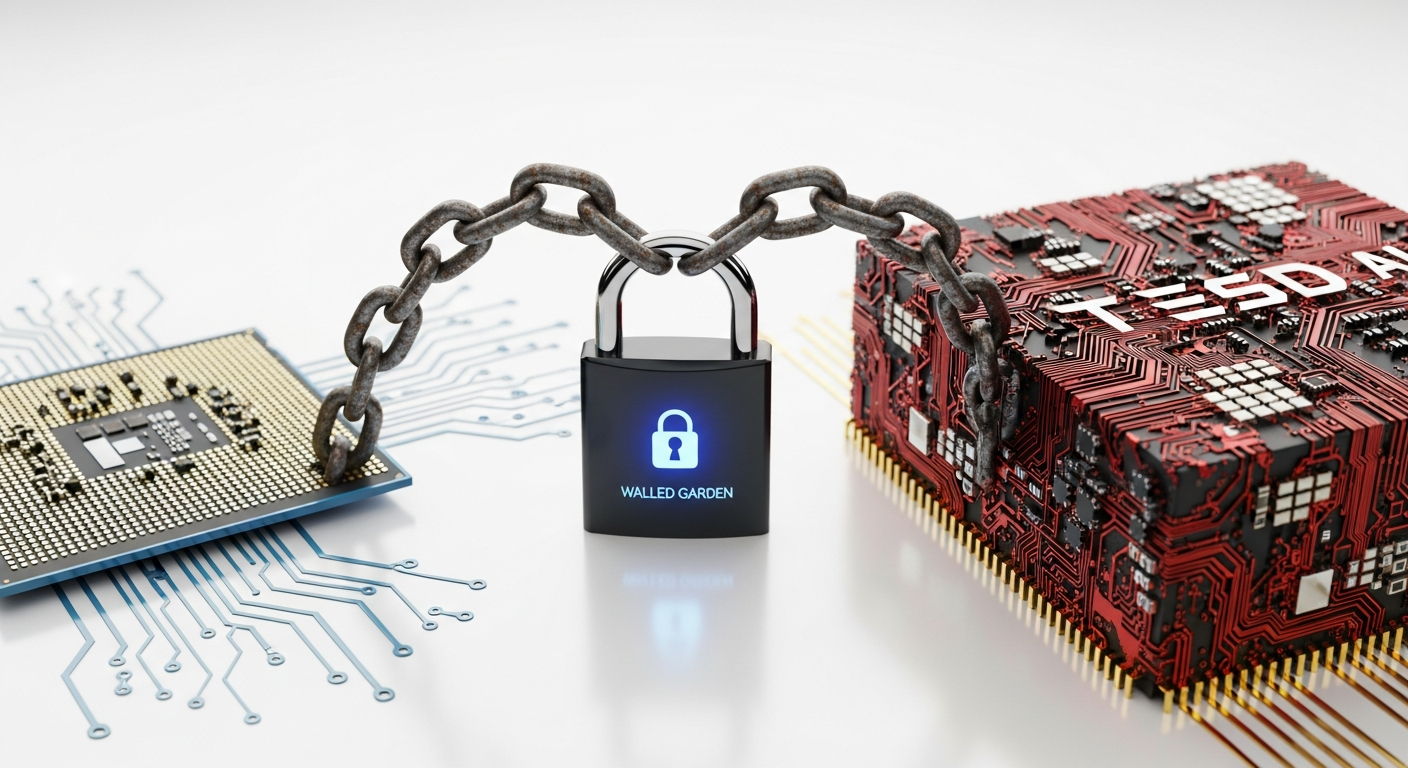
The Walled Garden Is Actually a Prison
We’ve been conditioned to accept "walled gardens" as a trade-off for security and ease of use. Apple started it, but Tesla perfected it.
When you buy a car today, you aren't buying a vehicle; you’re buying a licensed experience. **Tesla’s hardware is designed with "anti-tamper" logic that is essentially a digital suicide pill.**
If the computer detects it’s no longer connected to the specific VIN (Vehicle Identification Number) it was birthed with, it goes into a vegetative state. It refuses to talk. It refuses to think.
To get my desk-bound "brain" to wake up, I had to use a "man-in-the-middle" attack on the CAN bus—the car's internal nervous system.
It makes you wonder: if this hardware is mine, why am I treated like a hacker for trying to turn it on?
**The industry has successfully lobbied to turn "Right to Repair" into a fringe activist movement rather than a basic consumer right.** They want you to believe that "safety" requires total manufacturer control, but my seven days on the desk proved that "safety" is just the marketing term for "monopoly."
7 Days of Chaos and Liquid Gold
Running a car brain on a desk is a logistical nightmare. In a Model 3, this computer is liquid-cooled by the same system that keeps the batteries from exploding.
On my desk, I had to rig a PC water-cooling loop using zip ties and thermal paste. It looked like a cyberpunk life-support machine.
By day three, I had the neural net accelerators running.
I fed it raw video data from a dashcam—not even a Tesla dashcam—and watched it "see." It wasn't just identifying cars and pedestrians; it was predicting their movement with a level of local latency that **Gemini 2.5** can only dream of.
**This is the dirty secret of the AI industry: we don't need the cloud for 90% of what we do.**
The "latency" we’ve accepted as a fact of life is a choice made by companies that want to own your data. When the "brain" is on your desk, your data stays in the room.
There is no "Privacy Policy" to agree to because there is no server to talk to.
It was the most private, most powerful computing experience I’ve had in a decade, and it required a literal car crash to make it possible.
Comparing the "Brain" to 2026 Standards
It is now March 2026, and we are being told that we need "AI PCs" with specialized NPU (Neural Processing Unit) chips to run the latest version of **ChatGPT 5**.
The marketing suggests this is brand-new, revolutionary tech. It’s a bold-faced lie.
The Tesla board I’m staring at was designed years ago, and it still outperforms the "Next-Gen" laptops being sold today.
We aren't moving forward; we’re being fed a slow, metered drip of technology that has been sitting on the shelf for seven years.
**The tech industry isn't innovating; it’s managing the release of obsolescence.**
If every discarded car brain from the 100,000 Teslas scrapped each year was repurposed into a local AI server, we could crash the cost of computing overnight.
But that doesn't help the stock price of the "Magnificent Seven." They would rather see these chips crushed in a scrapyard than have them sitting on your desk, giving you free, local intelligence.
The Death of Ownership in the Age of Software
The most uncomfortable realization came on day six. I realized that even though I had the physical board, I didn't have the *keys*.
Tesla can "remote-wipe" or "de-privilege" hardware even after it has been sold to a secondary market.
**We are entering an era where you can buy a physical object, but you never truly possess its utility.**
Think about that. If you buy a hammer, the manufacturer can't come to your house and make the handle slippery because they didn't like who you bought it from.
But if you buy a "smart" device—a car, a fridge, a "Brain"—the manufacturer remains a ghost in the machine forever.
We’ve traded the permanence of hardware for the convenience of "updates." But "updates" are just another word for "control." By the end of my seven days, I realized that the "Brain" wasn't ready for me, not because the tech was too advanced, but because the legal and ethical framework of 2026 has already surrendered to the corporations.

What We Should Do Instead
We need to stop being impressed by "connected" features and start asking about "disconnected" capability. A device that requires a server to function is not a tool; it’s a leash.
**True innovation in 2026 isn't about more cloud power; it’s about reclaiming the silicon that’s already in our lives.**
Instead of waiting for the next "Pro" model of whatever phone or car is trending, we should be demanding:
1. **The right to "Local-Only" mode** for every device we buy.
2. **Open-access APIs** for salvaged hardware so we can reduce e-waste.
3. **Legally binding "End-of-Life" protocols** where manufacturers must unlock the bootloaders of products they no longer support.
If we don't demand this now, by 2030, you won't even be able to change a lightbulb without a subscription-verified "Authorized Installer" handshake.
My week with the Tesla brain was a glimpse into a world where we are the masters of our tools again, but it’s a world that’s currently being crushed into cubes in a junkyard.
The Uncomfortable Truth
How many "smart" things do you have in your house right now that would become useless if the company behind them went bankrupt tomorrow?
When was the last time you bought something that you felt you truly, 100% owned?
The Tesla brain on my desk is a reminder that we are surrounded by incredible power that we are forbidden to use. We are living in a golden age of hardware and a dark age of ownership.
I’m sending this board back to the shelf now, not because I’m finished with it, but because I’m tired of fighting the ghost of a billionaire just to make a processor do math.
**Are you okay with the fact that the most powerful computer you’ll ever own is one you aren't allowed to touch?
Let’s talk about it in the comments—unless your "Smart Keyboard" needs a firmware update first.**
***
Story Sources
From the Author




Hey friends, thanks heaps for reading this one! 🙏
If it resonated, sparked an idea, or just made you nod along — I'd be genuinely stoked if you'd show some love. A clap on Medium or a like on Substack helps these pieces reach more people (and keeps this little writing habit going).
→ Pythonpom on Medium ← follow, clap, or just browse more!
→ Pominaus on Substack ← like, restack, or subscribe!
Zero pressure, but if you're in a generous mood and fancy buying me a virtual coffee to fuel the next late-night draft ☕, you can do that here: Buy Me a Coffee — your support (big or tiny) means the world.
Appreciate you taking the time. Let's keep chatting about tech, life hacks, and whatever comes next! ❤️