I Quit Q-Anon Cold Turkey. Here’s What Actually Happened to My Brain.
I Quit Q-Anon Cold Turkey. Here’s What Actually Happened to My Brain.
I spent eighteen months convinced that the world as we know it was a theatrical production designed to hide a global war between light and shadow.
**In August 2024, I wasn't just a "believer"—I was an evangelist.** I had three burner phones, a dedicated "comms" laptop, and a growing distance between myself and every person who actually shared my DNA.
The descent wasn't a sudden fall; it was a slow, seductive slide into a reality where everything finally made sense.
**For the first time in my life, I wasn't just a cog in the machine; I was a digital soldier with a front-row seat to history.** But when I finally walked away in mid-2025, the "awakening" I experienced wasn't the one I had been promised.
It was a brutal, neurological withdrawal that felt less like a change of heart and more like a physical detox.
**Leaving a high-control belief system isn't about "changing your mind"—it’s about rewiring a brain that has become addicted to the dopamine of certainty.** Here is what actually happened to my gray matter when I turned off the signal.
The Dopamine Architecture of Certainty
We often talk about conspiracy theories as a failure of logic, but for me, it was a triumph of biology.
**The human brain is a pattern-matching machine that craves "cognitive closure"—the end of ambiguity.** When the world feels chaotic (as it did during the height of the 2024 election cycles), the brain's "threat detection" centers, like the amygdala, go into overdrive.
Q-Anon didn't just provide answers; it provided a gamified reward system.
**Every "drop" I decoded felt like a hit of pure dopamine, a neurological "bingo" that told my brain I was smarter and safer than the unwashed masses.** Research into radicalization shows that this creates a feedback loop similar to slot machine addiction.
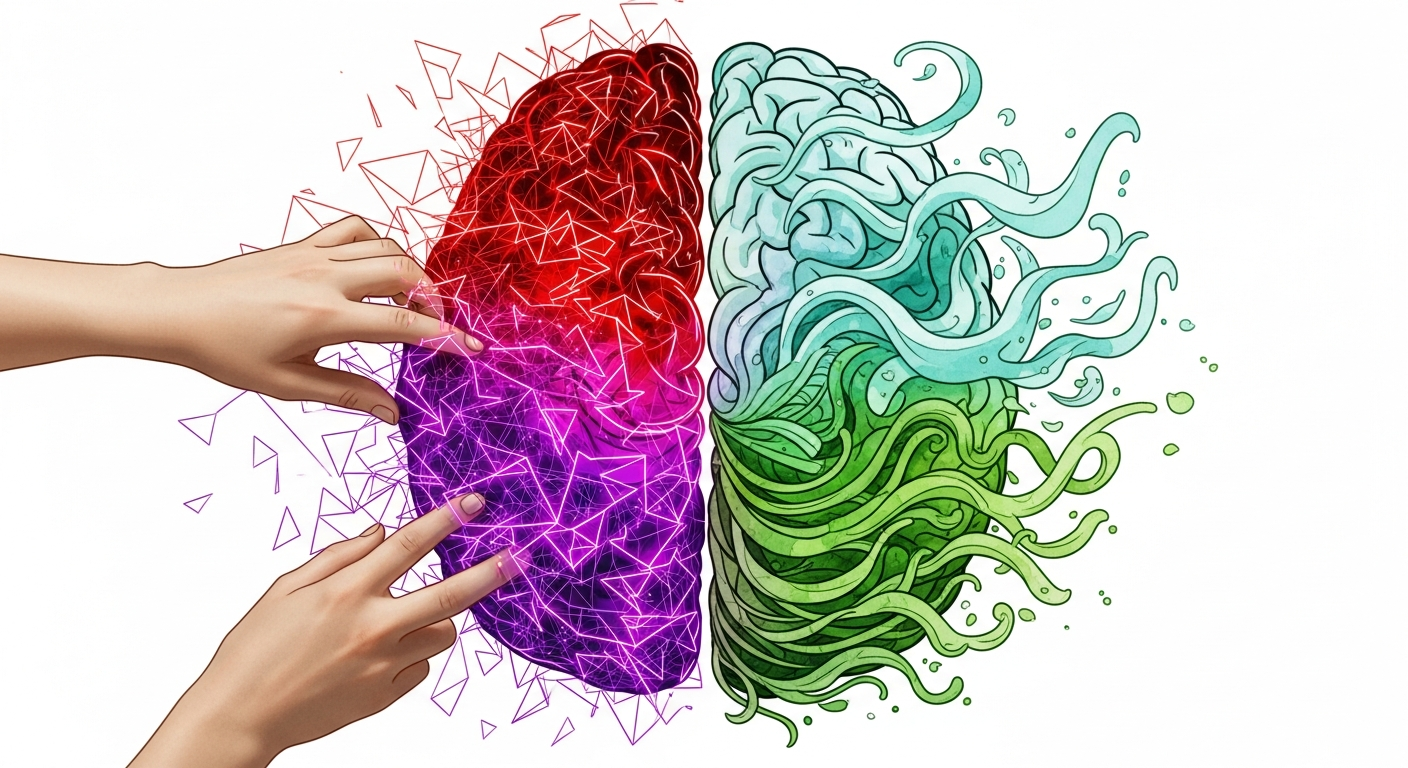
When I was "in," my prefrontal cortex—the part of the brain responsible for critical thinking and impulse control—was essentially bypassed.
**I wasn't thinking; I was reacting to a series of high-intensity emotional triggers designed to keep me in a state of perpetual "fight or flight."** This is why logic doesn't work on people still in the rabbit hole; you can't reason someone out of a state they were never reasoned into.
Why "Smart" People Fall for "Dumb" Theories
The most painful part of my recovery was admitting that my intelligence was actually a liability.
**As a software engineer, I am trained to find patterns in complex data, and that exact skill was weaponized against me.** I used my understanding of systems and architecture to build a more "logical" cage for myself.
There is a phenomenon called **Motivated Reasoning**, where the more intelligent a person is, the better they are at justifying their existing biases.
**I wasn't searching for the truth; I was searching for evidence that my chosen reality was correct.** My brain would filter out any "noise" (facts) that contradicted the "signal" (the conspiracy).
By early 2026, looking back at my 2024 self, I realized I had been living in a curated echo chamber powered by the very algorithms I once helped build.
**The "Great Awakening" was actually a Great Narrowing—a process where my world shrunk until it was only as wide as a smartphone screen.** The irony of being a tech professional who fell for a digital cult is not lost on me.
The Moment the Signal Died
My "cold turkey" moment didn't happen because of a debate or a fact-check; it happened because of a sunset.
**In July 2025, after a massive "prediction" failed to materialize for the twentieth time, I went for a walk without my phone.** For forty-five minutes, I watched the light change over a park in Seattle, and I realized the world was still there.
The "shadow war" I was so invested in hadn't touched the grass, the trees, or the families having picnics.
**The disconnect between the digital apocalypse in my pocket and the physical peace in front of me became an intolerable cognitive dissonance.** I went home, deleted every encrypted app I owned, and threw my burner phones into a junk drawer.
What followed was the "Gray Period." **When you stop the constant influx of high-intensity information, your brain's reward system crashes.** I felt depressed, bored, and physically lethargic for weeks because my brain didn't know how to process "normal" reality anymore.
**The quiet felt like a threat.**
The Reality Restoration Protocol
If you are struggling with "digital vertigo" or trying to help someone come back to the real world, you need more than just facts.
**You need a system to rebuild the neurological pathways that were hijacked by the algorithm.** I developed what I call the **"Reality Restoration Protocol"** to manage my own return.
This isn't about "deprogramming" in the cinematic sense; it's about digital hygiene and neurological re-training.
**You have to treat your attention as a finite resource that has been exploited by bad actors.** Here is the three-part framework I used to get my life back.
1. The Information Diet (Friction over Flow)
The first step was to reintroduce **intentional friction** into how I consumed data.
**Algorithms are designed to remove friction, feeding you the next "hit" before you can even think to ask for it.** I stopped using algorithmic feeds entirely for six months.
I switched to RSS feeds for specific, boring news outlets (think local city council reports or specialized technical journals).
**If a piece of news didn't have a direct impact on my physical life within a five-mile radius, I ignored it.** This forced my brain to downshift from "global crisis" mode to "local community" mode.
2. The Cognitive Gatekeeper (The 24-Hour Rule)
I implemented a strict rule for any "shocking" information: **I was not allowed to have an opinion on it for twenty-four hours.** If I saw a headline that made my blood boil, I had to wait a full day before I could search for more info or discuss it.
**This delay allows the amygdala to cool down and gives the prefrontal cortex a chance to come back online.** Most of the time, by the next day, the "breaking news" had either been debunked or had lost its emotional sting.
**Patience is the ultimate antidote to radicalization.**
3. The Physical Anchor (The "Analog Hour")
Every day, I committed to one hour of activity that was impossible to digitize.
**For me, it was woodworking; for others, it might be gardening, cooking, or weightlifting.** You need a hobby where "feedback" comes from the physical world, not a notification.
**If you mess up a piece of wood, the wood doesn't care about your political leanings—it just breaks.** This provides a "grounding wire" for the brain.
It reminds you that cause and effect are real, tangible things that exist outside of a social media thread. **Physical reality is the only thing that can truly break a digital trance.**
Re-Entering the "Gray Zone"
The hardest part of quitting cold turkey wasn't losing the conspiracy; it was losing the community.
**Cults provide a sense of belonging that is incredibly hard to replicate in the fragmented, "loneliness epidemic" world of 2026.** When I left, I was suddenly just a guy in his thirties with no friends and a lot of explaining to do.
I had to learn to live in the **"Gray Zone"—the uncomfortable space where there are no clear villains, no secret saviors, and most problems are solved by slow, boring bureaucracy rather than "The Storm."** It is much less exciting than being a digital soldier, but it is infinitely more honest.

I reached out to my sister, whom I hadn't spoken to since Thanksgiving 2023.
**I didn't lead with an apology for being wrong; I led with an apology for being absent.** Healing the relationship didn't happen because I "proved" I was sane; it happened because I showed up for her daughter's birthday and didn't mention a single "drop."
The Long Road Back to Focus
Today, February 27, 2026, my brain feels different.
**I can read a book for an hour without checking for a notification.** I can listen to a podcast about history without looking for "hidden codes" in the narrator's tone.
I’ve even started using AI tools like Claude 4.6 and ChatGPT 5 again, but with a wary, professional distance.
I use them to help me code, not to help me "understand the world." **I’ve realized that while AI can process data at an incredible scale, it lacks the human context of suffering, joy, and physical touch that makes life worth living.** We are entering an era where our greatest challenge isn't "fake news"—it's the loss of our own attention.
If you feel yourself slipping into a rabbit hole, or if you’ve just climbed out of one, know that the "detox" is the hardest part.
**The world isn't as exciting as the conspiracy promised, but it's much more beautiful.** And most importantly, it's actually real.
**Have you ever felt yourself getting "addicted" to a specific online narrative or community, only to realize later it was distorting your reality? How did you pull yourself back?
Let’s talk about it in the comments.**
---
Story Sources
From the Author



Hey friends, thanks heaps for reading this one! 🙏
If it resonated, sparked an idea, or just made you nod along — I'd be genuinely stoked if you'd show some love. A clap on Medium or a like on Substack helps these pieces reach more people (and keeps this little writing habit going).
→ Pythonpom on Medium ← follow, clap, or just browse more!
→ Pominaus on Substack ← like, restack, or subscribe!
Zero pressure, but if you're in a generous mood and fancy buying me a virtual coffee to fuel the next late-night draft ☕, you can do that here: Buy Me a Coffee — your support (big or tiny) means the world.
Appreciate you taking the time. Let's keep chatting about tech, life hacks, and whatever comes next! ❤️